Impact-Site-Verification: 65ebaf0c-2dbc-4200-9d50-11ea7af40e54

Florida wellness retreat guide: beach resorts, spas and short wellness programs
Best Wellness Retreats in Florida: Where to Look and What to Know (2026)

Florida is known for beaches and theme parks, but it also has many places where you can slow down, stretch and rest. This guide helps you understand wellness retreats in Florida: the main areas, the kinds of programs you will find, what to check before booking and what to know about timing. It is a planning guide, not a ranking, because prices, programs and availability change often.

Quick answer: Florida wellness retreats are mostly beachside resort spas, small private retreats and short yoga or wellness programs. Popular areas include Naples and Marco Island, Key West, Miami, Palm Beach and the Gulf Coast. Compare what is included, check cancellation rules (hurricane season runs June to November), and confirm current prices with each provider.
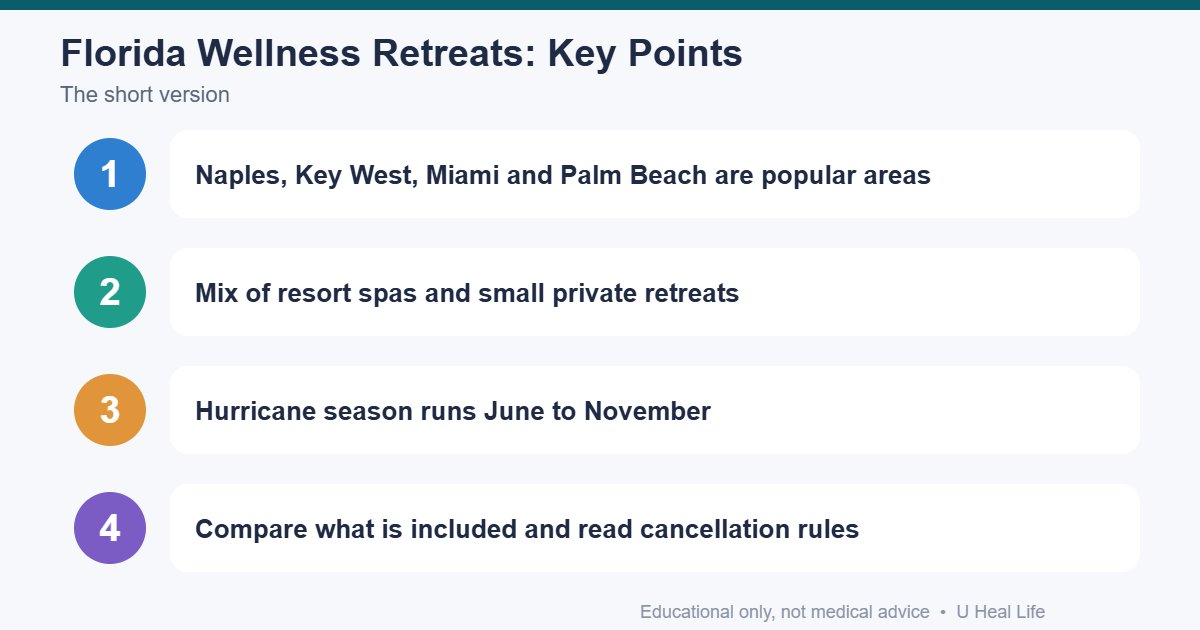
Florida wellness retreat key points: areas to look, what is included, hurricane season, check cancellation and reviews
Key points at a glance.

What Wellness Retreats in Florida Look Like

Unlike large destination spa ranches in Arizona, Florida’s wellness scene is spread across resorts and small organizers. You may find:

  • Resort spas with wellness programming: beach yoga, guided meditation, Pilates, tai chi or sound baths
  • Boutique and private retreats: short stays of 2 to 7 days, often listed on retreat booking sites
  • Fitness and activity retreats: workouts plus healthy meals and group activities
  • Women-focused or emotional wellness retreats: small groups on the beach

Naples and Marco Island (Paradise Coast)

Local tourism information highlights resort wellness here. The Naples Beach Club, a Four Seasons Resort, has a spa with a thermal circuit that includes a cold plunge, steam room and sauna. The Ritz-Carlton, Naples has a large spa, and the JW Marriott Marco Island offers beach yoga, meditation and Pilates classes.

Key West and the Florida Keys

Visit Florida has featured spa and yoga packages in Key West, including at resorts on Duval Street. The relaxed island feel suits short, slow trips.

Miami, Palm Beach and South Florida

Retreat booking sites list many private and boutique wellness retreats in Miami, Palm Beach and Singer Island, from a 2-day spa weekend to 7-day programs. Quality varies, so read reviews and ask who leads the program.

Tampa Bay and the Gulf Coast

Clearwater and nearby beaches offer fitness and wellness-style retreats with beachfront stays.

How Much Do They Cost?

Prices vary widely by length, lodging and what is included. An older Visit Florida feature cited roughly $1,500 to $6,000 per week for retreats with lodging and healthy food. That article is dated, so treat it only as a rough guide and check current rates. For a bigger picture, see how much a wellness retreat costs.

Best Time to Go and Hurricane Season

Florida stays warm most of the year. The Atlantic hurricane season runs from June 1 to November 30, so check cancellation and refund policies and consider travel insurance if you book in that window.

Checklist Before You Book

  1. Know your goal: rest, fitness, spa or a quiet reset
  2. See what is included in writing: lodging, meals, classes, transfers
  3. Check the leaders: training, experience and group size
  4. Read recent reviews from several sources
  5. Check cancellation and weather policies
  6. Plan how you will keep habits after you return

Florida vs Other States

Florida is good for beach days, warm weather and easy flights. If you want a strict program with doctors and nutritionists on site, large destination spas in states like Arizona or California may be a better fit. Our guide to luxury wellness retreats in the USA compares them.

Frequently Asked Questions About Florida Wellness Retreats

What is the best area in Florida for a wellness retreat?

It depends on your goal. Naples and Marco Island suit resort spa stays, Key West suits a slow island break, and South Florida has the most private retreat listings.

Can I go to a Florida wellness retreat alone?

Yes. Many retreats welcome solo guests and small groups.

Are Florida retreats all-inclusive?

Some are, many are not. Always confirm meals, classes and spa treatments.

Is a wellness retreat the same as a spa weekend?

Not exactly. A retreat has a planned program for wellbeing. See wellness retreat vs spa vs mental health retreat.

Will insurance cover it?

Usually not for wellness retreats.

Helpful resource: For official travel information about the state, see Visit Florida.

Disclaimer: This article is for general information only and is not medical or mental health advice. Prices, programs and availability change, so please check current details with each provider. If you are in crisis or thinking about harming yourself, call or text 988 (the Suicide & Crisis Lifeline in the US) or your local emergency number right away.
Mental health retreat near me: checklist to find a licensed, safe program
Mental Health Retreats Near Me: How to Find a Licensed, Safe Program

Searching “mental health retreat near me” can bring up hundreds of results, from spa-style getaways to hospital-level programs. It is hard to tell which ones are safe and which are only good marketing. This guide gives you simple steps to find programs near you and a checklist to judge them.

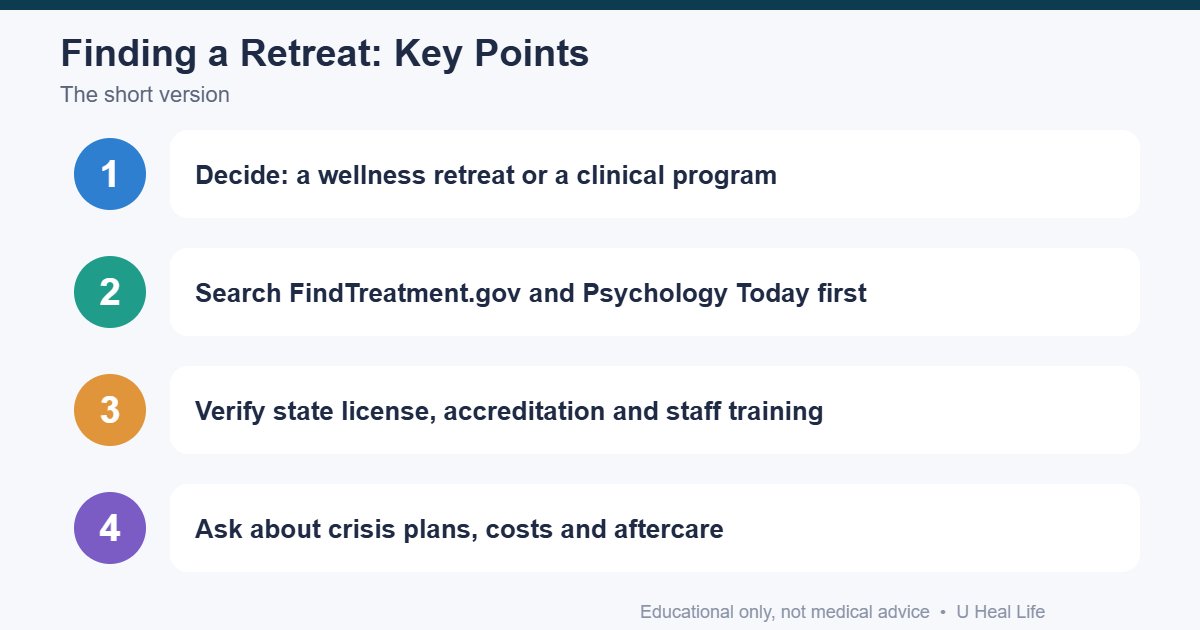
Quick answer: To find a mental health retreat near you, decide whether you want a wellness retreat or a clinical program, then search by state and verify each place: licenses, accreditation, staff credentials, crisis plan and aftercare. For clinical care, SAMHSA’s FindTreatment.gov and Psychology Today’s treatment directory are good places to start.

Mental health retreat near me key points: decide the type, search trusted directories, verify licenses and accreditation, ask about crisis plans
Key points at a glance.

Step 1: Decide What You Need

  • Rest and reset: a wellness-based retreat may be enough
  • Treatment for a condition: you need a licensed clinical or residential program

If you are unsure, ask your doctor or therapist before you book. Our guide to how to choose a mental health retreat explains the difference.

  1. Your therapist or doctor. They can recommend programs they trust.
  2. FindTreatment.gov. This is SAMHSA’s national locator for mental health and substance use treatment.
  3. Psychology Today’s treatment directory. The ADAA also points readers to it.
  4. Your insurance company. Ask for in-network residential or intensive programs.
  5. Local search and maps. Use “mental wellness retreat” plus your state or city, then verify everything below.

Step 3: Check the Basics

What to checkGood signRed flag
State licenseFacility and clinicians are licensedNo license shown or vague answers
AccreditationThe Joint Commission or CARFNone, with claims of “clinical” care
StaffLicensed psychologists, therapists, psychiatristsOnly coaches or “healers” doing therapy
Crisis planClear emergency stepsNo answer
MedicationsA doctor reviews your medicinesPressure to stop medication
CostsPrices and refunds in writingHidden fees or pressure to pay now
AftercareA plan for after you leave“One retreat will fix it”

Step 4: Questions to Ask on the Phone

  • Who leads sessions and what are their licenses?
  • What happens if a guest has a crisis at night?
  • Do you coordinate with my therapist or doctor?
  • What is a typical day like?
  • What is the total cost, and what does insurance cover?
  • Can I speak with a past guest or read independent reviews?

Step 5: Think About Distance and Day Options

Nearby is not always best. A program a few hours away can still be fine if it is licensed and safe. If you cannot leave home, ask about day programs, intensive outpatient programs or weekend workshops led by licensed therapists.

Costs and Insurance

Wellness retreats are rarely covered by insurance. Clinical programs may be covered if they meet your plan’s rules. Always call your insurer first. See our insurance coverage guide.

If You Need Help Right Now

A retreat is not for emergencies. If you are in crisis or thinking about harming yourself, call or text 988 (the Suicide & Crisis Lifeline in the US) or your local emergency number.

Frequently Asked Questions About Mental Health Retreats Near Me

How do I know a retreat is legitimate?

Verify licenses with your state board, check for Joint Commission or CARF accreditation for clinical programs, and read independent reviews.

Are mental health retreats covered by insurance?

Wellness retreats rarely are. Clinical programs sometimes are. Call your insurer.

Can I go to a retreat if I am on medication?

Often yes, but tell the program and your prescriber. Never stop medication on your own.

What if there is no program near me?

Look at online therapy, intensive outpatient programs or a nearby wellness retreat after talking to your therapist.

How long should I stay?

It depends on your goal. Wellness retreats range from a weekend to a week or more. Clinical programs vary.

Helpful resource: SAMHSA’s national locator, FindTreatment.gov, lists licensed mental health and substance use programs, and the 988 Lifeline offers support in a crisis.

Disclaimer: This article is for general information only and is not medical or mental health advice. Prices, programs and availability change, so please check current details with each provider. If you are in crisis or thinking about harming yourself, call or text 988 (the Suicide & Crisis Lifeline in the US) or your local emergency number right away.
Mental health retreat: wellness-based versus clinical programs and how to choose safely
Mental Health Retreat: What It Is and How to Choose a Safe One

When life feels heavy, a quiet stay away from home can sound like exactly what you need. But the words “mental health retreat” are used for very different things, from a relaxing weekend to a clinical program with doctors and therapists. This guide explains what a mental health retreat is and how to choose a safe one.

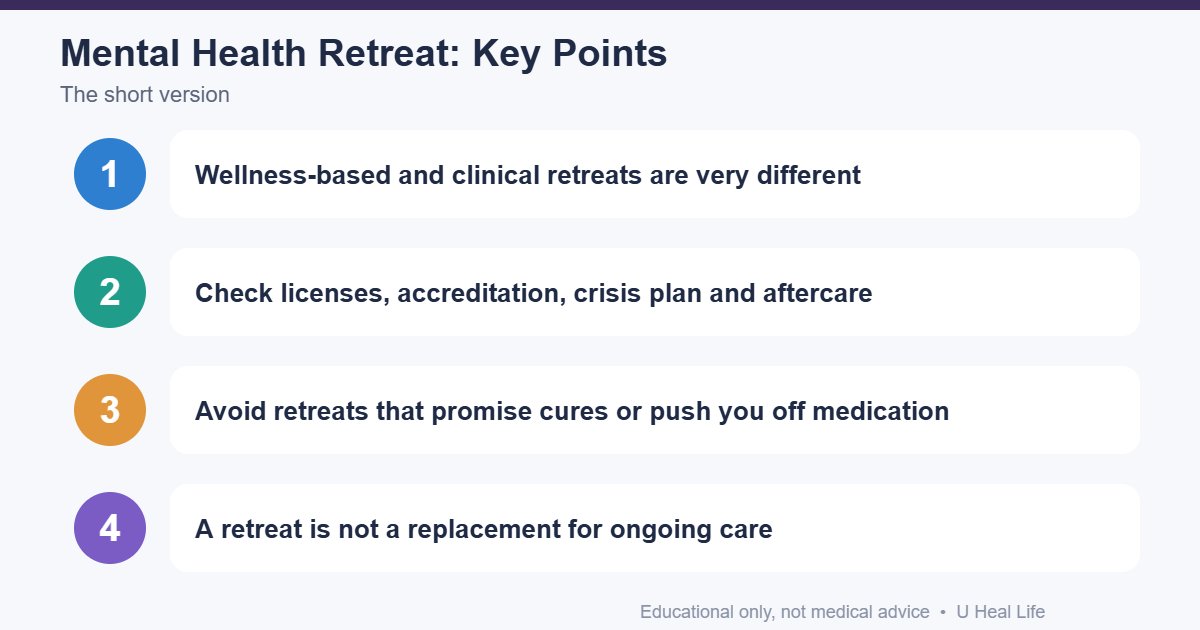
Quick answer: A mental health retreat is a stay focused on emotional wellbeing. Some are wellness retreats with workshops and rest, and some are clinical programs run by licensed professionals. Before booking, check licenses, staff training, accreditation, crisis plans and aftercare. A retreat is not a replacement for ongoing mental health care.

Mental health retreat key points: wellness versus clinical, check licenses and accreditation, watch for red flags, not a replacement for care
Key points at a glance.

What Is a Mental Health Retreat?

A mental health retreat is a short or longer stay that centers on stress, mood, relationships or emotional healing. The label is not regulated, so one retreat may offer yoga and journaling while another offers therapy with licensed clinicians. Knowing which type you are booking is the most important step.

Two Very Different Types

Wellness-based retreatClinical or residential program
Main goalRest, reflection, healthy habitsTreat a mental health condition
Who leadsCoaches, teachers, facilitatorsLicensed psychologists, therapists, psychiatrists
TherapyUsually none, or light group workIndividual and group therapy
Medication careNot providedOften available
AccreditationUsually noneOften CARF or Joint Commission
InsuranceRarely coveredSometimes covered

Retreats led by coaches or healers may have certificates, but that is not the same as being a licensed mental health provider.

What to Check Before You Book

  1. Licenses and training. Ask who leads the sessions and which licenses they hold. Check the state licensing board for clinicians.
  2. Accreditation. For clinical programs, look for The Joint Commission or CARF accreditation and a state license. The Anxiety and Depression Association of America (ADAA) also advises checking this before choosing a residential program.
  3. Crisis plan. Ask what happens if a guest has a mental health emergency.
  4. Medication rules. Ask how they handle your current medicines and whether a doctor is involved.
  5. Aftercare. Good programs help you plan what comes next.
  6. Clear costs and policies. Get prices and refund rules in writing.

Red Flags

  • Promises to cure depression, anxiety or trauma
  • Pressure to stop medication or leave therapy
  • Leaders with no clear training or licenses
  • Intense confrontation exercises with no safety plan
  • Vague answers about costs or what happens in a crisis

Does Insurance Cover Mental Health Retreats?

Wellness retreats are rarely covered. Clinical residential programs sometimes are, but only if they meet accreditation and medical necessity rules. Call your insurer first. Our mental health insurance coverage guide explains the basics.

Who Might Benefit?

A wellness-based retreat may help if you feel stressed, burned out or need a quiet reset. A clinical program may be right if symptoms are making daily life hard. If you are not sure, start by talking to a doctor or licensed therapist. Women looking at residential care can also read our guide on women’s trauma recovery and residential treatment.

Frequently Asked Questions About Mental Health Retreats

Is a mental health retreat the same as therapy?

No. Some include therapy, but many do not. Always ask who leads the sessions.

Can a retreat help with depression or anxiety?

Rest and support may help you feel better for a time, but retreats are not a cure. Ongoing care with a professional matters most.

How long do mental health retreats last?

From a weekend to several weeks. Clinical programs can run longer.

Should I stop my medication before a retreat?

No. Talk to your prescriber before making any change.

When should I get help right away?

If you are in crisis or thinking about harming yourself, call or text 988 in the US, or your local emergency number.

Helpful resource: To look for licensed treatment, you can use SAMHSA’s FindTreatment.gov, and for urgent help the 988 Suicide and Crisis Lifeline.

Disclaimer: This article is for general information only and is not medical or mental health advice. Prices, programs and availability change, so please check current details with each provider. If you are in crisis or thinking about harming yourself, call or text 988 (the Suicide & Crisis Lifeline in the US) or your local emergency number right away.
What is a silent retreat: a quiet stay for meditation and rest
What Is a Silent Retreat? What Happens, Rules and Benefits

The idea of staying quiet for days can sound scary, or very appealing. A silent retreat is a stay where you choose not to talk for a set time so your mind can slow down. This guide explains what a silent retreat is, what happens each day, the usual rules, possible benefits and who should be careful.

Quick answer: A silent retreat is a retreat where participants stay silent for all or part of the program, often while meditating, walking and resting. Some, like 10-day Vipassana courses, ask for full silence and no phones, reading or writing. Others only keep silence at certain times. It can be calming, but it can also bring up strong feelings.

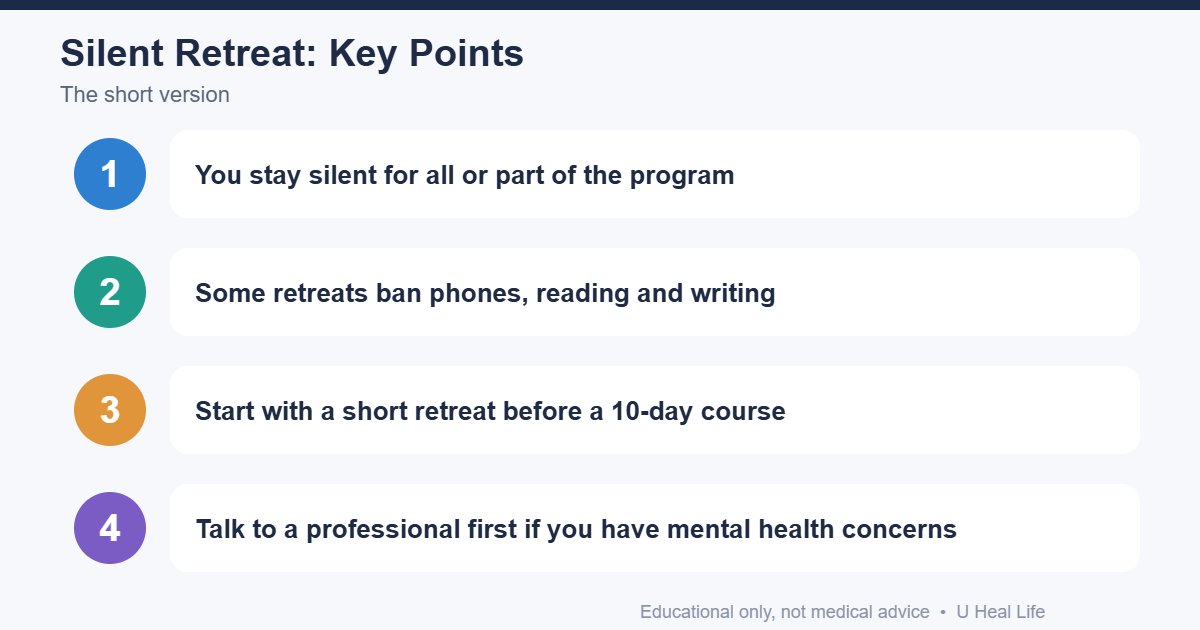
What is a silent retreat key points: full or partial silence, strict rules at some retreats, start small, check with a professional if you have a mental health condition
Key points at a glance.

What Is a Silent Retreat? (Silent Retreat Meaning)

The silent retreat meaning is simple: you give up talking, and often phones, books and other distractions, so you can focus on your breath, body and thoughts. Silence is usually the main tool, not a punishment. Retreats run from a single day to several weeks.

There are two common styles:

  • Full silence (“noble silence”): no talking, no eye contact or gestures with other guests. Strict Vipassana courses follow this.
  • Partial silence: quiet during set hours, with group sharing or optional talks at other times. Many yoga-based silent retreats work this way.

What Is Noble Silence?

In the Vipassana tradition taught by S.N. Goenka, noble silence means silence of body, speech and mind. Students keep it from the start of the course until the morning of the last full day, then speaking opens up again so people can ease back into normal life.

What Happens on a Silent Retreat?

A 10-day Vipassana course, one of the best known formats, usually looks like this, according to the Vipassana centers themselves:

  • Days start very early, around 4 a.m.
  • About ten hours of meditation are spread through the day, with breaks and rest
  • The Vipassana technique itself is taught from about day 4
  • A loving-kindness (mettā) meditation is taught on day 10, and silence ends
  • The course ends on the morning of day 11

Other silent retreats are gentler. Days may include seated and walking meditation, yoga, quiet meals, journaling and free time in nature.

Common Rules

Rules differ, so read each retreat’s code of conduct. At strict courses you may be asked to give up:

  • Talking and eye contact with other students
  • Phones and other electronics
  • Reading and writing
  • Exercise other than walking
  • Alcohol and other intoxicants

Some retreats allow journaling or reading. Always check before you go.

How Much Does a Silent Retreat Cost?

Vipassana courses run on a donation basis. The centers say that food and lodging are covered by donations from past students, and you may give a donation after completing a course. Other silent retreats, especially at resorts or private centers, charge a normal price, which can range from a modest fee to several hundred dollars for a few days. See our guide on wellness retreat costs.

Possible Benefits

People often describe feeling calmer, more focused and more aware of their thoughts. Quiet time may also help you notice stress habits. Research is still limited and mostly small, so benefits are not guaranteed.

Who Should Be Careful?

Long periods of silence and meditation can stir up strong emotions. Please talk to your doctor or therapist before attending if you have a history of trauma, severe anxiety, depression, psychosis or other mental health conditions. Many retreats ask about this on the application. A silent retreat is not a treatment for any condition.

Tips for Your First Silent Retreat

  1. Start with a weekend or a short program before a 10-day course.
  2. Practice 10 to 20 minutes of daily meditation first. Our simple mindfulness exercises are a good start.
  3. Tell friends and family you will be offline.
  4. Pack comfortable layers. See what to pack for a retreat.
  5. Expect hard moments such as boredom, restlessness or sadness. They often pass.

Frequently Asked Questions About What Is a Silent Retreat

Do I need to be religious or Buddhist?

No. Many retreats welcome people of any belief, but read what each retreat teaches.

Can I leave early?

Some programs, such as 10-day Vipassana courses, ask students to stay for the full course. Ask before you book.

Is a silent retreat only for experienced meditators?

No. Many centers teach beginners, but starting small is wise.

What if I feel very upset during the retreat?

Tell a teacher or staff member. Retreats usually have a way to speak with them even during silence.

How long should my first retreat be?

Two to three days is a gentle start for most people.

Helpful resource: You can read how 10-day courses work on the official Vipassana site, dhamma.org.

Disclaimer: This article is for general information only and is not medical or mental health advice. Prices, programs and availability change, so please check current details with each provider. If you are in crisis or thinking about harming yourself, call or text 988 (the Suicide & Crisis Lifeline in the US) or your local emergency number right away.
What is a wellness retreat: a calm place for rest and healthy habits
What Is a Wellness Retreat? What to Expect, Cost and Who It’s For

Hearing the words “wellness retreat” can feel confusing. Is it a spa trip, a yoga camp or a type of therapy? In simple words, it is a planned break where you step away from daily life to rest, reset and focus on your health. This guide explains what a wellness retreat is, what it includes, how long it lasts, what it costs and who it is for.

Quick answer: A wellness retreat is a planned stay, usually a few days to about a week, at a calm place where you focus on your health with activities like yoga, meditation, healthy meals and nature time. It is not medical treatment. Lodging, meals and sessions are usually included, but prices vary a lot.

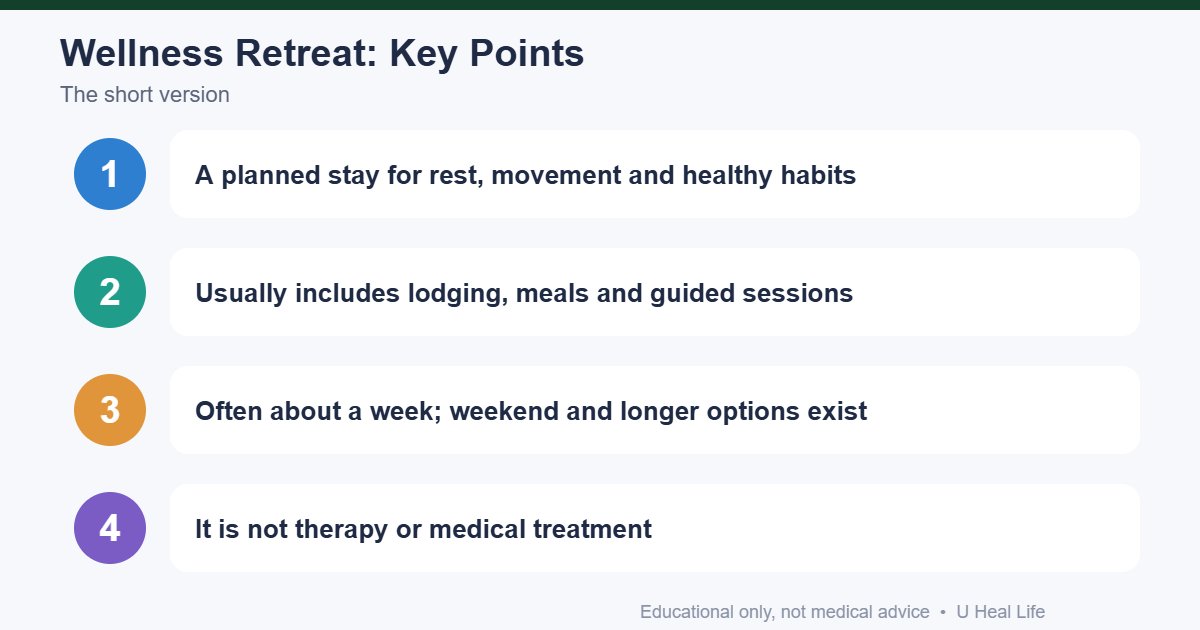
What is a wellness retreat key points: planned stay, usual inclusions, cost varies, not medical treatment
Key points at a glance.

What Is a Wellness Retreat?

A wellness retreat is a short stay built around rest, healthy habits and personal reflection. You live at the retreat, follow a simple daily schedule and take part in guided sessions. Many people go to slow down, recover from stress or try new routines in a supportive setting.

Retreats can be quiet and simple, or comfortable and luxurious. What they share is the goal of helping you reconnect with yourself, away from work, screens and noise.

What Does a Wellness Retreat Include?

Every retreat is different, so always read the program. Most include some mix of:

  • Lodging: a shared or private room
  • Meals: often healthy, plant-forward food
  • Movement: yoga, walking, stretching or light fitness
  • Mindfulness: meditation, breathing exercises or journaling
  • Talks and workshops: topics like sleep, stress or nutrition
  • Nature time: hikes, beaches or garden walks
  • Optional extras: massage or spa treatments, which may cost more

How Long Does a Wellness Retreat Last?

Travel experts often say a typical retreat lasts about a week. Shorter weekend retreats of 2 to 3 days are common too, and some programs run for 2 to 4 weeks. If you are new to retreats, a short one is a good way to try the idea.

Types of Wellness Retreats

TypeMain focusGood for
Yoga and meditationMovement and calmBeginners, stress relief
Silent retreatQuiet and inner focusPeople who want deep rest
Fitness retreatExercise and healthy habitsActive people
Spa and relaxationRest and treatmentsBurnout-style tiredness
Nutrition or detoxFood and routinesPeople learning healthy eating
Medical-wellnessWellness plus licensed health staffPeople who want health checks

Who Is a Wellness Retreat For?

A wellness retreat may suit you if you feel stretched thin, want a reset or want to learn healthy routines. Many guests travel alone, so you do not need a partner or friends to go.

A retreat is not a replacement for therapy or medical care. If you have a mental health condition, talk to your doctor or therapist first. Our guide to how to choose a mental health retreat explains the difference.

How Much Does a Wellness Retreat Cost?

Prices vary a great deal. Simple retreats can cost a few hundred dollars for a short stay, while luxury resorts cost much more. For example, Canyon Ranch lists all-inclusive stays from about $950 per person per night on its website. Health insurance generally does not pay for wellness retreats. See our full guide on how much a wellness retreat costs.

Possible Benefits and Limits

Many guests say they feel calmer, more rested and clearer about their next steps. Time away, regular sleep, movement and healthy meals can all support wellbeing. But a retreat is a short experience. Habits you keep after you return matter more than the days you spend there, and results differ from person to person.

How to Choose a Wellness Retreat

  1. Know your goal. Rest, learning or a reset?
  2. Read what is included in writing: lodging, meals, sessions and transfers.
  3. Check the leaders. Ask about training and experience.
  4. Look at group size and daily schedule.
  5. Read recent reviews and cancellation terms.

Frequently Asked Questions About What Is a Wellness Retreat

Is a wellness retreat worth it?

It can be worth it if you pick one that fits your goal and budget, and if you keep a few habits afterward.

Can I go to a wellness retreat alone?

Yes. Many guests are solo travelers, and retreats are often friendly and well suited to it.

How is a retreat different from a vacation?

A vacation is mostly for fun and rest. A retreat has a planned program focused on wellbeing.

Does insurance cover a wellness retreat?

Usually not. Ask your insurer, and check whether an HSA applies.

How do I prepare?

Read the schedule, pack comfortable clothes and tell the organizer about any health needs.

Helpful resource: For general information on relaxation techniques such as breathing exercises, see the NIH’s NCCIH guide to relaxation techniques.

Disclaimer: This article is for general information only and is not medical or mental health advice. Prices, programs and availability change, so please check current details with each provider. If you are in crisis or thinking about harming yourself, call or text 988 (the Suicide & Crisis Lifeline in the US) or your local emergency number right away.
Warm sunset over hills with the text 10-Minute Evening Routine: reduce stress and unwind tonight
10-Minute Evening Routine to Reduce Stress

Short on time but full of stress? You do not need an hour of self-care. A simple 10-minute evening routine can help your body and mind slow down after a busy day.

You get home, but your mind is still at work. Your shoulders are tight, your thoughts are racing, and you are not sure how to relax. Sound familiar?

The good news is that small, repeatable habits work better than big, rare ones. This 10-minute evening routine to reduce stress is easy to follow, needs no equipment, and can be done on any night.

Quick answer: A 10-minute evening routine to reduce stress can include putting your phone away, slow breathing, gentle stretching, a short brain dump, and a few moments of gratitude. Do it at the same time each night so your body learns that it is time to wind down.

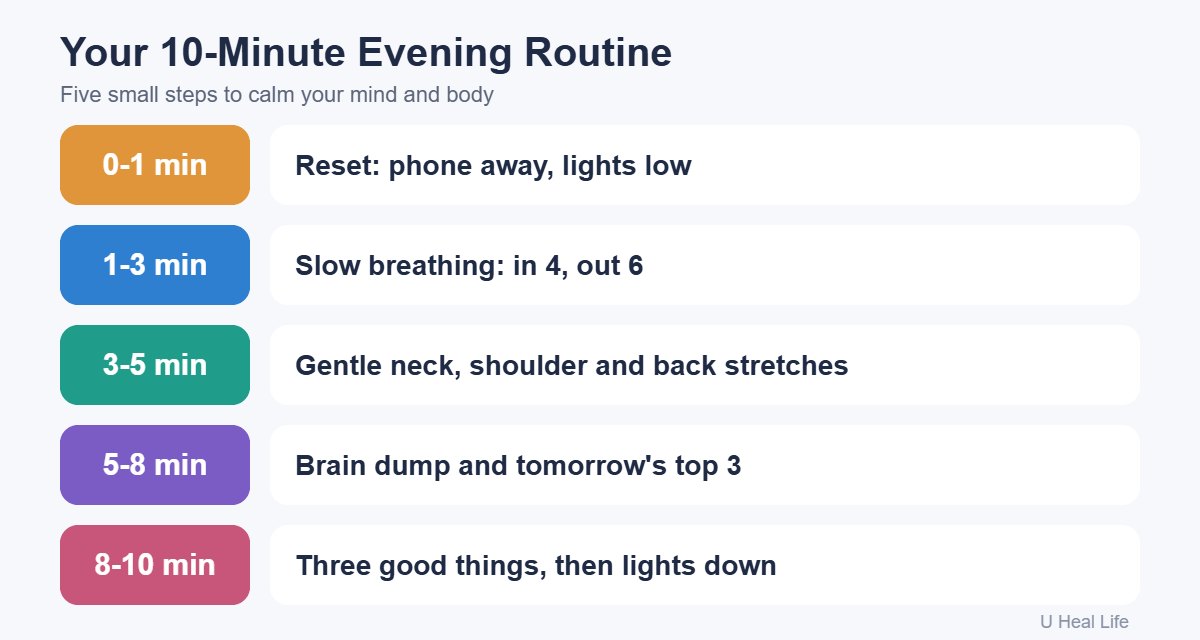
10-minute evening routine to reduce stress: reset, slow breathing, gentle stretching, brain dump and three good things
Your 10-minute evening routine at a glance.

Why Evenings Matter for Stress

During the day, your body stays alert to deal with tasks and problems. If you carry that tension into the night, it can be harder to relax and fall asleep. A short evening routine to reduce stress tells your body: “The day is done. You are safe now.”

It also helps you avoid the late-night spiral of worry. If you often lie awake thinking, read our guide on how to stop overthinking at night.

The 10-Minute Evening Routine to Reduce Stress, Step by Step

Minutes 0 to 1: Reset Your Space

Put your phone on silent and move it away from you. Dim the lights, close your laptop and take one deep breath. This small signal helps your brain switch from “work mode” to “rest mode.”

Minutes 1 to 3: Slow Breathing

Sit or lie down comfortably.

  1. Breathe in through your nose for 4 seconds.
  2. Breathe out slowly through your mouth for 6 seconds.
  3. Repeat for about 2 minutes.

A longer out-breath helps your body relax, and the NIH’s NCCIH lists breathing exercises among common relaxation techniques. For more quick calming tools, see how to calm your mind in 5 minutes.

Minutes 3 to 5: Gentle Stretching

Stress often sits in the neck, shoulders and back. Try:

  • Slow neck rolls from side to side
  • Shoulder rolls, forward and backward
  • Reaching your arms up, then folding forward
  • Child’s pose or a simple seated twist

Move slowly and stop if anything hurts.

Minutes 5 to 8: Brain Dump and Tomorrow’s Top 3

Take a notebook and spend a few minutes writing:

  • Anything that is worrying you
  • The three most important things you want to do tomorrow

Getting thoughts out of your head and onto paper helps your mind stop trying to hold on to them all night.

Minutes 8 to 10: Three Good Things

Write or think of three small things that went well today. They can be tiny: a warm meal, a kind message, a quiet moment. Then switch off the main lights. This ends your day with a calmer, kinder feeling.

The Routine at a Glance

TimeWhat to doWhy it helps
0-1 minPhone away, lights lowSignals that the day is over
1-3 minSlow breathingCalms your body
3-5 minGentle stretchingReleases muscle tension
5-8 minBrain dump and top 3Clears racing thoughts
8-10 minThree good thingsEnds the day on a positive note

Tips to Make It a Habit

  • Do it at the same time each night, such as right after dinner or 30 minutes before bed.
  • Link it to something you already do, like brushing your teeth.
  • Keep a notebook and pen where you will see them.
  • Start with just 5 minutes if 10 feels like too much.
  • Be kind to yourself. If you miss a night, just start again tomorrow.

No Time? Try the 5-Minute Version

Do 2 minutes of slow breathing, 2 minutes of brain dump, and 1 minute of gratitude. Even this short version can make a difference.

Want More Than 10 Minutes?

If you have extra time, add a warm shower, calming music, a few pages of a light book, or a cup of caffeine-free herbal tea. Our guide to calming down after a stressful day has 12 more ideas, and our simple mindfulness exercises for busy people are easy to add.

What to Avoid in the Evening

  • Scrolling through news or social media right before bed
  • Heavy meals and caffeine late in the day
  • Working on your laptop in bed
  • Replaying the day’s problems in your head

When to Get Extra Help

A routine can reduce everyday stress, but it is not a cure for every problem. Please talk to a doctor or mental health professional if you:

  • Feel stressed or anxious most days
  • Cannot sleep for many nights in a row
  • Feel hopeless or very low
  • Notice that stress is affecting your health, work or relationships

If you are unsure why you feel anxious, read why you might feel anxious for no reason. Looking after your brain every day also matters, so see daily habits that support long-term brain health.

Frequently Asked Questions About an Evening Routine to Reduce Stress

Can 10 minutes really reduce stress?

Many people feel calmer after even a few minutes of slow breathing and stretching. Doing it regularly helps the effect build over time.

What is the best time to do an evening routine?

Right after dinner or about 30 to 60 minutes before bed works for most people. Choose a time you can keep.

Do I need to do every step?

No. Pick the steps you enjoy and build from there.

What if I am too tired to do a routine?

Try the 5-minute version, or just do the breathing step lying down in bed.

Will this help me sleep better?

A calm routine may make it easier to fall asleep, but it is not a treatment for sleep disorders. See a doctor if sleep problems continue.

Final Thoughts

You do not need a perfect evening routine to reduce stress. Ten quiet minutes each evening can help your mind let go of the day. Start tonight with just one step and build from there.

Disclaimer: This article is for general information only and is not medical advice. If you are struggling with stress or your mental health, please speak with a qualified healthcare professional.

Warm sunset over hills with the text Calm Down After a Stressful Day: 12 easy ways to relax tonight
How to Calm Down After a Stressful Day: 12 Easy Ways to Relax

Some days just feel too heavy. Work was stressful, people were difficult, and your mind is still racing even after you reach home.

If you can’t switch off after a hard day, you are not alone. Stress stays in your body and mind unless you give it a way out.

In this guide, you will find 12 simple ways to calm down after a stressful day. You can try them tonight.

Quick answer: To calm down after a stressful day, slow your breathing, move your body, take a break from screens, do something relaxing, and talk or write about your feelings. Small habits done every day work better than big changes once in a while.

Why Do We Feel So Stressed After a Hard Day?

When you are stressed, your body gets ready to deal with danger. Your heart beats faster, your muscles get tight, and your mind stays alert.

This is useful for a short time. But if you don’t relax afterward, your body may stay in “stress mode.” That is why you may feel tired but still tense, or find it hard to sleep.

Calming down gives your body the signal: “You are safe now. You can rest.”

12 Easy Ways to Calm Down After a Stressful Day

1. Pause and Take 5 Slow Breaths

Before doing anything else, stop for one minute. Breathe in slowly through your nose for 4 seconds, then breathe out for 6 seconds. Do this 5 times.

Slow breathing helps your body relax almost right away.

2. Change Your Clothes and Wash Up

This sounds small, but it works. Changing clothes and washing your face or taking a shower helps your mind feel like the work day is over. A warm shower can also relax tight muscles.

3. Go for a Short Walk

A 10 to 20 minute walk helps release stress energy. Fresh air and sunlight can also lift your mood. You don’t need to walk fast. Just move slowly and notice what is around you.

4. Stretch Your Body

Stress often shows up as tight shoulders, neck, and back. Try:

  • Rolling your shoulders slowly
  • Gently turning your neck side to side
  • Reaching up and then bending forward
  • Child’s pose or simple yoga stretches

Even 5 minutes can make you feel lighter.

5. Put Your Phone Down for a While

Emails, messages, and social media keep your brain “on.” Try taking 30 to 60 minutes away from your phone. Turn off notifications if you can.

6. Listen to Calming Music

Slow, soft music can help calm your heart rate and thoughts. Choose music that makes you feel peaceful, not music that makes you feel more worked up.

7. Write Down Your Thoughts

Take a notebook and write:

  • What made today stressful
  • How you feel right now
  • One thing that went well today, even a small thing

Writing helps you let go of thoughts so they don’t keep running in your head.

8. Do Something You Enjoy

Give yourself a small treat. It could be:

  • Reading
  • Drawing or coloring
  • Cooking a simple meal
  • Watching a light, funny show
  • Playing with a pet

Doing something you love tells your brain that life is not only about work and problems.

9. Talk to Someone You Trust

Sharing your day with a friend or family member can make you feel lighter. You don’t need advice. Sometimes just being heard is enough.

10. Try the 5-4-3-2-1 Method

If your mind is still racing, bring it back to the present moment. Notice:

  • 5 things you can see
  • 4 things you can touch
  • 3 things you can hear
  • 2 things you can smell
  • 1 thing you can taste

11. Eat Something Nourishing and Drink Water

Stress can make us skip meals or reach for too much junk food or caffeine. Try to have a simple, healthy meal and drink enough water. A warm herbal tea, such as chamomile, can be a comforting evening drink.

12. Make a Plan for Tomorrow

If worries about tomorrow keep coming up, spend 5 minutes writing a short to-do list. Choose just the top 3 things. Once it is written, your brain can stop trying to remember everything.

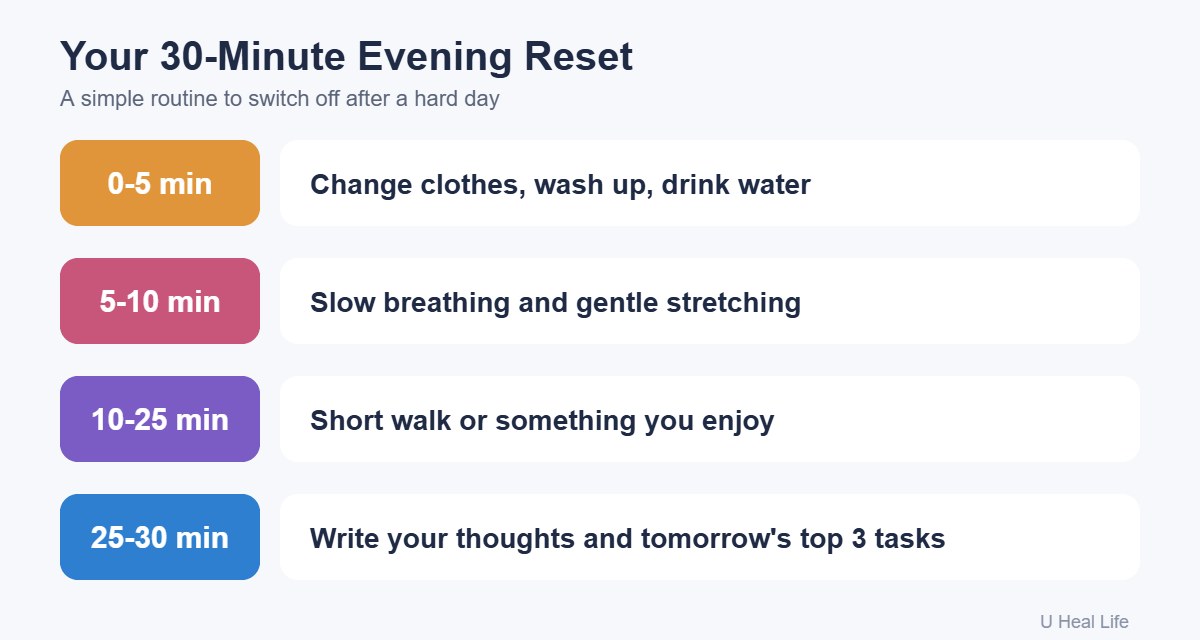
A Simple 30-Minute Evening Reset

If you want an easy routine, try this:

TimeWhat to Do
0-5 minutesChange clothes, wash up, drink water
5-10 minutesSlow breathing and gentle stretching
10-25 minutesShort walk or something you enjoy
25-30 minutesWrite down your thoughts and tomorrow’s top 3 tasks
Timeline infographic of a 30-minute evening reset routine to calm down after a stressful day
A simple 30-minute routine to switch off after a hard day.

Things to Avoid When You’re Stressed

  • Too much caffeine late in the day
  • Doom-scrolling news or social media
  • Drinking alcohol to cope. It may feel relaxing at first but can make stress and sleep worse
  • Overworking late at night
  • Being too hard on yourself

How to Stress Less Over Time

Calming down after a hard day is helpful. But it’s also good to lower stress in the long run:

  • Sleep 7 to 9 hours most nights
  • Exercise a few times a week
  • Take short breaks during work
  • Learn to say “no” when you are overloaded
  • Spend time with people who support you
  • Try meditation or mindfulness, even for 5 minutes a day

When to Get Extra Help

Everyone has stressful days. But please talk to a doctor or mental health professional if:

  • You feel stressed or overwhelmed almost every day
  • You can’t sleep, eat, or focus properly
  • You feel hopeless, very sad, or anxious
  • Stress is affecting your health or relationships

You deserve support, and help is available.

Frequently Asked Questions

How do I calm down quickly after a stressful day?

Start with slow breathing for a minute or two. Then try a short walk, stretching, or listening to calm music.

How long does it take to calm down after stress?

It depends on the person. Some feel better in a few minutes with deep breathing. For others, it may take an hour or more. Practice helps.

What is the best way to relax after work?

There is no single best way. Walking, stretching, music, a warm shower, and talking to a loved one are all good options. Choose what works for you.

Why can’t I relax even after the day is over?

Your body may still be in stress mode. Slow breathing, movement, and a calm evening routine can help your body switch off.

Is it OK to nap after a stressful day?

A short nap of 20 minutes is fine for many people. Long naps late in the day may make it harder to sleep at night.

What foods or drinks help reduce stress?

There is no magic food, but regular meals, water, and calming drinks like herbal tea can help. Try to limit caffeine and alcohol.

Can stress make me physically sick?

Long-term stress can lead to headaches, poor sleep, stomach issues, and tiredness. If you are worried about your health, please see a doctor.

Final Thoughts

You don’t need a perfect routine to feel calm. Even a few small steps, like deep breathing, a short walk, and a screen break, can make a big difference.

Be gentle with yourself. You did your best today, and now it’s time to rest.

Disclaimer: This article is for general information only and is not medical advice. If stress is affecting your health or daily life, please speak with a qualified healthcare professional.

Related Reading

Glowing red light illustration with the text Red Light Therapy: Benefits, Risks and What Science Really Says
Red Light Therapy: Benefits, Risks, and What the Science Really Says (2026 Guide)

Red light therapy has gone from a niche clinical treatment to one of the most searched wellness topics online. Celebrities use it, gyms offer it, and home panels and face masks are everywhere. But does it actually work, or is it just another wellness trend?

In this guide, we break down what red light therapy is, what research supports, what is still unproven, who should be careful, and how to use it safely.

Quick answer: Red light therapy has reasonable evidence for some skin concerns, wound healing, and certain types of pain. Evidence for mood, sleep, and stress is promising but still early. It is not a replacement for medical or mental health treatment.

What Is Red Light Therapy?

Red light therapy (RLT) uses low-level wavelengths of red and near-infrared light to stimulate cells in the body. In research it is often called photobiomodulation (PBM) or low-level light therapy (LLLT).

Unlike a tanning bed or sunlamp, RLT does not use ultraviolet (UV) light. It does not tan or burn the skin, and it works through light energy rather than heat.

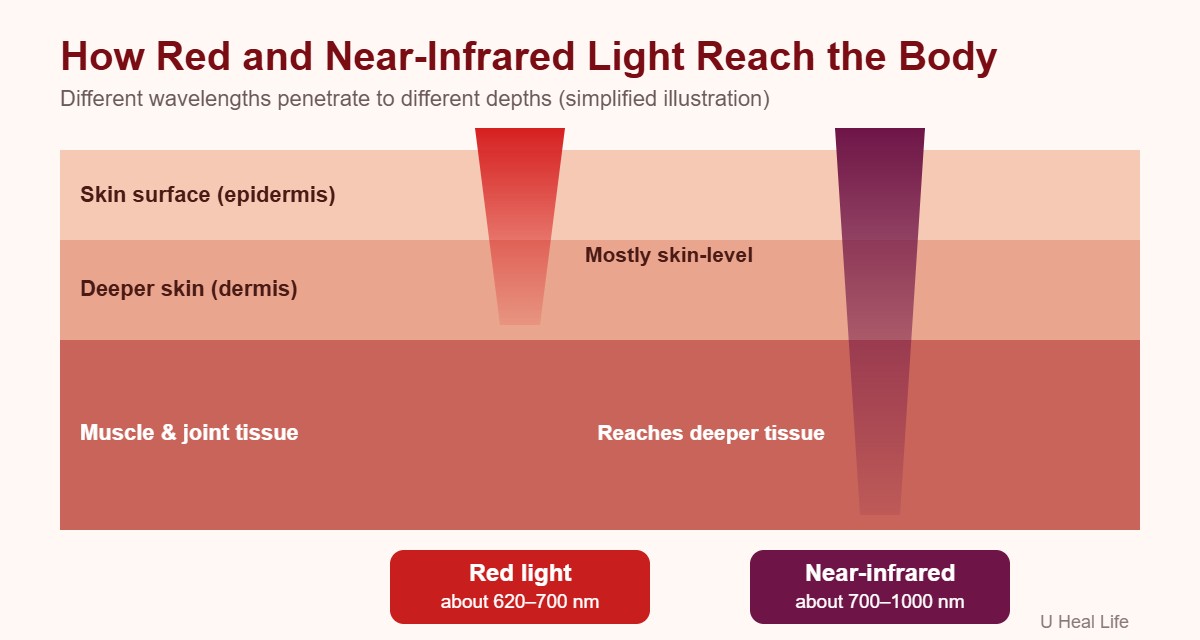
Two main wavelength ranges are commonly used:

  • Red light (about 620-700 nm): Absorbed mostly near the skin surface. Common for skin-related goals.
  • Near-infrared light (about 700-1000 nm): Invisible to the eye and penetrates deeper, toward muscles and joints.
Diagram comparing red light, which reaches mostly the skin, with near-infrared light, which reaches deeper muscle and joint tissue
Red light works near the skin surface, while near-infrared light reaches deeper tissue.

How Does Red Light Therapy Work?

The leading theory is that light is absorbed by structures inside our cells, especially the mitochondria, often called the “powerhouse” of the cell. Researchers believe this may increase cellular energy production (ATP) and influence inflammation and tissue repair.

It is important to note that scientists are still studying the exact mechanisms. Results depend heavily on wavelength, dose, session length, and distance from the device, which is why results vary so much between products.

Potential Benefits of Red Light Therapy

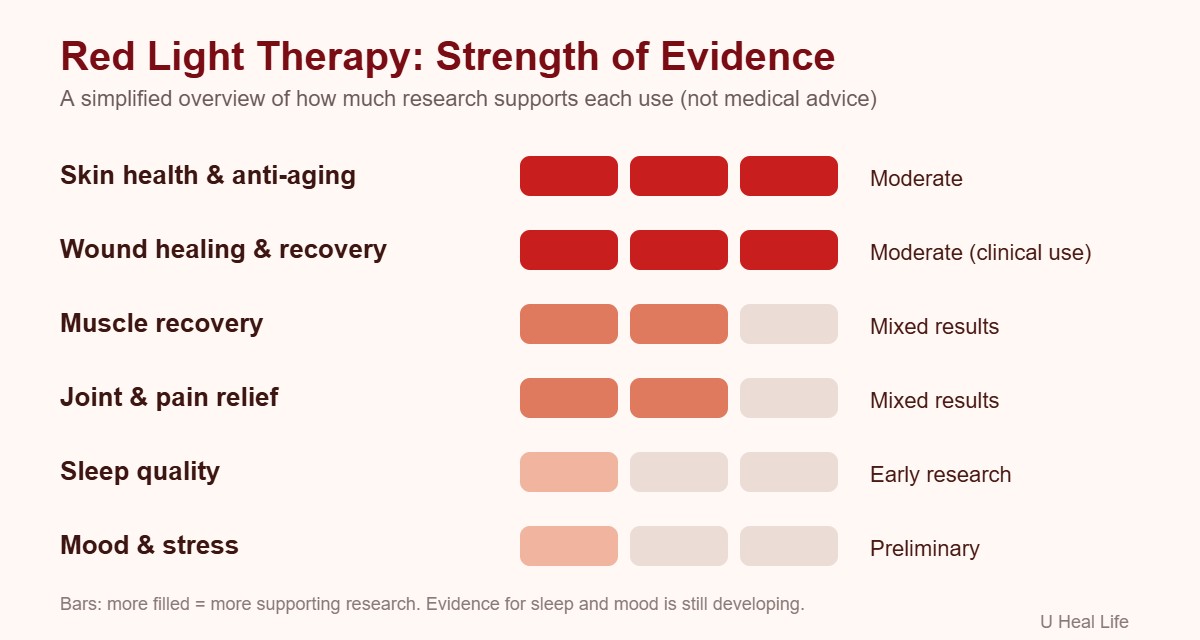
Chart showing strength of evidence for red light therapy uses: skin and wound healing moderate, muscle and pain mixed, sleep and mood early
How much research supports each use of red light therapy (simplified overview).

1. Skin Health and Anti-Aging

This is the area with the most consumer interest. Some studies suggest red light may support collagen production and improve the look of fine lines, skin texture, and tone. Certain devices have also been studied for mild to moderate acne, often alongside other treatments.

Results are usually gradual and modest, not dramatic overnight changes.

2. Wound Healing and Recovery

Photobiomodulation has been studied in clinical settings for helping tissue repair. For example, it is used in some healthcare settings for painful mouth sores caused by certain cancer treatments. This is supervised medical use, not the same as using a home panel.

3. Muscle Recovery and Exercise Performance

Athletes and gym-goers use RLT hoping to reduce soreness and speed recovery. Some research suggests possible benefits for muscle fatigue and recovery, but results differ between studies and protocols.

4. Joint and Pain Relief

Near-infrared light has been studied for conditions like osteoarthritis-related joint pain, neck pain, and tendon problems. Some trials show pain reduction, while others show little difference from placebo, so the evidence is mixed.

5. Sleep Quality

Many people search for red light therapy for sleep. Early, small studies suggest that red light exposure may support sleep quality in some groups, and red-toned light in the evening is less disruptive than blue light. However, large, high-quality human trials are still limited.

6. Mood, Stress, and Mental Wellness

This is an exciting but early area of research. Some small studies have explored near-infrared light on the head for low mood and cognitive function, and others have looked at light exposure for seasonal mood changes. The research is preliminary.

Important: Red light therapy is not an approved or proven treatment for depression or anxiety. If you are struggling with your mental health, please speak with a licensed healthcare professional.

What Red Light Therapy Cannot Do

To keep expectations realistic, RLT is not proven to:

  • Melt body fat or replace diet and exercise
  • Cure depression, anxiety, or any mental health condition
  • Treat cancer or serious disease
  • Replace sunscreen, medication, or doctor-prescribed care

Be cautious of any brand that promises miracle results.

Is Red Light Therapy Safe? Side Effects to Know

For most people, RLT is considered low risk when used as directed. Reported side effects are usually mild and may include:

  • Temporary skin redness or warmth
  • Mild headache or eye strain
  • Skin irritation or dryness
  • Trouble sleeping if used too late or too intensely

Eye safety matters. Bright light can strain or harm eyes. Use the protective goggles that come with a device and avoid staring into the lights.

Who Should Talk to a Doctor First?

Check with a healthcare provider before using RLT if you:

  • Are pregnant
  • Have a history of skin cancer or suspicious moles
  • Take medications that make skin sensitive to light (photosensitizing drugs)
  • Have a light-sensitive condition, such as lupus or certain eye conditions
  • Have a seizure disorder or epilepsy
  • Plan to use it directly over a tumor, implant, or medical device

Red Light Therapy at Home vs. Professional Treatment

FeatureAt-Home DevicesClinic / Professional
CostOne-time purchase (varies widely)Pay per session or package
PowerUsually lowerUsually higher and calibrated
ConvenienceUse anytimeNeed to book appointments
SupervisionSelf-guidedTrained staff
Best forMaintenance, general wellnessSpecific concerns, faster monitoring

How to Use Red Light Therapy Safely

  1. Read the manufacturer’s instructions. Time and distance guidelines differ by device.
  2. Start short. Begin with the lowest recommended session time and increase gradually.
  3. Use clean, bare skin. Remove makeup, lotions, and sunscreen unless the manufacturer says otherwise.
  4. Protect your eyes. Wear the included goggles.
  5. Be consistent. Most studies use multiple sessions per week over several weeks.
  6. Track your results. Take photos or journal changes in skin, sleep, or mood.
  7. Stop if irritation occurs and consult a professional.

How to Choose a Red Light Therapy Device

Not all devices are equal. Look for:

  • Clearly stated wavelengths (for example, red around 630-670 nm and near-infrared around 810-850 nm)
  • Published power output (irradiance) rather than just “LED count”
  • Regulatory clearance where available, such as FDA-cleared for specific uses
  • Independent testing or third-party reviews
  • A fair return policy and warranty

Be careful with unrealistic claims, no technical specs, or “cure-all” marketing.

Can Red Light Therapy Help With Mental Wellness?

Many people explore RLT as part of a broader self-care routine. A realistic way to think about it:

  • It may support relaxation and better evening routines, especially when it replaces bright blue-light screen time.
  • It may be a helpful addition, but not a substitute, for therapy, medication, exercise, sunlight, social connection, and sleep hygiene.

Pair it with habits that have stronger evidence: regular movement, morning daylight, a consistent sleep schedule, and professional support when needed.

Frequently Asked Questions

Does red light therapy really work?

It appears to work for certain uses, such as some skin concerns, healing support, and some types of pain. Evidence for other claims is still developing, and results depend on the device and consistency.

How long does red light therapy take to work?

Many people use it for several weeks before noticing changes. Skin results are typically gradual, often over 8-12 weeks, though individual results vary.

How often should I use red light therapy?

Most protocols use sessions a few times per week. Follow your device’s guidelines and avoid overuse.

Is red light therapy better than sunlight?

They are different. Sunlight provides vitamin D and supports your body clock but also includes UV. RLT does not provide vitamin D.

Can I use red light therapy every day?

Some devices allow daily use at low doses, but more is not always better. Follow the manufacturer’s instructions and talk to your doctor if unsure.

Does red light therapy help with sleep?

It may help some people, particularly when used as part of an evening wind-down routine. Research is still limited, so it should not replace good sleep habits or medical care for sleep disorders.

Is red light therapy FDA approved?

Specific devices may be FDA-cleared for particular uses, such as certain skin or pain applications. Many wellness devices make general claims without clearance, so check the exact device and its approved use.

Can red light therapy cure depression?

No. It is not a proven treatment for depression. If you feel persistently low, anxious, or hopeless, please contact a licensed mental health professional or your doctor.

Final Thoughts

Red light therapy is not magic, but it is more than just a trend. It shows real promise for skin, recovery, and comfort, while its effects on sleep and mood are still being explored. If you try it, choose a reputable device, use it consistently and safely, and treat it as one tool within a healthy lifestyle, not a cure-all.

Disclaimer: This article is for informational purposes only and is not medical advice. Always consult a qualified healthcare professional before starting any new wellness therapy, especially if you have a medical condition or take medication.

Blue graphic with the text How to Calm Your Mind in 5 Minutes: 12 quick, science-backed techniques
How to Calm Your Mind in 5 Minutes: 12 Science-Backed Techniques

Racing thoughts, a tight chest, and a mind that won’t switch off are something almost everyone experiences at some point. The good news is that you don’t need an hour of meditation or a weekend retreat to feel calmer. Many simple techniques can help settle your nervous system in about five minutes or less.

Below are 12 practical, research-informed ways to calm your mind. Try a few and keep the ones that work best for you.

Quick answer: To calm your mind in 5 minutes, slow your breathing (try box breathing or a longer exhale), ground yourself with the 5-4-3-2-1 exercise, take a short walk, or write your thoughts down. Pick one or two techniques and practice them for 2 to 5 minutes.

1. Box Breathing

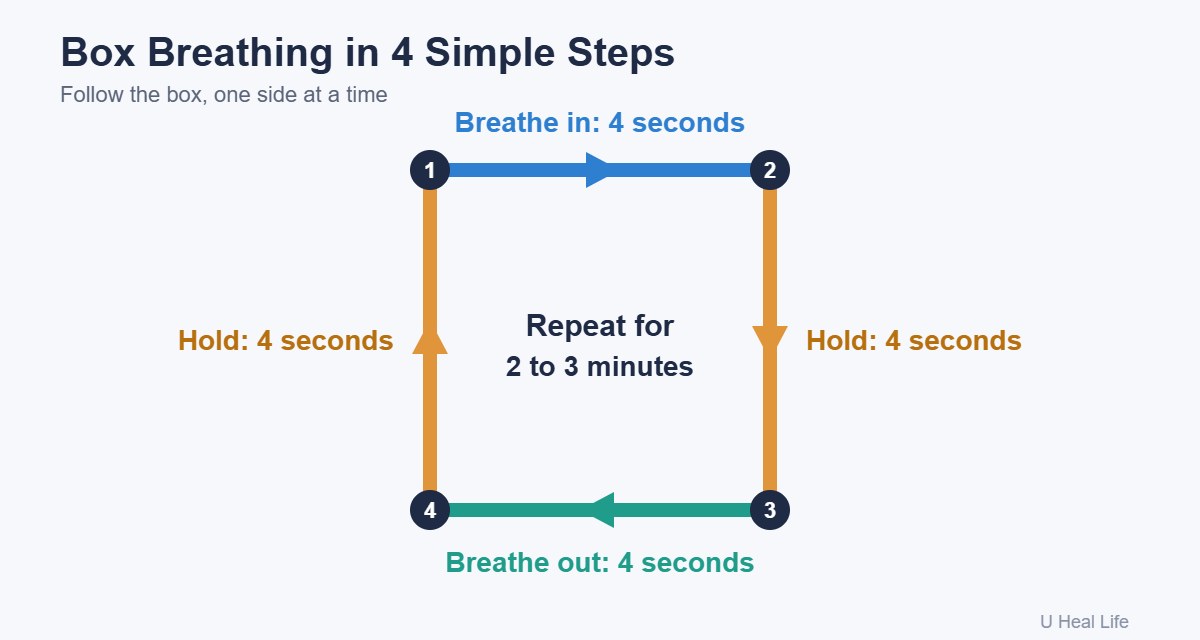
Breathe in for four seconds, hold for four, breathe out for four, and hold for four. Repeat for two to three minutes. The steady rhythm gives your mind something simple to focus on and can slow your heart rate.

Diagram of box breathing: breathe in for 4 seconds, hold for 4, breathe out for 4, hold for 4, and repeat for 2 to 3 minutes
Box breathing: four equal steps, repeated for two to three minutes.

2. Extend Your Exhale

Breathe in through your nose for a count of four, then out slowly for a count of six to eight. Longer exhales are commonly used to help activate the body’s relaxation response.

3. The Physiological Sigh

Take a deep breath in through your nose, add a second short inhale on top of it, then let out a long, slow breath through your mouth. A 2023 Stanford-led study found that a few minutes a day of this kind of “cyclic sighing” improved mood and reduced breathing rate over time.

4. The 5-4-3-2-1 Grounding Exercise

Look around and name five things you can see, four you can touch, three you can hear, two you can smell, and one you can taste. This pulls your attention out of anxious thoughts and back into the present moment.

5. Splash Cold Water on Your Face

Cold water on your face or wrists can briefly slow your heart rate and interrupt a spiral of stress. It’s quick, free, and works almost anywhere.

6. Progressive Muscle Relaxation

Starting with your feet and moving upward, tense each muscle group for five seconds, then release. Noticing the contrast between tension and relaxation helps your body let go of stress it may be holding without you realizing it.

7. Do a Quick Brain Dump

Grab a pen and write down everything that’s on your mind for three to five minutes without editing. Getting worries out of your head and onto paper can make them feel more manageable and less overwhelming.

8. Take a Short Walk

Even five minutes of walking, especially outdoors, can lift your mood and clear mental clutter. If you can, leave your phone behind or keep it in your pocket.

9. Try a One-Minute Mindfulness Check-In

Close your eyes and focus on the sounds around you, or on the feeling of your feet on the floor. When your mind wanders, gently bring it back. You don’t have to empty your mind; you just practice noticing where it is.

10. Listen to Slow, Calming Music

Slow-tempo music without lyrics can help lower tension and make it easier to breathe more slowly. Keep a short calming playlist ready for stressful moments.

11. Name the Emotion

Silently say, “I’m feeling anxious” or “I’m feeling overwhelmed.” Putting a label on what you feel, sometimes called affect labeling, has been linked in research to reduced emotional intensity.

12. Reach Out to Someone

A quick call or message to a friend or family member can remind you that you’re not alone. You don’t have to talk about the problem; sometimes just hearing a familiar voice is enough to settle you.

Make Calm a Daily Habit

These techniques work best when you practice them regularly, not only when you’re overwhelmed. Try pairing a breathing exercise with something you already do each day, such as brushing your teeth or making your morning coffee. Small, consistent habits can make it easier to stay calm when stress spikes. If constant scrolling is adding to your stress, our guide to social media anxiety offers more ideas.

When It’s More Than Everyday Stress

If racing thoughts, panic attacks, or constant worry are interfering with your sleep, work, or relationships, it’s worth talking with a doctor or a licensed mental health professional. Our guides to mental health insurance coverage and online therapy costs can help you figure out your options. If you ever have thoughts of harming yourself, call or text 988 (the Suicide & Crisis Lifeline in the US) or contact local emergency services right away.

Frequently Asked Questions

How can I calm my mind in 5 minutes?

Choose one simple technique and practice it for 2 to 5 minutes. Slow breathing (such as box breathing or a longer exhale), the 5-4-3-2-1 grounding exercise, or a short walk are easy places to start.

What is the fastest way to calm a racing mind?

Many people find that slowing their breathing is one of the quickest ways to settle. Try breathing in for 4 seconds and out for 6 to 8 seconds. If your thoughts are still racing, writing them down in a quick brain dump can help.

Does box breathing really work?

Many people find box breathing helpful for feeling calmer because it gives the mind a simple rhythm to follow. It is a helpful tool for everyday stress, but it is not a treatment for anxiety disorders or other medical conditions.

What is the 5-4-3-2-1 technique?

It is a grounding exercise that brings your attention to the present moment. You notice 5 things you can see, 4 you can touch, 3 you can hear, 2 you can smell, and 1 you can taste.

How do I stop overthinking?

Try writing your thoughts down, slowing your breathing, and giving your mind a calm routine. Our guide on how to stop overthinking at night has more simple steps.

When should I talk to a professional?

If worry, panic, or racing thoughts happen often or interfere with your sleep, work, or relationships, it is a good idea to speak with a doctor or licensed mental health professional.

Related Reading

This article is for general educational purposes and is not a substitute for professional medical or mental health advice.

Graphic for 8 signs you need a mental health day and how to take one
8 Signs You Need a Mental Health Day (and How to Take One)

Most of us don’t think twice about calling in sick when we have a fever or a migraine. But when what’s worn down is your mind rather than your body, it’s much easier to push through, tell yourself it’s “not that bad,” and keep going until something gives.

A mental health day is a planned break from work, school, or daily obligations so you can rest, reset, and look after your emotional well-being. It isn’t a cure for anxiety, depression, or chronic burnout, but it can interrupt a downward spiral before it gets worse. Here are eight signs it may be time to take one.

Quick answer: You may need a mental health day if you feel exhausted even after sleep, get irritated easily, cannot focus, dread everyday responsibilities, feel physically tense, or no longer enjoy things. A day to rest can help you reset, but if these signs last for weeks, please talk to a professional.

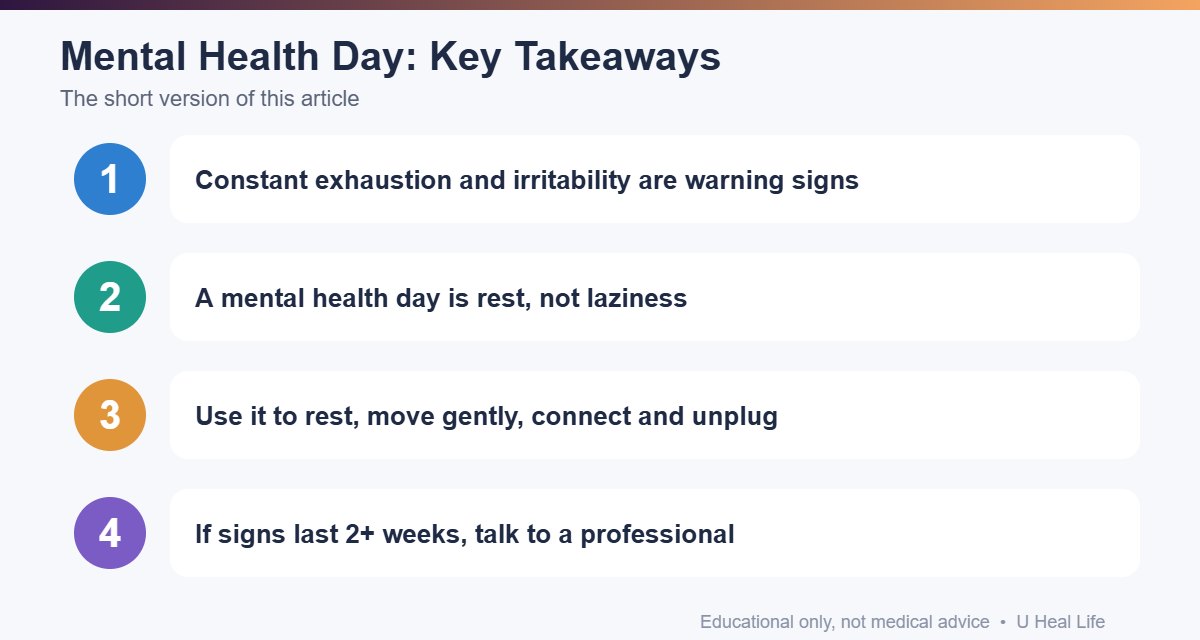
Key takeaways infographic: Constant exhaustion and irritability are warning signs; A mental health day is rest, not laziness; Use it to rest, move gently, connect and unplug; If signs last 2+ weeks, talk to a professional
The key points at a glance.

1. You’re Exhausted Even After Sleeping

Fatigue that doesn’t improve with a full night’s rest is one of the most common signals of mental overload. When stress stays high for weeks, your body stays in a state of alert, and sleep stops feeling restorative.

2. Small Things Set You Off

If a slow driver, a noisy coworker, or an unanswered text suddenly feels unbearable, your stress tolerance may be running on empty. Irritability is often the first thing others notice before we notice it ourselves.

3. You Can’t Concentrate

Reading the same email three times, forgetting simple tasks, or staring at a screen without taking anything in are signs your brain is overloaded. Chronic stress can interfere with attention and memory, which is why “brain fog” and burnout often go hand in hand.

4. You Dread Work or Everyday Responsibilities

Everyone has bad Mondays. But if dread about work, school, or home life shows up most days, or starts creeping in on the weekend, it’s worth paying attention to.

5. Your Body Is Sending Signals

Stress doesn’t stay in the mind. Frequent headaches, stomach trouble, tight shoulders, a clenched jaw, changes in appetite, and getting sick more often can all be physical signs that you’re running on too little rest and too much pressure.

6. Things You Usually Enjoy Feel Flat

When hobbies, favorite shows, or time with friends stop feeling enjoyable, your mind may be asking for a break. Losing interest in things you normally like is also a symptom commonly linked with depression, so keep an eye on how long it lasts.

7. You’re Pulling Away From People

Canceling plans, ignoring messages, or avoiding conversations because you simply have no energy left is a classic sign of emotional overload. A day to rest can help you show up for the people you care about with more to give.

8. You’re Leaning on Coping Crutches

More caffeine to get going, more alcohol to wind down, endless scrolling to avoid thinking, or comfort eating to get through the day can all be signs you’re coping rather than recovering. If you notice the pattern, it’s a good moment to pause.

What a Good Mental Health Day Looks Like

A mental health day works best when it’s genuinely restful, not just a day off spent catching up on chores or doom-scrolling. A few ideas:

Want a gentle way to unwind in the evening too? Try our 10-minute evening routine to reduce stress or these 12 ways to calm down after a stressful day.

  • Disconnect on purpose. Mute work email and chat notifications for the day.
  • Let yourself rest. Sleep in if you can, or take a nap without guilt.
  • Move gently. A walk outside, light stretching, or yoga can lower tension without draining you.
  • Do something restorative. Cook a meal you enjoy, read, draw, listen to music, or spend time in nature.
  • Connect with someone safe. A short call with a friend or family member can lift your mood more than staying isolated.
  • Name what’s weighing on you. Write down what’s been draining you, then pick one small thing you can change this week.

How to Ask for a Mental Health Day

Policies vary by employer and by state, so check your company handbook or HR guidelines. Many workplaces allow sick leave to be used for mental health reasons, and in most cases you don’t have to share details. A simple message such as “I’m not feeling well and need to take a sick day” is usually enough.

When One Day Off Isn’t Enough

A mental health day is a short-term reset, not a long-term solution. If you’ve felt this way most days for two weeks or longer, or if your sleep, appetite, work, or relationships are being affected, it’s a good idea to talk with your doctor or a licensed mental health professional. If you’re not sure how to afford care, our guide to mental health insurance coverage and our breakdown of online therapy costs can help you plan next steps. You may also find our article on social media anxiety useful if constant scrolling is adding to your stress.

If you often feel anxious without a clear reason, read why you might feel anxious for no reason, and build small habits with our simple mindfulness exercises.

If you ever have thoughts of harming yourself, call or text 988 (the Suicide & Crisis Lifeline in the US) or contact your local emergency services right away.

Illustration of a video call with a therapist on a laptop
Sponsored

Thinking about talking to someone?

If you often feel drained or overwhelmed, talking to someone can be a good next step. Online-Therapy.com offers CBT-based online therapy programs for individuals and couples.

Learn moreAffiliate link: we may earn a commission at no extra cost to you. This is not for emergencies. In the US, call or text 988.

Frequently Asked Questions

What is a mental health day?

It is a day you take off to rest and recover from stress, burnout or emotional overload, in the same way you would take a sick day for physical illness.

How do I know if I need one?

Common signs include constant tiredness, irritability, trouble focusing, dread about work, physical tension and losing interest in things you enjoy.

What should I do on a mental health day?

Rest, spend time outside, move gently, eat well, limit screens and do something that calms you. Avoid filling the day with chores or work.

How often can I take a mental health day?

There is no fixed number. If you need them very often, that is a sign to look at your workload, sleep and stress, and to talk with a professional.

Is a mental health day the same as a sick day?

Many workplaces treat them the same, but policies differ. Check your company policy before you ask.

When should I get professional help?

If you have felt this way most days for two weeks or longer, or if sleep, appetite, work or relationships are affected, speak with a doctor or licensed mental health professional.

Related Reading

This article is for general educational purposes and is not a substitute for professional medical or mental health advice.