Both yoga retreats and wellness retreats promise rest and a reset, so it is easy to mix them up. The main difference is focus. This guide explains yoga retreat vs wellness retreat in simple words, with a comparison table, typical costs and tips for choosing.
By the U Heal Life editorial team. Last updated: October 2026. This is general information, not medical advice.
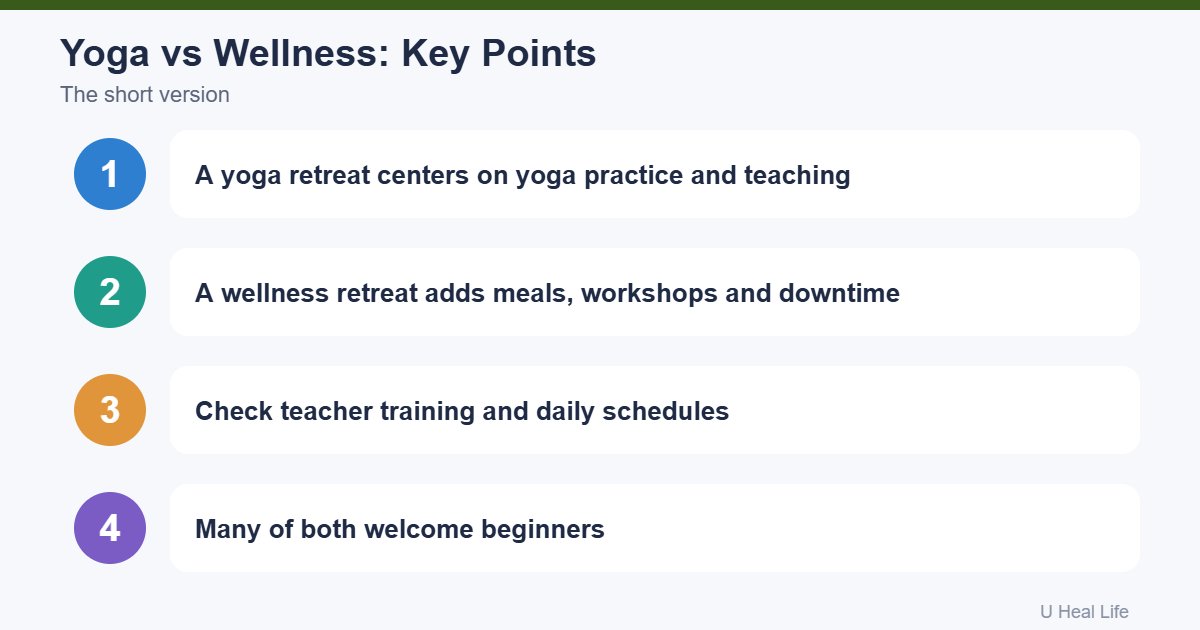
Quick answer: A yoga retreat centers on yoga practice, with daily classes and often meditation and teacher-led talks. A wellness retreat is broader: it may include yoga, but also healthy meals, workshops, spa time, nature activities and free time. Both can suit beginners. Check the daily schedule, the teachers’ training and what is included in the price.
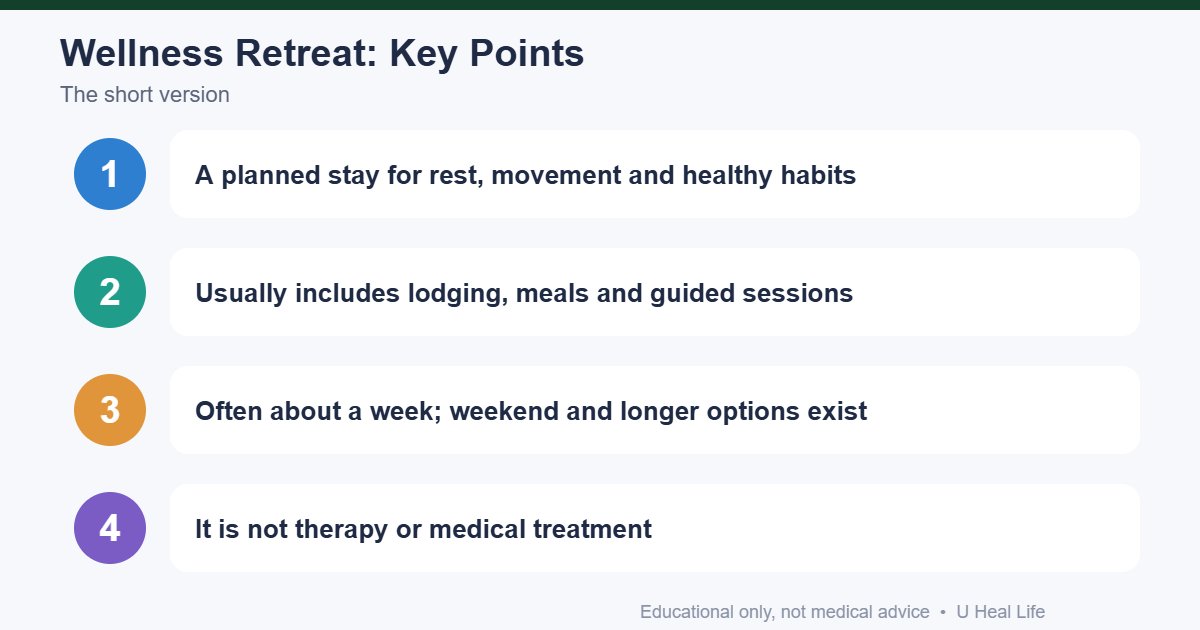
Key points at a glance.
Table of Contents
What Is a Yoga Retreat?
A yoga retreat is built around yoga. You usually practice once or twice a day, and the rest of the day may include meditation, breathing practice, simple meals and talks. Some focus on a style, such as gentle or restorative yoga. Look for teachers trained through recognized programs, such as those listed with Yoga Alliance.
What Is a Wellness Retreat?
A wellness retreat is a planned stay that supports rest and healthy habits. It may include yoga or movement, but also nutrition talks, mindfulness, nature walks, creative workshops or spa treatments. To learn more, read what is a wellness retreat.
Yoga Retreat vs Wellness Retreat: Comparison
Yoga retreat
Wellness retreat
Main focus
Yoga practice
Overall wellbeing
Daily schedule
Yoga classes, meditation, talks
Movement, workshops, meals, spa or nature time
Best for
People who want to deepen or start a yoga practice
People who want rest and a mix of activities
Leaders
Yoga teachers
Coaches, teachers and other facilitators
Typical stay
Weekend to a week or more
Weekend to a week or more
Food
Often simple, vegetarian or plant-based
Varies, often healthy and balanced
How Much Do They Cost?
Prices vary by place, length and room type. Travel guides report simple yoga or wellness weekends from about $150 to $600 and typical weeks from about $500 to $1,800, with luxury resorts costing more. Read how much a wellness retreat costs for a fuller breakdown.
How to Choose
Decide your goal: do you want to learn yoga, or simply rest?
Check your level: look for “all levels” or “beginner-friendly” classes
Read the daily schedule: see how packed it is
Check who leads it: training and experience matter
See what is included: meals, classes, transfers and extras
Disclaimer: This article is for general information only and is not medical or mental health advice. Prices, programs and availability change, so please check current details with each provider. If you are in crisis or thinking about harming yourself, call or text 988 (the Suicide and Crisis Lifeline in the US) or your local emergency number right away.
Packing for a retreat is different from packing for a normal trip. You need comfortable clothes, a few simple tools for rest, and a plan for what to leave behind. This guide gives you a clear checklist for a wellness retreat or silent retreat, plus things you may be asked not to bring.
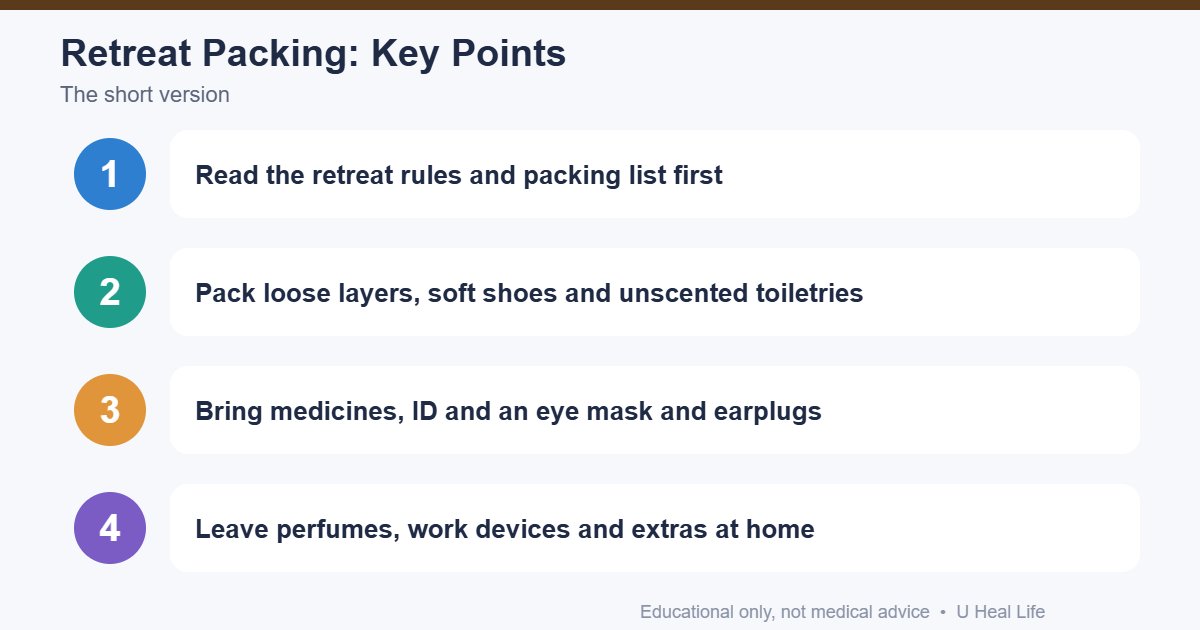
Quick answer: For a wellness or silent retreat, pack loose comfortable layers, soft shoes, basic toiletries, a water bottle, any medicines, an eye mask and earplugs. Check the retreat’s rules first: some silent retreats do not allow phones, books, writing or exercise gear, and many ask for unscented products.
Key points at a glance.
Table of Contents
First, Read the Retreat’s Packing List and Rules
Every retreat is different. Before you pack, read the “what to bring” page and the code of conduct. Strict silent courses, such as 10-day Vipassana retreats, ask students to give up phones, reading and writing, so check what is allowed. When in doubt, email the organizer.
What to Pack: Checklist
Clothing
Loose, comfortable clothes you can move and sit in
Layers for morning and evening (a sweater or shawl)
Modest clothing if the center asks for it
Comfortable socks and slip-on shoes (you may remove shoes often)
Walking shoes if there are hikes
Swimwear if the retreat has a pool, sea or hot springs
Rest and Comfort
Eye mask and earplugs
Small pillow or cushion if you want extra comfort
Light blanket or scarf
Reusable water bottle
Toiletries and Health
Basic toiletries, preferably unscented (many retreats ask for this)
Any prescribed medicines in original packaging
Sunscreen, lip balm and hand cream
Basic first-aid items and any personal health items
Documents and Money
ID, booking confirmation and travel insurance details
Some cash for tips or small purchases
Emergency contact details written on paper
Optional
Journal and pen (only if allowed)
A mat or yoga towel (many retreats provide mats)
Reusable bag and a small flashlight for evening walks
What to Leave at Home
Item
Why
Strong perfumes
Many retreats ask for scent-free products
Work laptop
Helps you really switch off
Books and notebooks (for strict silent retreats)
Some courses do not allow reading or writing
Valuables and lots of jewelry
You do not need them
Heavy snacks or outside food
Some centers have food rules
What About Your Phone?
Rules vary. Some retreats ask you to hand in your phone for the whole stay. Others allow it in your room. Tell family and work in advance that you will be offline, and share the retreat’s contact number for emergencies. If you struggle to unplug, our 10-minute evening routine to reduce stress can help you practice at home first.
Disclaimer: This article is for general information only and is not medical or mental health advice. Prices, programs and availability change, so please check current details with each provider. If you are in crisis or thinking about harming yourself, call or text 988 (the Suicide & Crisis Lifeline in the US) or your local emergency number right away.
A spa weekend, a wellness retreat and a mental health retreat can sound alike, but they are very different. Choosing the wrong one can waste money, or leave you without the care you need. This guide compares them side by side in simple words.
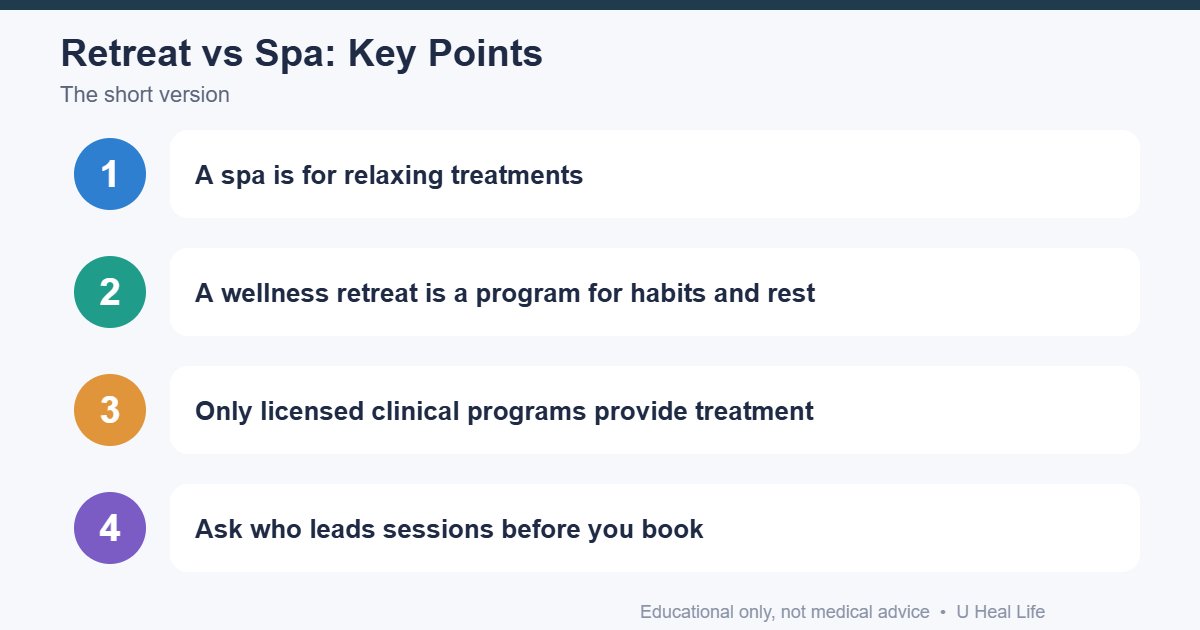
Quick answer: A spa vacation is for relaxing treatments, a wellness retreat is a planned program for healthy habits and rest, and a mental health retreat focuses on emotional wellbeing, either with wellness-style support or with licensed clinicians. Only clinical programs led by licensed professionals provide mental health treatment.
Key points at a glance.
Table of Contents
Wellness Retreat vs Spa vs Mental Health Retreat: Quick Comparison
Spa vacation
Wellness retreat
Mental health retreat
Main goal
Relaxation and treatments
Healthy habits, rest, reflection
Emotional wellbeing or treatment
Typical activities
Massage, facials, pools
Yoga, meditation, meals, workshops
Therapy, group work, coping skills
Who leads
Spa therapists
Coaches, teachers, facilitators
Licensed clinicians (clinical programs)
Medical or clinical care
No
Rarely
Yes, in clinical programs
Length
1 to 3 days
3 to 7+ days
Days to weeks, or longer
Cost
Pay per treatment or package
Often all-inclusive
Varies widely
Insurance
No
Usually no
Sometimes, for clinical programs
Best for
Rest and pampering
A reset and new routines
Support for stress, mood or trauma
What Is a Spa Vacation?
A spa vacation focuses on treatments such as massage, facials and thermal pools. There is usually no set program. It can help you relax, but it is not designed to build long-term habits. See Florida wellness retreats for resort examples.
What Is a Wellness Retreat?
A wellness retreat is a planned stay with a daily program of movement, mindfulness, healthy meals and talks. It is not medical treatment. Learn more in what is a wellness retreat.
What Is a Mental Health Retreat?
A mental health retreat focuses on emotional wellbeing. Some are wellness-style stays with workshops. Others are clinical programs run by licensed psychologists, therapists or psychiatrists. Always ask who leads sessions. Read how to choose a mental health retreat.
Which One Should You Choose?
I am tired and need to relax: a spa vacation or short wellness retreat
I want to build healthy routines: a wellness retreat
I feel anxious, low or overwhelmed most days: talk to a doctor or licensed therapist first, then consider a clinical program or retreat they support
Disclaimer: This article is for general information only and is not medical or mental health advice. Prices, programs and availability change, so please check current details with each provider. If you are in crisis or thinking about harming yourself, call or text 988 (the Suicide & Crisis Lifeline in the US) or your local emergency number right away.
Hearing the words “wellness retreat” can feel confusing. Is it a spa trip, a yoga camp or a type of therapy? In simple words, it is a planned break where you step away from daily life to rest, reset and focus on your health. This guide explains what a wellness retreat is, what it includes, how long it lasts, what it costs and who it is for.
Quick answer: A wellness retreat is a planned stay, usually a few days to about a week, at a calm place where you focus on your health with activities like yoga, meditation, healthy meals and nature time. It is not medical treatment. Lodging, meals and sessions are usually included, but prices vary a lot.
Key points at a glance.
Table of Contents
What Is a Wellness Retreat?
A wellness retreat is a short stay built around rest, healthy habits and personal reflection. You live at the retreat, follow a simple daily schedule and take part in guided sessions. Many people go to slow down, recover from stress or try new routines in a supportive setting.
Retreats can be quiet and simple, or comfortable and luxurious. What they share is the goal of helping you reconnect with yourself, away from work, screens and noise.
What Does a Wellness Retreat Include?
Every retreat is different, so always read the program. Most include some mix of:
Lodging: a shared or private room
Meals: often healthy, plant-forward food
Movement: yoga, walking, stretching or light fitness
Mindfulness: meditation, breathing exercises or journaling
Talks and workshops: topics like sleep, stress or nutrition
Nature time: hikes, beaches or garden walks
Optional extras: massage or spa treatments, which may cost more
How Long Does a Wellness Retreat Last?
Travel experts often say a typical retreat lasts about a week. Shorter weekend retreats of 2 to 3 days are common too, and some programs run for 2 to 4 weeks. If you are new to retreats, a short one is a good way to try the idea.
Types of Wellness Retreats
Type
Main focus
Good for
Yoga and meditation
Movement and calm
Beginners, stress relief
Silent retreat
Quiet and inner focus
People who want deep rest
Fitness retreat
Exercise and healthy habits
Active people
Spa and relaxation
Rest and treatments
Burnout-style tiredness
Nutrition or detox
Food and routines
People learning healthy eating
Medical-wellness
Wellness plus licensed health staff
People who want health checks
Who Is a Wellness Retreat For?
A wellness retreat may suit you if you feel stretched thin, want a reset or want to learn healthy routines. Many guests travel alone, so you do not need a partner or friends to go.
A retreat is not a replacement for therapy or medical care. If you have a mental health condition, talk to your doctor or therapist first. Our guide to how to choose a mental health retreat explains the difference.
How Much Does a Wellness Retreat Cost?
Prices vary a great deal. Simple retreats can cost a few hundred dollars for a short stay, while luxury resorts cost much more. For example, Canyon Ranch lists all-inclusive stays from about $950 per person per night on its website. Health insurance generally does not pay for wellness retreats. See our full guide on how much a wellness retreat costs.
Possible Benefits and Limits
Many guests say they feel calmer, more rested and clearer about their next steps. Time away, regular sleep, movement and healthy meals can all support wellbeing. But a retreat is a short experience. Habits you keep after you return matter more than the days you spend there, and results differ from person to person.
How to Choose a Wellness Retreat
Know your goal. Rest, learning or a reset?
Read what is included in writing: lodging, meals, sessions and transfers.
Check the leaders. Ask about training and experience.
Look at group size and daily schedule.
Read recent reviews and cancellation terms.
Frequently Asked Questions About What Is a Wellness Retreat
Is a wellness retreat worth it?
It can be worth it if you pick one that fits your goal and budget, and if you keep a few habits afterward.
Can I go to a wellness retreat alone?
Yes. Many guests are solo travelers, and retreats are often friendly and well suited to it.
How is a retreat different from a vacation?
A vacation is mostly for fun and rest. A retreat has a planned program focused on wellbeing.
Does insurance cover a wellness retreat?
Usually not. Ask your insurer, and check whether an HSA applies.
How do I prepare?
Read the schedule, pack comfortable clothes and tell the organizer about any health needs.
Helpful resource: For general information on relaxation techniques such as breathing exercises, see the NIH’s NCCIH guide to relaxation techniques.
Disclaimer: This article is for general information only and is not medical or mental health advice. Prices, programs and availability change, so please check current details with each provider. If you are in crisis or thinking about harming yourself, call or text 988 (the Suicide & Crisis Lifeline in the US) or your local emergency number right away.
In a world of relentless notifications, 60-hour workweeks, and information overload, our brains are tired. We aren’t just physically exhausted; we are cognitively drained. This modern epidemic has a name: Brain Fog.
For high-performing professionals, executives, and creatives, a standard beach vacation is no longer enough. Sipping a margarita by the pool might relax your body, but it doesn’t necessarily turn off the racing thoughts or restore your sharp focus.
To truly reset, you need something different. You need a brain power wellness retreat.
These aren’t your typical spas. They are wellness programs that combine mindfulness, nutrition, movement, and digital detoxing to help you relax, reset, and support clear thinking.
If you are ready to trade burnout for brilliance, here is our curated list of the 7 best brain power wellness retreats in the USA and beyond for 2026.
Quick answer: The best brain power wellness retreats combine mindfulness, healthy food, movement and a digital detox to help you rest your mind and refocus. Our 2026 list includes Canyon Ranch (Arizona), The Ranch Malibu (California), The Art of Living Retreat Center (North Carolina) and Four Seasons Westlake Village (California). Choose based on your goal: medical support, a strict reset, silence, luxury or a digital detox.
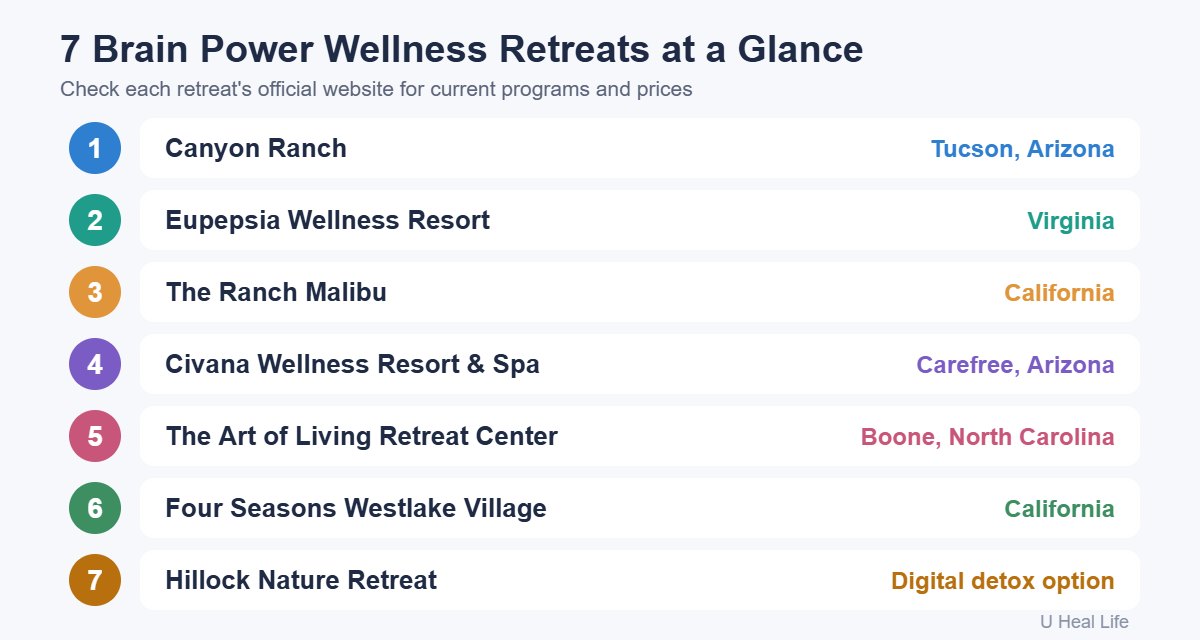
The 7 Retreats at a Glance
Our 7 picks for a brain power wellness retreat.
Retreat
Location
Best for
Canyon Ranch
Tucson, Arizona
Executives and data-driven people who want medical support
Eupepsia Wellness Resort
Virginia
A holistic, spiritual, nature-immersive reset
The Ranch Malibu
California
Those who want a strict “boot camp” structure
Civana Wellness Resort & Spa
Carefree, Arizona
Solo travelers and beginners
The Art of Living Retreat Center
Boone, North Carolina
Spiritual seekers and deep emotional exhaustion
Four Seasons Westlake Village
California
Luxury travelers working on their mental health
Hillock Nature Retreat
Digital detox option
A complete culture shift and escape
What is a Brain Power Wellness Retreat?
Before we dive into the list, it is essential to understand what separates these mental clarity getaways from a regular holiday.
A brain power wellness retreat focuses specifically on cognitive health. While a regular resort focuses on leisure, these retreats focus on neuroplasticity—the brain’s ability to reorganize itself by forming new neural connections.
Key features often include:
Neuro-nutrition: Meals designed to lower inflammation and fuel brain cells.
Mindfulness & Meditation: Techniques that may help you train attention and focus.
Digital Detox: Strict “no-phone” policies to help you step away from constant notifications.
Biohacking: Use of cryotherapy, infrared saunas, or neurofeedback to optimize brain function.
For decades, Canyon Ranch has been the heavyweight champion of wellness in the USA. However, their “Life Enhancement” pathways take cognitive health retreats to a new level. Located in the stunning Sonoran Desert, this destination offers a comprehensive medical and holistic approach to brain health.
Why it’s great for Brain Power: Canyon Ranch employs board-certified physicians, nutritionists, and therapists. They don’t just guess what your brain needs; they test. Their “Executive Health” packages often include cognitive assessments, sleep studies, and stress management workshops tailored to rewire a stressed mind.
Best For: Executives and data-driven individuals seeking medical validation.
The Experience: Expect a mix of desert hiking (to boost BDNF – a protein that promotes brain cell growth) and lectures on sleep hygiene and stress resilience.
2. Eupepsia Wellness Resort (Virginia)
The Ayurvedic Approach to Cognitive Health
Nestled in the heart of the Blue Ridge Mountains, Eupepsia is a hidden gem that has repeatedly won “Best Wellness Resort” titles. Unlike the clinical feel of some resorts, Eupepsia focuses on Ayurveda—the ancient science of life—to restore mental balance.
Why it’s great for Brain Power: According to Ayurveda, mental fog is often a result of poor digestion and an imbalance in the body’s energies (doshas). Their program focuses on “Gut-Brain Axis” health. By fixing your digestion with farm-to-table vegetarian meals and herbal tonics, they aim to clear the mind.
Best For: Those looking for a holistic, spiritual, and nature-immersive reset.
The Experience: Hydrotherapy, halo-therapy (salt therapy), and forest bathing to calm the sympathetic nervous system.
3. The Ranch Malibu (California)
The Hard Reset for High Achievers
If your idea of relaxing is pushing your limits to break through mental barriers, The Ranch Malibu is for you. This is a rigorous, results-oriented program often favored by Hollywood celebrities and CEOs.
Why it’s great for Brain Power: The philosophy here is simple: Clarity through discipline. There is no Wi-Fi. There is no caffeine. There is no alcohol. There is no meat. By removing all toxins and distractions and engaging in 4-hour daily hikes, your brain is forced into a state of deep detoxification.
Best For: Type-A personalities who need a strict “boot camp” structure to disconnect.
The Experience: You will hike the Santa Monica mountains every morning. Intense physical activity can boost your mood and help ease stress.
Not everyone wants a boot camp or a medical exam. Sometimes, brain power returns simply by having the freedom to choose. Civana offers a more flexible approach to cognitive health retreats in the USA.
Why it’s great for Brain Power: Civana specializes in “inner work.” Their schedule is packed with over 70 weekly classes, many focusing on mental conditioning. From sound bath meditations to “aerial yoga” (which improves blood flow to the brain), you can curate a schedule that feels restorative to you.
Best For: Solo travelers and beginners to the wellness retreat world.
The Experience: Don’t miss their “Aqua Therapy” sessions. Floating weightlessly in warm water is often described as deeply relaxing, although research on its effects is still limited.
5. The Art of Living Retreat Center (Boone, North Carolina)
Mastering the Breath for Mental Focus
Located high in the Heavenly Mountain range, this center is rooted in yogic wisdom. It is one of the few places in the US that focuses intensely on Breathwork and Silence.
Why it’s great for Brain Power: They offer a “Silent Retreat” (Stepping into Silence). Some early research, mostly in animals, suggests that silence may affect brain cells linked to memory, but more human research is needed. Stepping away from constant talking and social interaction can also give your mind a rare chance to rest.
Best For: Spiritual seekers and those suffering from deep emotional exhaustion.
The Experience: You will learn the Sudarshan Kriya, a breathing technique that some studies suggest can help reduce stress and anxiety.
6. Four Seasons Westlake Village (California)
Luxury Meets Neuroscience
If you want luxury accommodation combined with cutting-edge science, the Center for Health & Wellbeing at the Four Seasons Westlake Village is the pinnacle. This isn’t just a hotel; it’s a wellness institute.
Why it’s great for Brain Power: They offer specific “Mind & Body” retreats. You can access life coaches, hypnotherapists, and guided meditation experts. Their approach is highly personalized—you might start your day with a luxury breakfast and end it with a biofeedback session to learn how to control your heart rate variability (HRV).
Best For: Luxury travelers who want 5-star comfort while working on their mental health.
The Experience: Their “Somadome” meditation pod is a futuristic experience that uses color and sound therapy to guide your brain into a state of deep relaxation.
7. Hillock Nature Retreat (The Exotic “Digital Detox” Option)
The Hidden Gem for Total Disconnection
While the USA has incredible options, sometimes the best way to reclaim your brain power is to leave the country entirely. For the adventurous soul, Hillock Nature Retreat (an emerging eco-luxury destination) offers something American resorts can’t: Raw, Untouched Nature.
Why it’s great for Brain Power: Located away from the hum of cities, this retreat offers a “Green Detox.” The Japanese concept of Shinrin-yoku (Forest Bathing) is the core here. Being surrounded by diverse flora and natural sounds may help ease mental fatigue.
Best For: Travelers wanting a complete culture shift and a true escape from the Western rat race.
The Experience: Farm-to-table organic eating, sunrise yoga on natural terrain, and a complete break from the digital world.
Sleep is crucial, but it is not the same as a cognitive reset. Long-term stress can affect how we think, sleep and feel. A weekend of binge-watching TV doesn’t fix that; it just pauses the stress.
A dedicated brain power wellness retreat provides:
Environment Design: A change of scenery can make it easier to build new habits. Changing your physical location is the first step to changing your mindset.
Community: Being around other people who are prioritizing their mental health removes the stigma of “taking a break.”
Tools for Life: The best retreats don’t just relax you for a week; they teach you breathing techniques, nutritional habits, and mental frameworks to protect your brain power when you return to the office.
Frequently Asked Questions
What is a brain power wellness retreat?
It is a wellness getaway that focuses on mental clarity, stress relief and focus, using mindfulness, healthy food, movement, rest and often a digital detox.
Do brain power wellness retreats really work?
Retreats can help you rest, build healthy routines and step away from daily stress, which many people find helpful for focus and mood. Scientific evidence for specific brain benefits is still limited, so think of a retreat as a reset, not a cure.
How long should a retreat be?
Programs range from a long weekend to a week or more. Longer stays give you more time to settle in, but even a few days can help you reset.
How much does a brain power wellness retreat cost?
Prices vary widely by resort, room type and program, and they change often. Check each retreat’s official website for current rates.
Anyone with a health condition, who takes medicine, is pregnant, or plans activities such as cold plunges, fasting or intense exercise should speak to a doctor before booking.
Final Thoughts: Invest in Your Mind
Your brain is your most valuable asset. Whether you are a CEO negotiating million-dollar deals or a parent managing a chaotic household, your ability to think clearly, focus deeply, and remain calm is your superpower.
In 2026, don’t just book a vacation. Book a reset for your mind.
Whether you choose the discipline of The Ranch Malibu, the medical expertise of Canyon Ranch, or the serene silence of the Art of Living Center, prioritizing a mental clarity getaway is the smartest investment you will make this year.
Ready to reclaim your focus? Start planning your itinerary today.
Disclaimer: This article is for general information only and is not medical advice. Retreat programs, prices and availability change, so please check each retreat’s official website before booking. Talk to a healthcare professional before starting any new wellness program, especially if you have a health condition or take medicine.