Impact-Site-Verification: 65ebaf0c-2dbc-4200-9d50-11ea7af40e54

Mental health retreat: wellness-based versus clinical programs and how to choose safely
Mental Health Retreat: What It Is and How to Choose a Safe One

When life feels heavy, a quiet stay away from home can sound like exactly what you need. But the words “mental health retreat” are used for very different things, from a relaxing weekend to a clinical program with doctors and therapists. This guide explains what a mental health retreat is and how to choose a safe one.

Quick answer: A mental health retreat is a stay focused on emotional wellbeing. Some are wellness retreats with workshops and rest, and some are clinical programs run by licensed professionals. Before booking, check licenses, staff training, accreditation, crisis plans and aftercare. A retreat is not a replacement for ongoing mental health care.
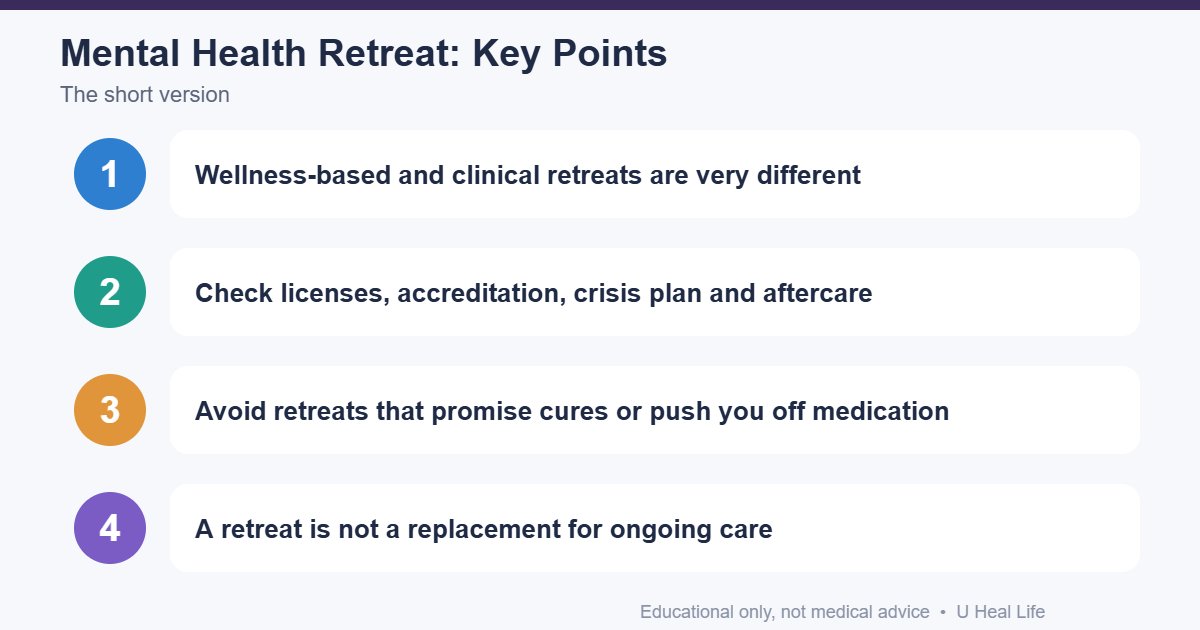
Mental health retreat key points: wellness versus clinical, check licenses and accreditation, watch for red flags, not a replacement for care
Key points at a glance.

What Is a Mental Health Retreat?

A mental health retreat is a short or longer stay that centers on stress, mood, relationships or emotional healing. The label is not regulated, so one retreat may offer yoga and journaling while another offers therapy with licensed clinicians. Knowing which type you are booking is the most important step.

Two Very Different Types

Wellness-based retreatClinical or residential program
Main goalRest, reflection, healthy habitsTreat a mental health condition
Who leadsCoaches, teachers, facilitatorsLicensed psychologists, therapists, psychiatrists
TherapyUsually none, or light group workIndividual and group therapy
Medication careNot providedOften available
AccreditationUsually noneOften CARF or Joint Commission
InsuranceRarely coveredSometimes covered

Retreats led by coaches or healers may have certificates, but that is not the same as being a licensed mental health provider.

What to Check Before You Book

  1. Licenses and training. Ask who leads the sessions and which licenses they hold. Check the state licensing board for clinicians.
  2. Accreditation. For clinical programs, look for The Joint Commission or CARF accreditation and a state license. The Anxiety and Depression Association of America (ADAA) also advises checking this before choosing a residential program.
  3. Crisis plan. Ask what happens if a guest has a mental health emergency.
  4. Medication rules. Ask how they handle your current medicines and whether a doctor is involved.
  5. Aftercare. Good programs help you plan what comes next.
  6. Clear costs and policies. Get prices and refund rules in writing.

Red Flags

  • Promises to cure depression, anxiety or trauma
  • Pressure to stop medication or leave therapy
  • Leaders with no clear training or licenses
  • Intense confrontation exercises with no safety plan
  • Vague answers about costs or what happens in a crisis

Does Insurance Cover Mental Health Retreats?

Wellness retreats are rarely covered. Clinical residential programs sometimes are, but only if they meet accreditation and medical necessity rules. Call your insurer first. Our mental health insurance coverage guide explains the basics.

Who Might Benefit?

A wellness-based retreat may help if you feel stressed, burned out or need a quiet reset. A clinical program may be right if symptoms are making daily life hard. If you are not sure, start by talking to a doctor or licensed therapist. Women looking at residential care can also read our guide on women’s trauma recovery and residential treatment.

Frequently Asked Questions About Mental Health Retreats

Is a mental health retreat the same as therapy?

No. Some include therapy, but many do not. Always ask who leads the sessions.

Can a retreat help with depression or anxiety?

Rest and support may help you feel better for a time, but retreats are not a cure. Ongoing care with a professional matters most.

How long do mental health retreats last?

From a weekend to several weeks. Clinical programs can run longer.

Should I stop my medication before a retreat?

No. Talk to your prescriber before making any change.

When should I get help right away?

If you are in crisis or thinking about harming yourself, call or text 988 in the US, or your local emergency number.

Helpful resource: To look for licensed treatment, you can use SAMHSA’s FindTreatment.gov, and for urgent help the 988 Suicide and Crisis Lifeline.

Disclaimer: This article is for general information only and is not medical or mental health advice. Prices, programs and availability change, so please check current details with each provider. If you are in crisis or thinking about harming yourself, call or text 988 (the Suicide & Crisis Lifeline in the US) or your local emergency number right away.
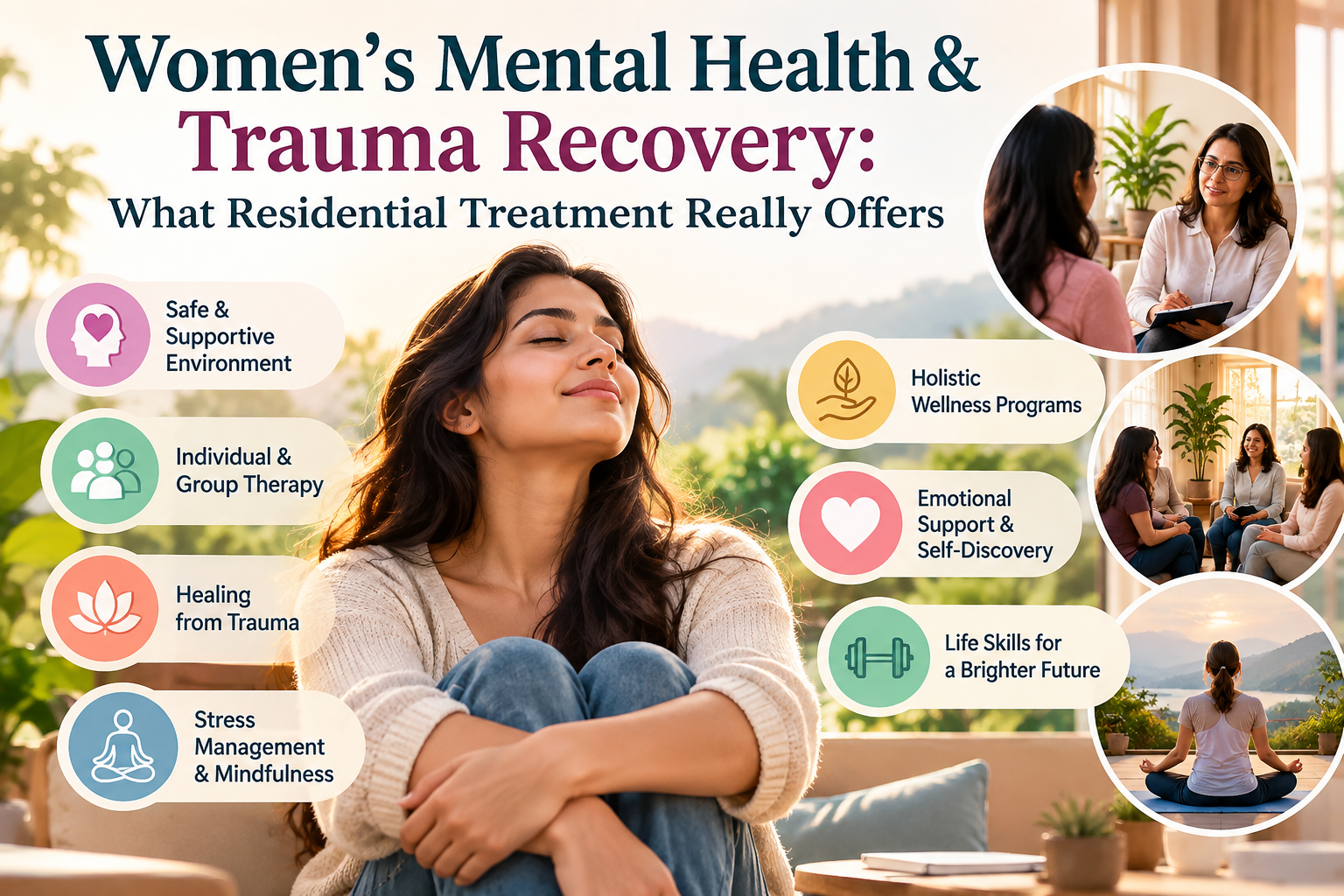
Graphic for women's mental health and trauma recovery in residential treatment
Women’s Mental Health & Trauma Recovery: What Residential Treatment Really Offers

For many women, the breaking point doesn’t arrive all at once. It builds quietly — through years of unprocessed trauma, chronic anxiety, burnout, or a slow slide into substance use as a way to cope. By the time someone starts searching for help, they’re often looking for more than a weekly therapy appointment. They’re looking for a place that can hold the whole picture: the mind, the body, and the life that needs rebuilding.

This is where women’s residential mental health and trauma treatment centers come in — programs like Villa Kali Ma in California, and others like it across the country, that offer immersive, live-in care specifically designed around how women experience trauma, addiction, and recovery differently than men do.

If you’re researching these programs for yourself or someone you love, here’s what to actually know before you choose one.

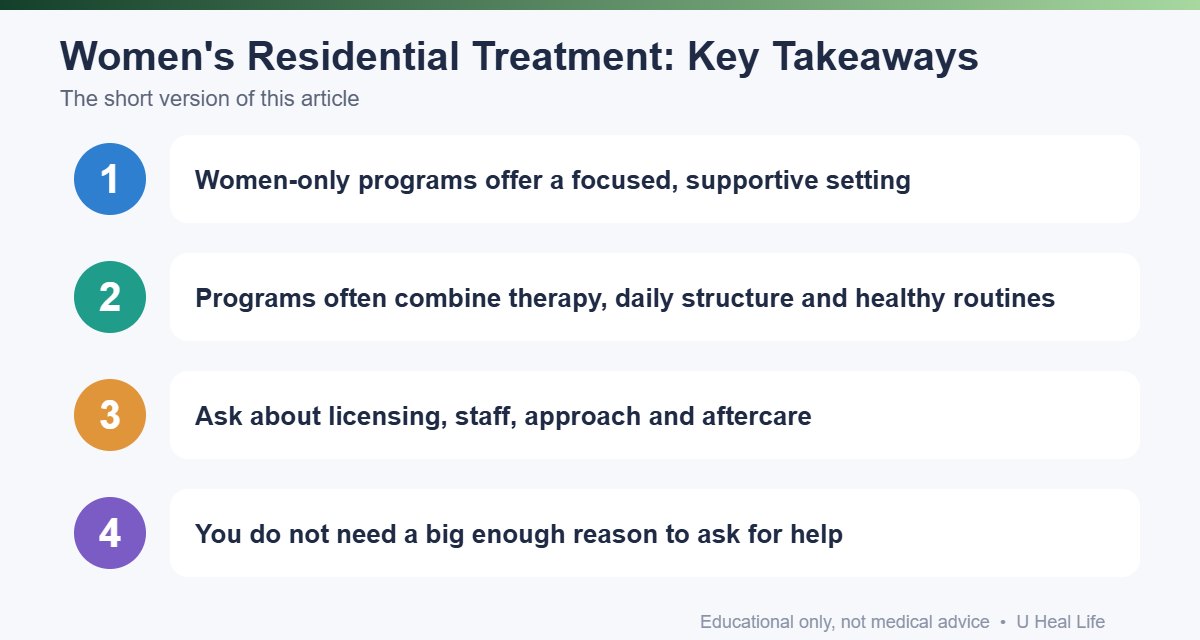
Quick answer: Residential mental health and trauma programs for women offer live-in care that usually combines therapy, daily structure and healthy routines in a supportive, women-only setting. Before choosing, ask about licensing, staff qualifications, treatment approach, aftercare, costs and insurance.

Key takeaways infographic: Women-only programs offer a focused, supportive setting; Programs often combine therapy, daily structure and healthy routines; Ask about licensing, staff, approach and aftercare; You do not need a big enough reason to ask for help
The key points at a glance.

Why Women-Only Treatment Programs Exist

Trauma doesn’t show up the same way for everyone. Research consistently shows that women are more likely to have experienced interpersonal trauma — abuse, assault, or complex relational wounds — and are more likely to develop co-occurring anxiety, depression, or eating patterns alongside substance use. Mixed-gender treatment settings can sometimes recreate the very dynamics — power imbalances, unsafe attention, difficulty being vulnerable — that contributed to the trauma in the first place.

Women-only residential programs are built to remove that barrier. The goal isn’t exclusion; it’s creating a setting where someone can actually let their guard down enough to do the deeper work.

What These Programs Typically Include

Most reputable women’s residential mental health and trauma centers combine several layers of care rather than relying on one method alone:

Small daily habits also support recovery. Try our 10-minute evening routine to reduce stress alongside professional care.

Clinical mental health treatment Licensed psychiatrists and therapists assess and treat co-occurring conditions — PTSD, anxiety, depression, and substance use disorders together, not in isolation. This is often called a “dual diagnosis” or “co-occurring disorders” approach, and it matters because treating addiction without treating the underlying trauma rarely holds long-term.

Somatic and body-based therapy Talk therapy alone often isn’t enough when trauma is stored in the nervous system, not just in memory. Many programs use somatic release work, nervous system regulation techniques, and body-based practices to help process trauma that words can’t fully reach.

Holistic and experiential practices Yoga, breathwork, art or movement therapy, and time in nature are common additions — not as a replacement for clinical care, but as a way to help the body reconnect with a sense of safety.

Structured community Living alongside other women going through similar struggles, in a home-like rather than clinical setting, is often cited by former residents as one of the most meaningful parts of recovery — the sense of not being the only one.

Aftercare and stepped-down support Good programs don’t end at discharge. They typically offer outpatient step-down options (like an Intensive Outpatient Program, or IOP) and connect residents to ongoing support groups so recovery doesn’t stop the moment treatment does.

Questions to Ask Before Choosing a Program

If you’re comparing options — whether it’s a well-known name like Villa Kali Ma or a smaller local program — these are the questions worth asking directly:

  • Is the facility licensed by the state’s Department of Health Care Services (or equivalent)? Ask for the license number.
  • Who is overseeing medical and psychiatric care — is there a licensed physician or psychiatrist on staff, not just counselors?
  • Does the program treat co-occurring conditions (trauma + addiction, or trauma + anxiety/depression) together, or only one at a time?
  • What does a typical day actually look like — how much is clinical therapy versus holistic/experiential work?
  • What insurance plans are accepted, and what happens if coverage runs out before treatment is complete?
  • What does aftercare look like once residential treatment ends?
  • Can you speak to the intake team before committing, and can family be involved in the process if appropriate?

A program that’s confident in its care will answer these clearly and without pressure tactics.

A Note on Cost and Insurance

Residential mental health and trauma treatment is a significant financial and time commitment — often 30 days or more, and not always fully covered by insurance. Many centers, including larger names in this space, work with major insurers (such as Health Net-affiliated plans) as in-network or out-of-network providers. Before enrolling anywhere, get a clear, written breakdown of what’s covered, what isn’t, and what the total out-of-pocket cost could look like.

For help understanding costs, see our mental health insurance coverage guide.

You Don’t Have to Have a “Big Enough” Reason

One of the most common things women say after starting treatment is that they waited too long because they didn’t think their pain was “bad enough” to deserve help. Trauma isn’t a competition, and burnout, chronic anxiety, and quiet substance dependence are just as valid reasons to seek residential-level care as a single dramatic crisis point.

If you’re not sure whether your situation calls for residential treatment versus outpatient therapy, that’s a conversation worth having with a licensed mental health professional rather than deciding alone.


This article is for general educational purposes and isn’t a substitute for professional medical or psychiatric advice. If you or someone you know is in immediate crisis, please contact a local emergency service or a crisis line such as the 988 Suicide & Crisis Lifeline (call or text 988 in the US).

https://www.uheallife.com/ SEO BLOG

Created by you

Frequently Asked Questions

What is residential trauma treatment?

It is a live-in program where you receive structured mental health care, usually including therapy and support, away from everyday triggers and stresses.

Why choose a women-only program?

Some women feel safer and more able to open up in a setting without men, especially after trauma. Programs may also focus on issues that affect women.

How long do programs last?

Length varies widely. Ask each program about typical stays, how they decide on length and what aftercare they provide.

Does insurance cover residential treatment?

Coverage depends on your plan and the program. Call your insurer and the program to ask about benefits, authorization and out-of-pocket costs.

How do I choose a program?

Check licensing, staff qualifications, the treatment approach, safety practices, family involvement and aftercare. Ask to speak with an admissions counselor and take your time.

What if I need help right now?

If you are in crisis or thinking about harming yourself, call or text 988 (the Suicide & Crisis Lifeline in the US) or your local emergency number right away.

Related Reading

Disclaimer: This article is for general information only and is not medical advice. If you are struggling with your mental health, please speak with a qualified healthcare professional. If you are in crisis or thinking about harming yourself, call or text 988 (the Suicide & Crisis Lifeline in the US) or your local emergency number right away.