Impact-Site-Verification: 65ebaf0c-2dbc-4200-9d50-11ea7af40e54

Warm sunset over hills with the text 10-Minute Evening Routine: reduce stress and unwind tonight
10-Minute Evening Routine to Reduce Stress

Short on time but full of stress? You do not need an hour of self-care. A simple 10-minute evening routine can help your body and mind slow down after a busy day.

You get home, but your mind is still at work. Your shoulders are tight, your thoughts are racing, and you are not sure how to relax. Sound familiar?

The good news is that small, repeatable habits work better than big, rare ones. This 10-minute routine is easy to follow, needs no equipment, and can be done on any night.

Quick answer: A 10-minute evening routine to reduce stress can include putting your phone away, slow breathing, gentle stretching, a short brain dump, and a few moments of gratitude. Do it at the same time each night so your body learns that it is time to wind down.
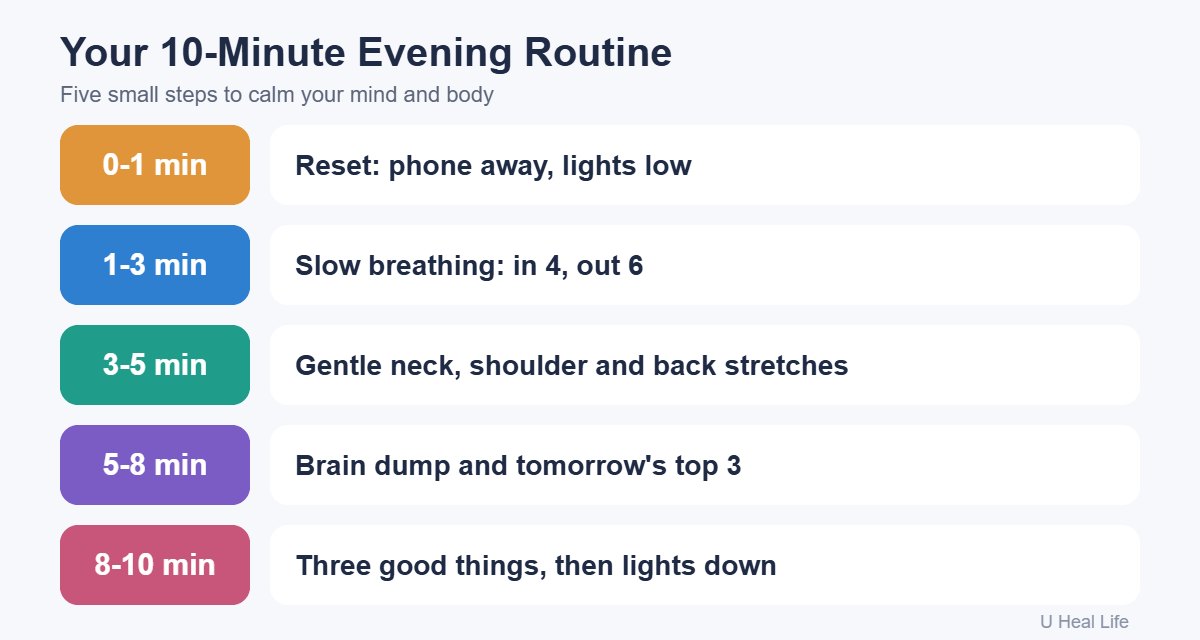
Timeline of a 10-minute evening routine: reset, slow breathing, gentle stretching, brain dump, and three good things
Your 10-minute evening routine at a glance.

Why Evenings Matter for Stress

During the day, your body stays alert to deal with tasks and problems. If you carry that tension into the night, it can be harder to relax and fall asleep. A short wind-down routine tells your body: “The day is done. You are safe now.”

It also helps you avoid the late-night spiral of worry. If you often lie awake thinking, read our guide on how to stop overthinking at night.

The 10-Minute Evening Routine, Step by Step

Minutes 0 to 1: Reset Your Space

Put your phone on silent and move it away from you. Dim the lights, close your laptop and take one deep breath. This small signal helps your brain switch from “work mode” to “rest mode.”

Minutes 1 to 3: Slow Breathing

Sit or lie down comfortably.

  1. Breathe in through your nose for 4 seconds.
  2. Breathe out slowly through your mouth for 6 seconds.
  3. Repeat for about 2 minutes.

A longer out-breath helps your body relax. For more quick calming tools, see how to calm your mind in 5 minutes.

Minutes 3 to 5: Gentle Stretching

Stress often sits in the neck, shoulders and back. Try:

  • Slow neck rolls from side to side
  • Shoulder rolls, forward and backward
  • Reaching your arms up, then folding forward
  • Child’s pose or a simple seated twist

Move slowly and stop if anything hurts.

Minutes 5 to 8: Brain Dump and Tomorrow’s Top 3

Take a notebook and spend a few minutes writing:

  • Anything that is worrying you
  • The three most important things you want to do tomorrow

Getting thoughts out of your head and onto paper helps your mind stop trying to hold on to them all night.

Minutes 8 to 10: Three Good Things

Write or think of three small things that went well today. They can be tiny: a warm meal, a kind message, a quiet moment. Then switch off the main lights. This ends your day with a calmer, kinder feeling.

The Routine at a Glance

TimeWhat to doWhy it helps
0-1 minPhone away, lights lowSignals that the day is over
1-3 minSlow breathingCalms your body
3-5 minGentle stretchingReleases muscle tension
5-8 minBrain dump and top 3Clears racing thoughts
8-10 minThree good thingsEnds the day on a positive note

Tips to Make It a Habit

  • Do it at the same time each night, such as right after dinner or 30 minutes before bed.
  • Link it to something you already do, like brushing your teeth.
  • Keep a notebook and pen where you will see them.
  • Start with just 5 minutes if 10 feels like too much.
  • Be kind to yourself. If you miss a night, just start again tomorrow.

No Time? Try the 5-Minute Version

Do 2 minutes of slow breathing, 2 minutes of brain dump, and 1 minute of gratitude. Even this short version can make a difference.

Want More Than 10 Minutes?

If you have extra time, add a warm shower, calming music, a few pages of a light book, or a cup of caffeine-free herbal tea. Our guide to calming down after a stressful day has 12 more ideas, and our simple mindfulness exercises for busy people are easy to add.

What to Avoid in the Evening

  • Scrolling through news or social media right before bed
  • Heavy meals and caffeine late in the day
  • Working on your laptop in bed
  • Replaying the day’s problems in your head

When to Get Extra Help

A routine can reduce everyday stress, but it is not a cure for every problem. Please talk to a doctor or mental health professional if you:

  • Feel stressed or anxious most days
  • Cannot sleep for many nights in a row
  • Feel hopeless or very low
  • Notice that stress is affecting your health, work or relationships

If you are unsure why you feel anxious, read why you might feel anxious for no reason. Looking after your brain every day also matters, so see daily habits that support long-term brain health.

Frequently Asked Questions

Can 10 minutes really reduce stress?

Many people feel calmer after even a few minutes of slow breathing and stretching. Doing it regularly helps the effect build over time.

What is the best time to do an evening routine?

Right after dinner or about 30 to 60 minutes before bed works for most people. Choose a time you can keep.

Do I need to do every step?

No. Pick the steps you enjoy and build from there.

What if I am too tired to do a routine?

Try the 5-minute version, or just do the breathing step lying down in bed.

Will this help me sleep better?

A calm routine may make it easier to fall asleep, but it is not a treatment for sleep disorders. See a doctor if sleep problems continue.

Final Thoughts

You do not need a perfect routine. Ten quiet minutes each evening can help your mind let go of the day. Start tonight with just one step and build from there.

Disclaimer: This article is for general information only and is not medical advice. If you are struggling with stress or your mental health, please speak with a qualified healthcare professional.
Related Reading

Blue graphic with the text How to Calm Your Mind in 5 Minutes: 12 quick, science-backed techniques
How to Calm Your Mind in 5 Minutes: 12 Science-Backed Techniques

Racing thoughts, a tight chest, and a mind that won’t switch off are something almost everyone experiences at some point. The good news is that you don’t need an hour of meditation or a weekend retreat to feel calmer. Many simple techniques can help settle your nervous system in about five minutes or less.

Below are 12 practical, research-informed ways to calm your mind. Try a few and keep the ones that work best for you.

Quick answer: To calm your mind in 5 minutes, slow your breathing (try box breathing or a longer exhale), ground yourself with the 5-4-3-2-1 exercise, take a short walk, or write your thoughts down. Pick one or two techniques and practice them for 2 to 5 minutes.

1. Box Breathing

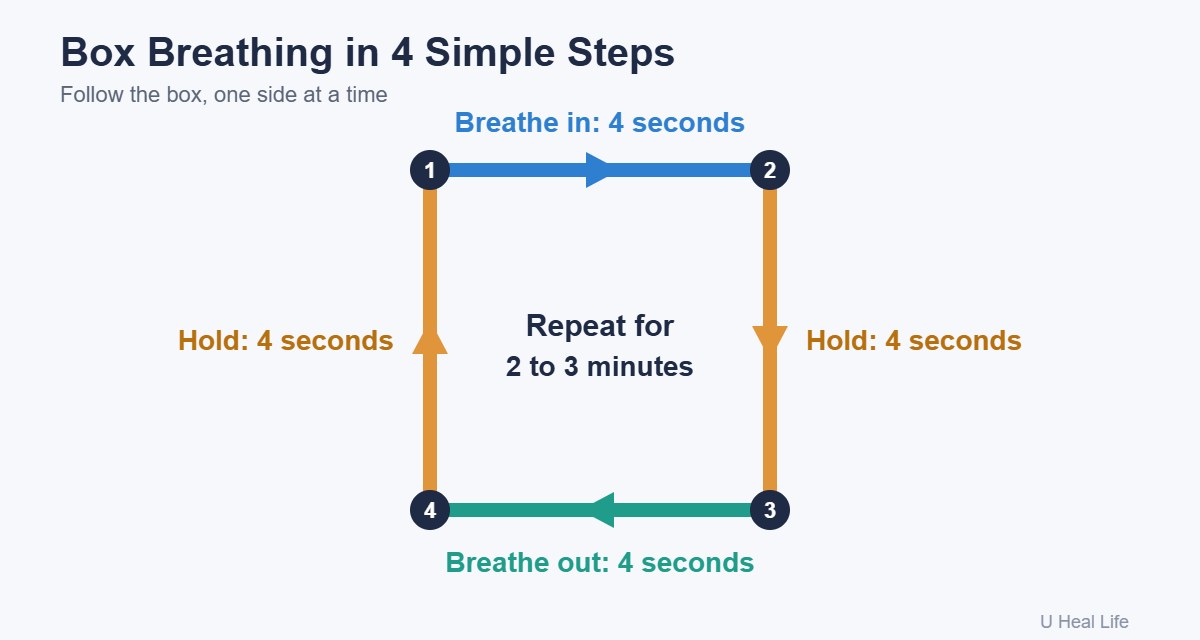
Breathe in for four seconds, hold for four, breathe out for four, and hold for four. Repeat for two to three minutes. The steady rhythm gives your mind something simple to focus on and can slow your heart rate.

Diagram of box breathing: breathe in for 4 seconds, hold for 4, breathe out for 4, hold for 4, and repeat for 2 to 3 minutes
Box breathing: four equal steps, repeated for two to three minutes.

2. Extend Your Exhale

Breathe in through your nose for a count of four, then out slowly for a count of six to eight. Longer exhales are commonly used to help activate the body’s relaxation response.

3. The Physiological Sigh

Take a deep breath in through your nose, add a second short inhale on top of it, then let out a long, slow breath through your mouth. A 2023 Stanford-led study found that a few minutes a day of this kind of “cyclic sighing” improved mood and reduced breathing rate over time.

4. The 5-4-3-2-1 Grounding Exercise

Look around and name five things you can see, four you can touch, three you can hear, two you can smell, and one you can taste. This pulls your attention out of anxious thoughts and back into the present moment.

5. Splash Cold Water on Your Face

Cold water on your face or wrists can briefly slow your heart rate and interrupt a spiral of stress. It’s quick, free, and works almost anywhere.

6. Progressive Muscle Relaxation

Starting with your feet and moving upward, tense each muscle group for five seconds, then release. Noticing the contrast between tension and relaxation helps your body let go of stress it may be holding without you realizing it.

7. Do a Quick Brain Dump

Grab a pen and write down everything that’s on your mind for three to five minutes without editing. Getting worries out of your head and onto paper can make them feel more manageable and less overwhelming.

8. Take a Short Walk

Even five minutes of walking, especially outdoors, can lift your mood and clear mental clutter. If you can, leave your phone behind or keep it in your pocket.

9. Try a One-Minute Mindfulness Check-In

Close your eyes and focus on the sounds around you, or on the feeling of your feet on the floor. When your mind wanders, gently bring it back. You don’t have to empty your mind; you just practice noticing where it is.

10. Listen to Slow, Calming Music

Slow-tempo music without lyrics can help lower tension and make it easier to breathe more slowly. Keep a short calming playlist ready for stressful moments.

11. Name the Emotion

Silently say, “I’m feeling anxious” or “I’m feeling overwhelmed.” Putting a label on what you feel, sometimes called affect labeling, has been linked in research to reduced emotional intensity.

12. Reach Out to Someone

A quick call or message to a friend or family member can remind you that you’re not alone. You don’t have to talk about the problem; sometimes just hearing a familiar voice is enough to settle you.

Make Calm a Daily Habit

These techniques work best when you practice them regularly, not only when you’re overwhelmed. Try pairing a breathing exercise with something you already do each day, such as brushing your teeth or making your morning coffee. Small, consistent habits can make it easier to stay calm when stress spikes. If constant scrolling is adding to your stress, our guide to social media anxiety offers more ideas.

When It’s More Than Everyday Stress

If racing thoughts, panic attacks, or constant worry are interfering with your sleep, work, or relationships, it’s worth talking with a doctor or a licensed mental health professional. Our guides to mental health insurance coverage and online therapy costs can help you figure out your options. If you ever have thoughts of harming yourself, call or text 988 (the Suicide & Crisis Lifeline in the US) or contact local emergency services right away.

Frequently Asked Questions

How can I calm my mind in 5 minutes?

Choose one simple technique and practice it for 2 to 5 minutes. Slow breathing (such as box breathing or a longer exhale), the 5-4-3-2-1 grounding exercise, or a short walk are easy places to start.

What is the fastest way to calm a racing mind?

Many people find that slowing their breathing is one of the quickest ways to settle. Try breathing in for 4 seconds and out for 6 to 8 seconds. If your thoughts are still racing, writing them down in a quick brain dump can help.

Does box breathing really work?

Many people find box breathing helpful for feeling calmer because it gives the mind a simple rhythm to follow. It is a helpful tool for everyday stress, but it is not a treatment for anxiety disorders or other medical conditions.

What is the 5-4-3-2-1 technique?

It is a grounding exercise that brings your attention to the present moment. You notice 5 things you can see, 4 you can touch, 3 you can hear, 2 you can smell, and 1 you can taste.

How do I stop overthinking?

Try writing your thoughts down, slowing your breathing, and giving your mind a calm routine. Our guide on how to stop overthinking at night has more simple steps.

When should I talk to a professional?

If worry, panic, or racing thoughts happen often or interfere with your sleep, work, or relationships, it is a good idea to speak with a doctor or licensed mental health professional.

Related Reading

This article is for general educational purposes and is not a substitute for professional medical or mental health advice.

Graphic for 8 signs you need a mental health day and how to take one
8 Signs You Need a Mental Health Day (and How to Take One)

Most of us don’t think twice about calling in sick when we have a fever or a migraine. But when what’s worn down is your mind rather than your body, it’s much easier to push through, tell yourself it’s “not that bad,” and keep going until something gives.

A mental health day is a planned break from work, school, or daily obligations so you can rest, reset, and look after your emotional well-being. It isn’t a cure for anxiety, depression, or chronic burnout, but it can interrupt a downward spiral before it gets worse. Here are eight signs it may be time to take one.

Quick answer: You may need a mental health day if you feel exhausted even after sleep, get irritated easily, cannot focus, dread everyday responsibilities, feel physically tense, or no longer enjoy things. A day to rest can help you reset, but if these signs last for weeks, please talk to a professional.

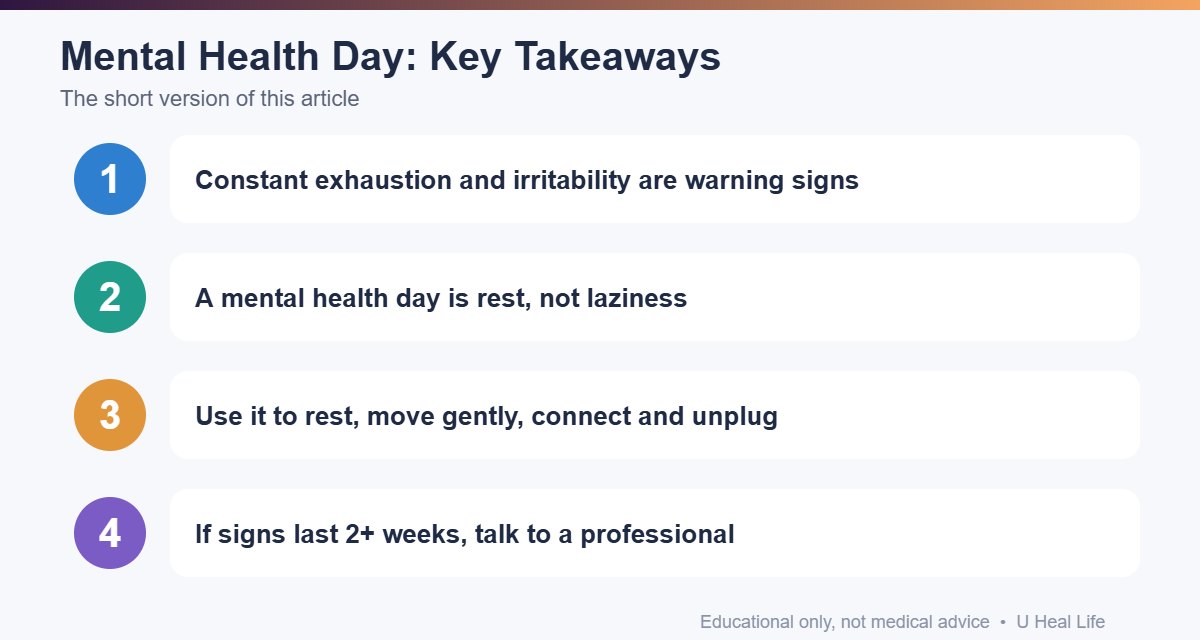
Key takeaways infographic: Constant exhaustion and irritability are warning signs; A mental health day is rest, not laziness; Use it to rest, move gently, connect and unplug; If signs last 2+ weeks, talk to a professional
The key points at a glance.

1. You’re Exhausted Even After Sleeping

Fatigue that doesn’t improve with a full night’s rest is one of the most common signals of mental overload. When stress stays high for weeks, your body stays in a state of alert, and sleep stops feeling restorative.

2. Small Things Set You Off

If a slow driver, a noisy coworker, or an unanswered text suddenly feels unbearable, your stress tolerance may be running on empty. Irritability is often the first thing others notice before we notice it ourselves.

3. You Can’t Concentrate

Reading the same email three times, forgetting simple tasks, or staring at a screen without taking anything in are signs your brain is overloaded. Chronic stress can interfere with attention and memory, which is why “brain fog” and burnout often go hand in hand.

4. You Dread Work or Everyday Responsibilities

Everyone has bad Mondays. But if dread about work, school, or home life shows up most days, or starts creeping in on the weekend, it’s worth paying attention to.

5. Your Body Is Sending Signals

Stress doesn’t stay in the mind. Frequent headaches, stomach trouble, tight shoulders, a clenched jaw, changes in appetite, and getting sick more often can all be physical signs that you’re running on too little rest and too much pressure.

6. Things You Usually Enjoy Feel Flat

When hobbies, favorite shows, or time with friends stop feeling enjoyable, your mind may be asking for a break. Losing interest in things you normally like is also a symptom commonly linked with depression, so keep an eye on how long it lasts.

7. You’re Pulling Away From People

Canceling plans, ignoring messages, or avoiding conversations because you simply have no energy left is a classic sign of emotional overload. A day to rest can help you show up for the people you care about with more to give.

8. You’re Leaning on Coping Crutches

More caffeine to get going, more alcohol to wind down, endless scrolling to avoid thinking, or comfort eating to get through the day can all be signs you’re coping rather than recovering. If you notice the pattern, it’s a good moment to pause.

What a Good Mental Health Day Looks Like

A mental health day works best when it’s genuinely restful, not just a day off spent catching up on chores or doom-scrolling. A few ideas:

Want a gentle way to unwind in the evening too? Try our 10-minute evening routine to reduce stress or these 12 ways to calm down after a stressful day.

  • Disconnect on purpose. Mute work email and chat notifications for the day.
  • Let yourself rest. Sleep in if you can, or take a nap without guilt.
  • Move gently. A walk outside, light stretching, or yoga can lower tension without draining you.
  • Do something restorative. Cook a meal you enjoy, read, draw, listen to music, or spend time in nature.
  • Connect with someone safe. A short call with a friend or family member can lift your mood more than staying isolated.
  • Name what’s weighing on you. Write down what’s been draining you, then pick one small thing you can change this week.

How to Ask for a Mental Health Day

Policies vary by employer and by state, so check your company handbook or HR guidelines. Many workplaces allow sick leave to be used for mental health reasons, and in most cases you don’t have to share details. A simple message such as “I’m not feeling well and need to take a sick day” is usually enough.

When One Day Off Isn’t Enough

A mental health day is a short-term reset, not a long-term solution. If you’ve felt this way most days for two weeks or longer, or if your sleep, appetite, work, or relationships are being affected, it’s a good idea to talk with your doctor or a licensed mental health professional. If you’re not sure how to afford care, our guide to mental health insurance coverage and our breakdown of online therapy costs can help you plan next steps. You may also find our article on social media anxiety useful if constant scrolling is adding to your stress.

If you often feel anxious without a clear reason, read why you might feel anxious for no reason, and build small habits with our simple mindfulness exercises.

If you ever have thoughts of harming yourself, call or text 988 (the Suicide & Crisis Lifeline in the US) or contact your local emergency services right away.

Frequently Asked Questions

What is a mental health day?

It is a day you take off to rest and recover from stress, burnout or emotional overload, in the same way you would take a sick day for physical illness.

How do I know if I need one?

Common signs include constant tiredness, irritability, trouble focusing, dread about work, physical tension and losing interest in things you enjoy.

What should I do on a mental health day?

Rest, spend time outside, move gently, eat well, limit screens and do something that calms you. Avoid filling the day with chores or work.

How often can I take a mental health day?

There is no fixed number. If you need them very often, that is a sign to look at your workload, sleep and stress, and to talk with a professional.

Is a mental health day the same as a sick day?

Many workplaces treat them the same, but policies differ. Check your company policy before you ask.

When should I get professional help?

If you have felt this way most days for two weeks or longer, or if sleep, appetite, work or relationships are affected, speak with a doctor or licensed mental health professional.

Related Reading

This article is for general educational purposes and is not a substitute for professional medical or mental health advice.