Impact-Site-Verification: 65ebaf0c-2dbc-4200-9d50-11ea7af40e54

Yoga retreat vs wellness retreat: people practicing yoga outdoors at a retreat
Yoga Retreat vs Wellness Retreat: What Is the Difference?

Both yoga retreats and wellness retreats promise rest and a reset, so it is easy to mix them up. The main difference is focus. This guide explains yoga retreat vs wellness retreat in simple words, with a comparison table, typical costs and tips for choosing.

By the U Heal Life editorial team. Last updated: October 2026. This is general information, not medical advice.

Quick answer: A yoga retreat centers on yoga practice, with daily classes and often meditation and teacher-led talks. A wellness retreat is broader: it may include yoga, but also healthy meals, workshops, spa time, nature activities and free time. Both can suit beginners. Check the daily schedule, the teachers’ training and what is included in the price.
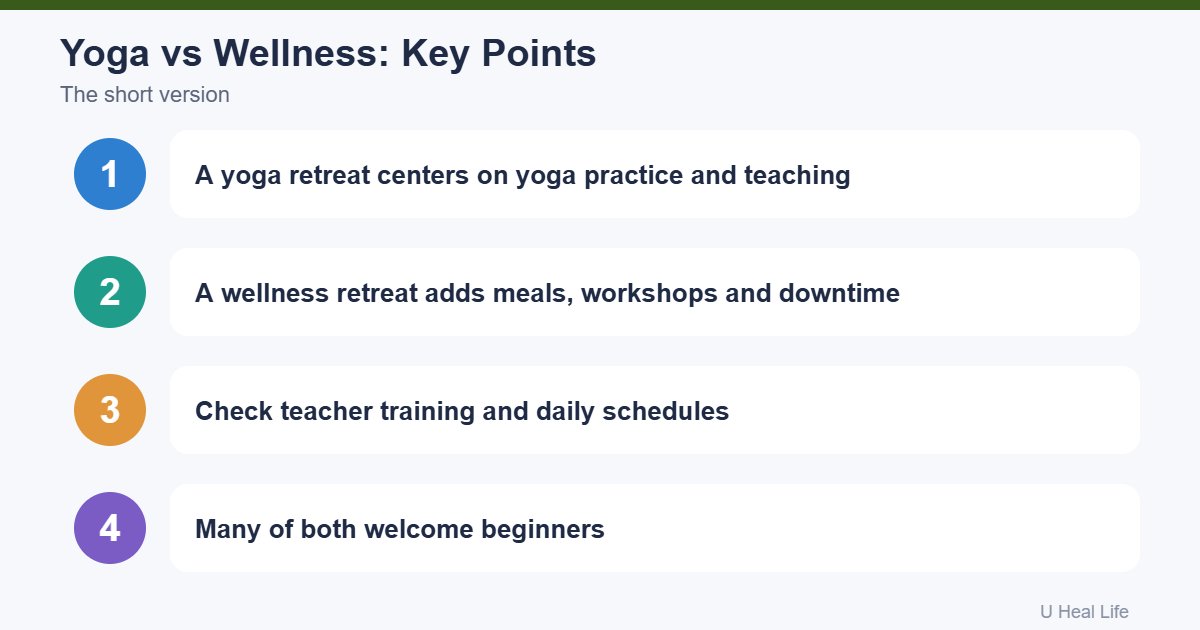
Yoga retreat vs wellness retreat key points: yoga focus vs broader wellness, check teacher training, compare costs, beginners are welcome
Key points at a glance.

What Is a Yoga Retreat?

A yoga retreat is built around yoga. You usually practice once or twice a day, and the rest of the day may include meditation, breathing practice, simple meals and talks. Some focus on a style, such as gentle or restorative yoga. Look for teachers trained through recognized programs, such as those listed with Yoga Alliance.

What Is a Wellness Retreat?

A wellness retreat is a planned stay that supports rest and healthy habits. It may include yoga or movement, but also nutrition talks, mindfulness, nature walks, creative workshops or spa treatments. To learn more, read what is a wellness retreat.

Yoga Retreat vs Wellness Retreat: Comparison

Yoga retreatWellness retreat
Main focusYoga practiceOverall wellbeing
Daily scheduleYoga classes, meditation, talksMovement, workshops, meals, spa or nature time
Best forPeople who want to deepen or start a yoga practicePeople who want rest and a mix of activities
LeadersYoga teachersCoaches, teachers and other facilitators
Typical stayWeekend to a week or moreWeekend to a week or more
FoodOften simple, vegetarian or plant-basedVaries, often healthy and balanced

How Much Do They Cost?

Prices vary by place, length and room type. Travel guides report simple yoga or wellness weekends from about $150 to $600 and typical weeks from about $500 to $1,800, with luxury resorts costing more. Read how much a wellness retreat costs for a fuller breakdown.

How to Choose

  1. Decide your goal: do you want to learn yoga, or simply rest?
  2. Check your level: look for “all levels” or “beginner-friendly” classes
  3. Read the daily schedule: see how packed it is
  4. Check who leads it: training and experience matter
  5. See what is included: meals, classes, transfers and extras
  6. Read recent reviews from several sources

If you are new, a short stay is a gentle start. See our solo wellness retreat guide for beginners.

Safety Tips

  • Tell the teacher about injuries or health conditions
  • Move at your own level, and do not push into pain
  • Talk to your doctor first if you have a health condition or are pregnant
  • A retreat does not replace medical or mental health care

Frequently Asked Questions About Yoga and Wellness Retreats

Is a yoga retreat the same as a wellness retreat?

Not exactly. A yoga retreat focuses on yoga, while a wellness retreat covers more activities.

Do I need to be flexible for a yoga retreat?

No. Many classes suit all levels, and teachers can offer easier options.

Which is better for beginners?

Either can be, if it says it welcomes beginners and the schedule is not too intense.

Which costs more?

It depends on the place and what is included, not only the type.

Can a retreat replace therapy?

No. Retreats can help you rest, but only licensed professionals provide therapy. See wellness retreat vs spa vs mental health retreat.

Helpful resource: To check yoga teacher training standards, see Yoga Alliance.

Disclaimer: This article is for general information only and is not medical or mental health advice. Prices, programs and availability change, so please check current details with each provider. If you are in crisis or thinking about harming yourself, call or text 988 (the Suicide and Crisis Lifeline in the US) or your local emergency number right away.

Wellness retreats in Arizona: desert resort spas in Tucson, Carefree and Sedona
Best Wellness Retreats in Arizona: Where to Look and What to Know (2026)

Arizona is known for desert scenery and a long history of destination spas. If you are looking for wellness retreats in Arizona, the choices range from famous all-inclusive resorts to smaller boutique stays. This guide is a planning guide, not a ranking: it explains where to look, what travel guides say about well-known resorts, what to check before you book and when to go.

By the U Heal Life editorial team. Last updated: October 2026. This is general information, not medical advice.

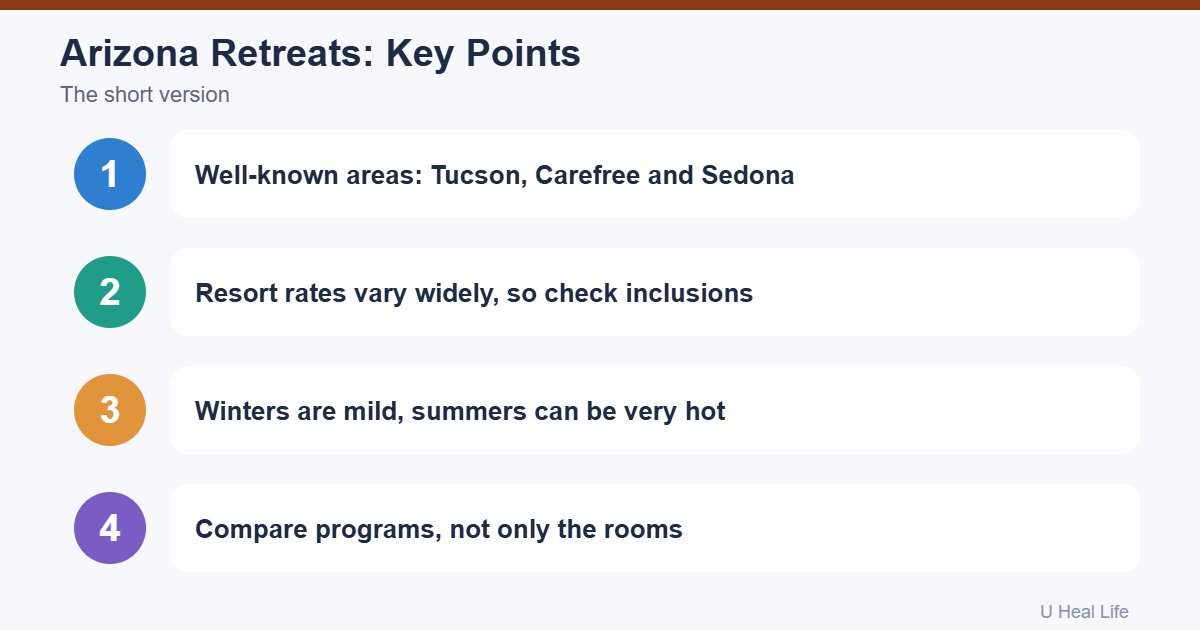
Quick answer: Well-known wellness destinations in Arizona include Canyon Ranch and Miraval in the Tucson area, CIVANA Wellness Resort and Spa in Carefree, and spa resorts in Sedona. Travel guides report all-inclusive rates of about $1,000 or more per night at the biggest names, with some other resorts priced lower. Winters are mild and summers are very hot. Prices and programs change, so confirm current details with each resort.

Wellness retreats in Arizona key points: Tucson, Carefree and Sedona, rates vary, summer is hot, check what is included
Key points at a glance.

Why Arizona for a Wellness Trip?

The Sonoran Desert, mountain views and clear skies make Arizona a popular place to slow down. Resorts there offer movement classes, hiking, spa treatments, healthy food and workshops. Winter can still be mild when other regions are cold, which makes it popular from late fall to spring.

Well-Known Places to Look

Travel guides and the resorts’ own websites commonly mention these:

PlaceAreaWhat guides say
Canyon RanchTucsonA long-running wellness resort (founded in 1979) with a structured, health-focused program and many specialists
Miraval ArizonaTucson areaAn all-inclusive wellness resort in the foothills, often described as more focused on mindful and emotional wellbeing
CIVANA Wellness Resort and SpaCarefreeKnown for a thermal aquatherapy circuit and wellness programs, and described in older reports as priced below the biggest names
Enchantment Resort and spaSedonaA resort in Boynton Canyon with access to red rock trails
Castle Hot SpringsMorristownA desert resort known for hot springs and stargazing

Do not rely on a single article. Check each resort’s current programs, dates and rates yourself.

What Do They Cost?

Rates vary by season, room and package. Travel guides report all-inclusive wellness resorts in the Tucson area starting around $1,000 per night, while some resorts such as CIVANA have been reported at lower rates. Our luxury wellness retreats in the USA guide explains what is included and what usually costs extra. For wider budgets, see how much a wellness retreat costs.

Best Time to Go

  • Late fall to spring: mild weather and the busiest season, so book early
  • Summer: very hot, but resorts may have lower rates and indoor programs

Checklist Before You Book

  1. What is included in the nightly rate?
  2. Are spa treatments extra, and are resort fees or tips added?
  3. Who leads the classes and what is their training?
  4. How big is the group, and how busy is it likely to be?
  5. What is the cancellation and weather policy?
  6. Does the program suit your fitness level?

Arizona vs Other States

If you want a beach, Florida may fit better. See best wellness retreats in Florida. If you want desert quiet and dry weather, Arizona is a strong option.

Frequently Asked Questions About Wellness Retreats in Arizona

What is the best area in Arizona for a wellness retreat?

It depends on what you want. Tucson has large destination resorts, Carefree has a more affordable-feeling spa resort scene, and Sedona is known for red rock scenery.

How much does a wellness retreat in Arizona cost?

Rates vary a lot. The best-known all-inclusive resorts report about $1,000 or more per night, and other places charge less.

When is the best time to visit?

Late fall to spring is mild. Summer is very hot.

Can I go alone?

Yes. See our solo wellness retreat guide for beginners.

Will insurance cover it?

Usually not for wellness retreats.

Helpful resource: For official travel information, see Visit Arizona.

Disclaimer: This article is for general information only and is not medical or mental health advice. Prices, programs and availability change, so please check current details with each provider. If you are in crisis or thinking about harming yourself, call or text 988 (the Suicide and Crisis Lifeline in the US) or your local emergency number right away.
Weekend wellness retreat: yoga and rest at a calm retreat center
Weekend Wellness Retreat: What It Includes and How Much It Costs

You do not need a week off to feel the benefit of a wellness getaway. A weekend wellness retreat is a short, simple way to rest, move gently and step away from daily routines. This guide explains what a weekend retreat includes, what it may cost and how to choose and plan one.

By the U Heal Life editorial team. Last updated: October 2026. This is general information, not medical advice.

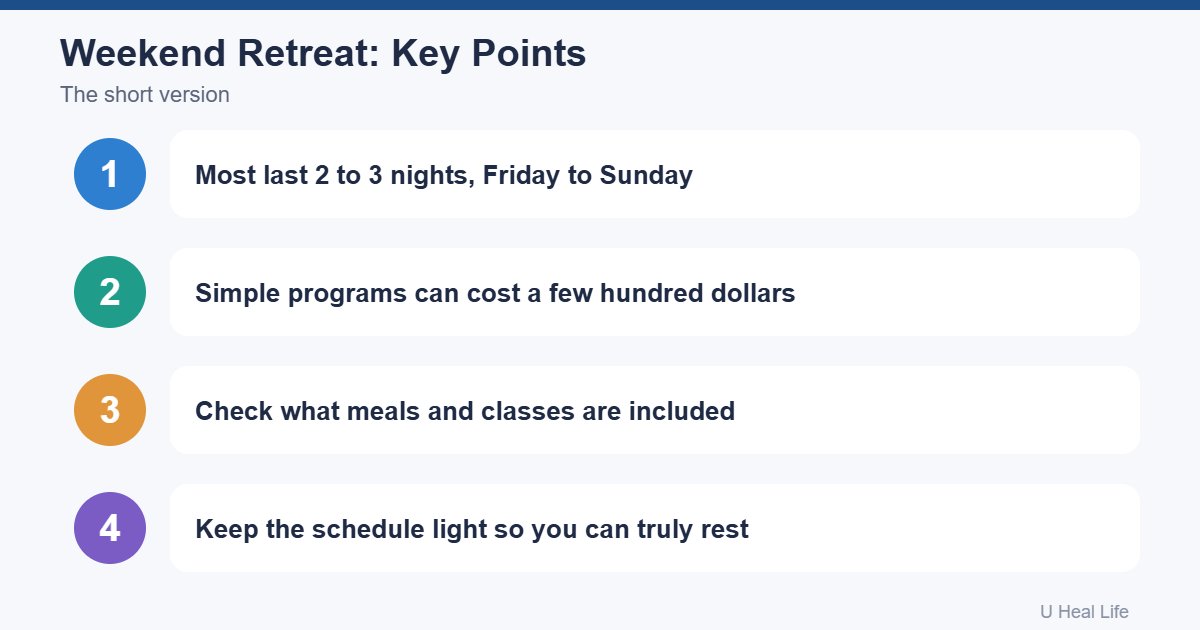
Quick answer: A weekend wellness retreat usually lasts 2 to 3 nights and includes simple activities such as yoga or gentle movement, meditation, healthy meals and free time. Travel guides report simple weekend stays from about $150 to $600, while luxury resorts cost much more. Check what is included, read recent reviews and keep your schedule light. A weekend retreat can help you rest, but it is not medical treatment.

Weekend wellness retreat key points: 2 to 3 nights, simple programs cost less, check inclusions, keep the schedule light
Key points at a glance.

What a Weekend Retreat Usually Includes

  • Friday evening: arrival, a welcome talk and a light dinner
  • Saturday: morning movement or yoga, meditation, healthy meals, a workshop and free time
  • Sunday: a gentle morning session, a closing circle and checkout

Some programs add nature walks, journaling, sound baths or spa time. Others, like silent retreats, keep quiet for most of the stay.

How Much Does It Cost?

Prices depend on location, room type and what is included. Travel guides report simple wellness or yoga weekends from about $150 to $600, while some established centers charge roughly $300 to $450 per night with meals and classes included. Luxury resorts can cost many times more. You can find more detail in how much a wellness retreat costs.

How to Choose a Weekend Retreat

QuestionWhy it matters
What is the focus?Rest, yoga, nature and silence feel very different
What is included?Meals, classes and treatments may or may not be in the price
How far is it?A short drive saves time and money
Is it beginner-friendly?Look for all-level classes
What are the rules?Phones, food and alcohol rules vary

Tips to Plan Your Weekend

  1. Book a place within a few hours of home
  2. Travel the day before if you can, so you arrive relaxed
  3. Choose one or two activities, not all of them
  4. Pack comfortable clothes using our packing checklist
  5. Leave your next day free, so you are not rushing back to work

Not Ready to Travel? Try a Home Weekend

You can borrow the same ideas at home: switch off notifications, take a long walk, cook a simple meal, stretch, and follow a gentle routine such as our 10-minute evening routine to reduce stress.

Frequently Asked Questions About Weekend Wellness Retreats

How long is a weekend wellness retreat?

Most are 2 to 3 nights, from Friday evening to Sunday afternoon.

Is a weekend enough to feel rested?

It can help you slow down, but results differ. Many people continue small habits at home afterward.

How much does a weekend wellness retreat cost?

Simple programs can start around a few hundred dollars. Luxury stays cost more. Always check what is included.

Do I need experience with yoga or meditation?

Usually not. Look for programs that say they welcome beginners.

Can a weekend retreat help with anxiety or depression?

A retreat can help you relax, but it is not treatment. If you struggle with your mental health, please talk to a licensed professional.

Helpful resource: For general wellness travel research, see the Global Wellness Institute.

Disclaimer: This article is for general information only and is not medical or mental health advice. Prices, programs and availability change, so please check current details with each provider. If you are in crisis or thinking about harming yourself, call or text 988 (the Suicide and Crisis Lifeline in the US) or your local emergency number right away.
Wellness retreats for couples: a couple relaxing together at a calm retreat
Wellness Retreats for Couples: Types, Costs and What to Look For

A couples getaway focused on wellbeing can be a great way to slow down together. But “couples retreat” can mean very different things, from a spa weekend to a structured relationship workshop. This guide explains the main types of wellness retreats for couples, what they may cost and what to check before you book.

By the U Heal Life editorial team. Last updated: October 2026. This is general information, not medical advice.

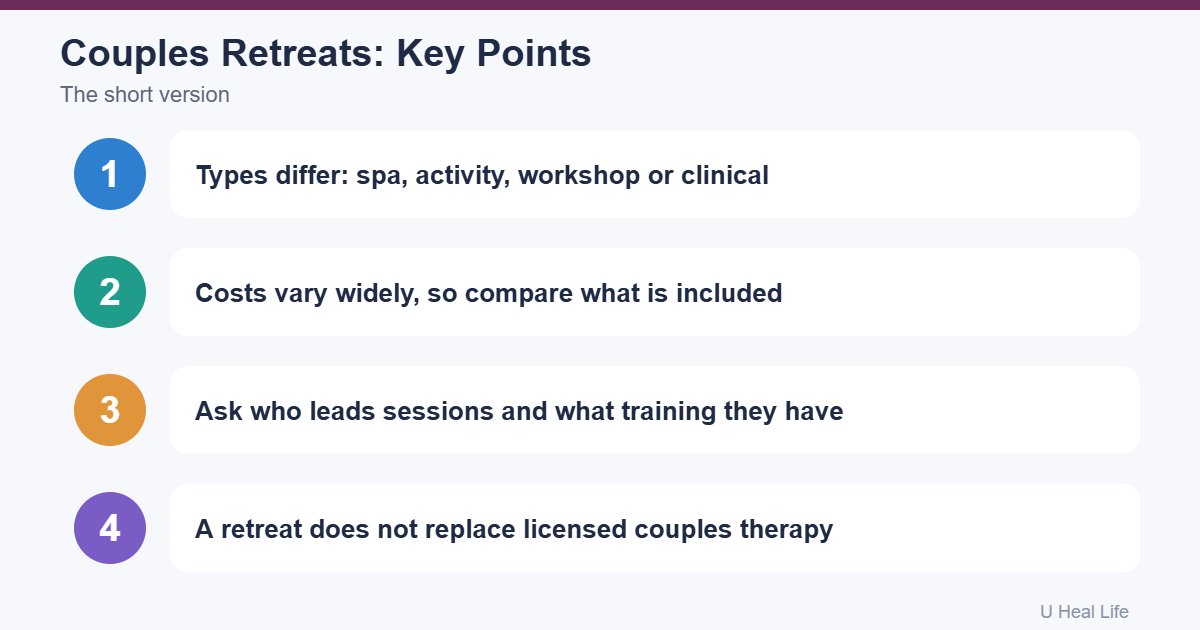
Quick answer: Wellness retreats for couples include spa and wellness stays, activity-based trips, relationship workshops and, in some cases, programs led by licensed professionals. Costs vary widely, from a few hundred dollars for a simple weekend to several thousand dollars per couple for luxury stays, according to travel guides. Ask who leads the sessions, what is included and whether the program is wellness-focused or therapy-focused. A retreat does not replace couples therapy.

Wellness retreats for couples key points: types differ, costs vary widely, ask who leads, not a replacement for couples therapy
Key points at a glance.

Types of Couples Retreats

TypeWhat it focuses onGood for
Wellness or spa stayYoga, meditation, healthy meals, spa treatmentsRest and time together
Activity retreatHiking, cooking classes, natureCouples who like to be active
Relationship workshopGuided exercises and talks on communicationCouples who want learning and structure
Clinical or therapy retreatSessions led by licensed therapistsCouples who want professional support

Only programs led by licensed professionals offer therapy. Our guide to wellness retreat vs spa vs mental health retreat explains the difference.

How Much Do They Cost?

Costs depend on location, length and what is included. Some travel features describe luxury couples retreats at roughly $1,000 to $5,000 per couple per day, while simpler wellness weekends cost much less. All-inclusive resorts such as those in our luxury wellness retreats guide list rates per person per night. Always compare:

  • What is included (meals, classes, treatments, transfers)
  • Extra fees (spa treatments, taxes, resort fees, tips)
  • Cancellation and change rules

For general price ranges, read how much a wellness retreat costs.

What to Look For Before You Book

  1. A clear goal: rest, fun, learning or support
  2. Who leads the sessions: check training, especially for relationship or emotional topics
  3. Group size: small groups can feel more private
  4. Privacy: ask how much time is just for the two of you
  5. Reviews: read several recent reviews from different sources
  6. Fit for both: pick something you will both enjoy, not only one of you

Tips for a Good Experience

  • Agree on what you each hope to get from the trip before you go
  • Leave room for rest, and do not overbook your days
  • Keep phones away during activities
  • Pick one habit to continue at home, like a weekly walk or a no-phone dinner
  • Be kind if one of you needs quiet time

When a Retreat Is Not Enough

If you are facing serious conflict, hurt, health concerns or safety concerns, a retreat is not the right tool. A licensed couples therapist can offer ongoing support. If you or your partner feel unsafe, contact local emergency services or a local support line right away.

Frequently Asked Questions: Wellness Retreats For Couples

What is a couples wellness retreat?

It is a planned stay for two with wellness activities such as yoga, meditation, healthy meals and spa treatments, sometimes with workshops on communication.

How much does a couples retreat cost?

It ranges from a few hundred dollars for a simple weekend to several thousand dollars for luxury stays. Check what is included.

Is a couples retreat the same as couples therapy?

No. Therapy is led by a licensed professional over time. A retreat is a short experience, and only some programs include professional-led sessions.

How long should we stay?

A weekend of 2 to 3 nights is a good first try.

What if only one of us wants to go?

Talk it through, or pick something lighter like a spa day or a nature weekend first.

Helpful resource: For wellness travel research, see the Global Wellness Institute.

Disclaimer: This article is for general information only and is not medical or mental health advice. Prices, programs and availability change, so please check current details with each provider. If you are in crisis or thinking about harming yourself, call or text 988 (the Suicide and Crisis Lifeline in the US) or your local emergency number right away.

Solo wellness retreat for beginners: a woman resting and reading in a calm retreat setting
Solo Wellness Retreat for Beginners: What to Expect and How to Choose

Going on a wellness retreat alone can feel exciting and a little scary at the same time. The good news is that many guests travel solo, and most retreats welcome beginners. This guide explains what a solo wellness retreat for beginners looks like, how long to stay, what it may cost and how to choose a program that fits you.

By the U Heal Life editorial team. Last updated: October 2026. This is general information, not medical advice.

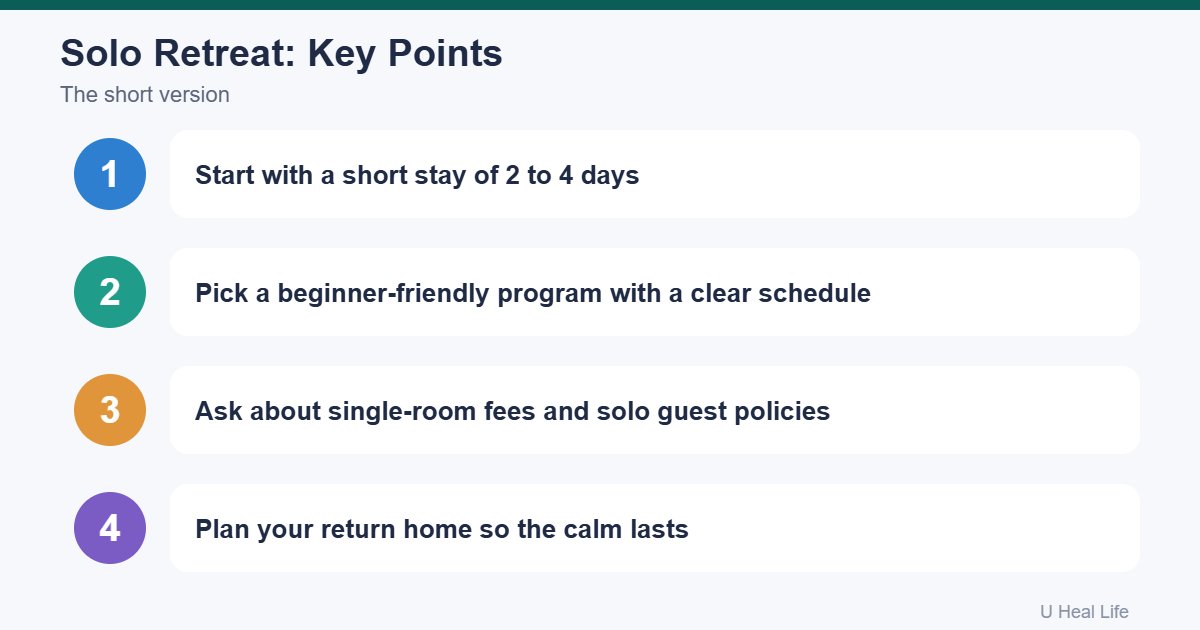
Quick answer: A solo wellness retreat is a planned stay with a daily program of movement, mindfulness, healthy meals and rest. For a first time, choose a short stay of 2 to 4 days, a beginner-friendly program with a clear schedule, and a place that welcomes solo guests. Ask about single-room fees, phone rules and cancellation before you book. A retreat can help you rest, but it is not medical treatment or therapy.

Solo wellness retreat for beginners key points: start short, pick a beginner program, ask about solo rooms, plan your return
Key points at a glance.

Why Go on a Retreat Alone?

Going solo gives you full control of your time. You can join group classes when you want company and rest when you need quiet. You do not have to plan around anyone else, and many people find it easier to switch off from daily life when they are on their own.

What to Expect at a Solo Retreat

  • A simple daily rhythm: yoga or gentle movement, meditation, healthy meals, workshops and free time
  • A mix of group time and downtime: you can usually choose how social to be
  • Different places to stay: from resort rooms to simple eco-lodges or shared rooms
  • Different rules: some retreats limit phones, alcohol or outside food, so read the guidelines

If you want a deeper quiet stay, read what is a silent retreat first.

How to Choose Your First Solo Retreat

QuestionWhy it matters
How long is it?Short stays of 2 to 4 days feel easier for beginners
Is it beginner-friendly?Check that classes suit all levels
Who leads the program?Look at teacher training and experience
Is there a single-room option?Some places charge extra for a private room
How big is the group?Smaller groups feel more personal
What are the cancellation rules?Plans change, so know the policy

How Much Does a Solo Retreat Cost?

Prices vary a lot. Travel guides report simple yoga or wellness stays from about $150 to $600 for a short trip, about $500 to $1,800 for a typical week, and $700 or more per night at luxury resorts. Solo guests may pay a single-room supplement, so ask. Our guide to how much a wellness retreat costs breaks this down.

Staying Safe as a Solo Traveler

  1. Share your plans and the retreat’s contact details with someone you trust
  2. Read reviews from several sources, not only the retreat’s own website
  3. Check how to reach staff in an emergency
  4. Tell the organizer about health needs or medicines
  5. Do not stop any medicine or treatment to attend a retreat

Tips to Get the Most From It

  • Set one simple intention, such as rest, quiet or a new routine
  • Do not overbook your days. Leave space for doing nothing
  • Pack light and check our retreat packing list
  • Write a few notes about what felt good so you can repeat it at home
  • Plan a calm first day back, with no big meetings or travel the same day

Frequently Asked Questions: Solo Wellness Retreat For Beginners

Is it okay to go to a wellness retreat alone?

Yes. Many guests go alone, and retreats are used to welcoming solo travelers.

How long should my first solo retreat be?

A short stay of 2 to 4 days is a gentle start. You can try a longer one later.

Will I have to talk to other people?

Usually not if you do not want to. You can join group activities or keep to yourself, but check the rules at silent or digital-detox retreats.

Is a solo retreat safe?

Most are, but do your homework: read recent reviews, confirm contact details and share your plans with someone.

Can a retreat replace therapy?

No. A retreat can help you rest and build habits, but it does not replace care from a licensed professional. See wellness retreat vs mental health retreat.

Helpful resource: For research and trends in wellness travel, see the Global Wellness Institute.

Disclaimer: This article is for general information only and is not medical or mental health advice. Prices, programs and availability change, so please check current details with each provider. If you are in crisis or thinking about harming yourself, call or text 988 (the Suicide and Crisis Lifeline in the US) or your local emergency number right away.
Silent retreat in Greece and Europe: Vipassana courses, monasteries and yoga retreats
Silent Retreats in Europe, Including Greece: Types, Costs and How to Choose

Europe has many places to practice silence, from mountain meditation centers to monasteries and island yoga retreats. Interest in a silent retreat in Greece is growing too, but the choices there are smaller and less marketed than in places like Bali or India. This guide explains the main types of silent retreats in Europe, what to expect in Greece, how to choose one and what to check before you book.

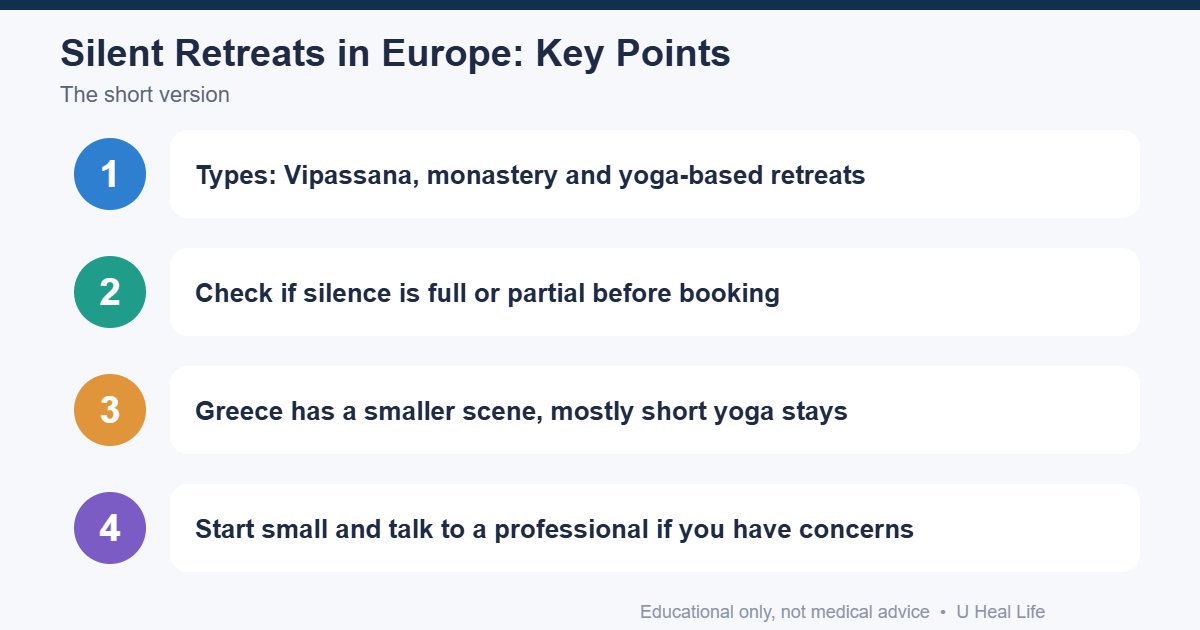
Quick answer: Silent retreats in Europe range from strict 10-day Vipassana courses (donation-based) to Buddhist monastery retreats and gentler yoga-based programs with partial silence. Greece has a smaller scene, mostly short yoga and meditation retreats. Always confirm whether the silence is full or partial, check current dates and prices, and talk to a professional first if you have a mental health condition.

Silent retreat in Greece and Europe key points: full versus partial silence, Vipassana is donation-based, Greece scene is small, check rules
Key points at a glance.

Types of Silent Retreats in Europe

1. Vipassana 10-day courses

Vipassana centers across Europe run the same style of 10-day course as elsewhere. Students observe noble silence for the first nine full days, meditate for about ten hours a day and give up phones, reading and writing. Courses are donation-based. For example, a Swiss guide describes Dhamma Sumeru, a center in Switzerland. See our guide on what is a silent retreat for the full rules.

2. Buddhist monastery retreats

Monasteries such as Plum Village in France run retreats where guests practice mindfulness and silence with monks and nuns. Programs have set dates and themes, so check each schedule and any registration rules.

3. Yoga and meditation retreats with partial silence

Many private retreats in Greece, Spain, Portugal, Italy and other countries keep silence only during certain hours, with yoga, breathwork and group sharing at other times. These are gentler for beginners.

Silent Retreats in Greece

A Greek travel planner notes that Greece’s silent retreat scene is smaller than Bali’s and less marketed than India’s, but serious. Programs range from structured 7-day Vipassana-style courses to short yoga stays on islands. Retreat booking sites list programs in places like Icaria and the Peloponnese, and a Greek travel writer once described a silence retreat at the Noosfera Centre near Xylokastro in the Peloponnese mountains.

Be careful with the word “silent.” The same guide points out that some Greek retreats do not use noble silence at all and allow speech between guests. Always read the schedule.

How to Choose a Silent Retreat in Europe

QuestionWhy it matters
Is silence full or partial?Full silence is much harder for beginners
How long is it?Start with 2 to 5 days if you are new
Who leads it?Check training and teaching tradition
What are the rules?Phones, books and writing may be banned
What does it cost?Vipassana is donation-based, private retreats charge a price
How do I get there?Remote centers may need extra travel time

Costs

Costs vary a lot. Vipassana centers are donation-based. Private retreats list prices that range from modest to several hundred euros for a few days, and listings change often, so confirm current prices and dates with the organizer. For a broader view, see how much a wellness retreat costs.

Safety and Health Tips

  • Talk to your doctor or therapist first if you have a history of trauma, severe anxiety, depression or other conditions
  • Tell the organizer about health needs and medicines
  • Do not stop medication to attend
  • Start small before booking 10 days

Practical Travel Tips

  1. Book early for popular dates
  2. Check visa and travel rules for your country before you fly
  3. Read the cancellation policy
  4. Pack for the season and the center’s rules, using our packing checklist

Frequently Asked Questions About Silent Retreats in Europe

Is there a silent retreat in Greece?

Yes, there are silent and quiet retreats in Greece, mostly short yoga and meditation programs. The scene is smaller than in some other countries, so check each program’s rules.

Are silent retreats in Europe cheaper than in the USA?

It varies. Vipassana centers are donation-based everywhere. Private retreats can cost less or more depending on country and season.

Do I need experience to join?

Not always, but starting with a short retreat is wise.

Can I talk at a silent retreat?

It depends. Strict courses ask for full silence. Others allow talking at set times.

Is a silent retreat safe for everyone?

Not necessarily. Please talk to a professional first if you have a mental health condition.

Helpful resource: For monastery retreats, see Plum Village, and for Vipassana courses see dhamma.org.

Retreat dates and prices change often. We have no paid relationship with any retreat mentioned.

Disclaimer: This article is for general information only and is not medical or mental health advice. Prices, programs and availability change, so please check current details with each provider. If you are in crisis or thinking about harming yourself, call or text 988 (the Suicide & Crisis Lifeline in the US) or your local emergency number right away.
What to pack for a wellness retreat: simple checklist for a silent or wellness stay
What to Pack for a Silent or Wellness Retreat: Simple Checklist

Packing for a retreat is different from packing for a normal trip. You need comfortable clothes, a few simple tools for rest, and a plan for what to leave behind. This guide gives you a clear checklist for a wellness retreat or silent retreat, plus things you may be asked not to bring.

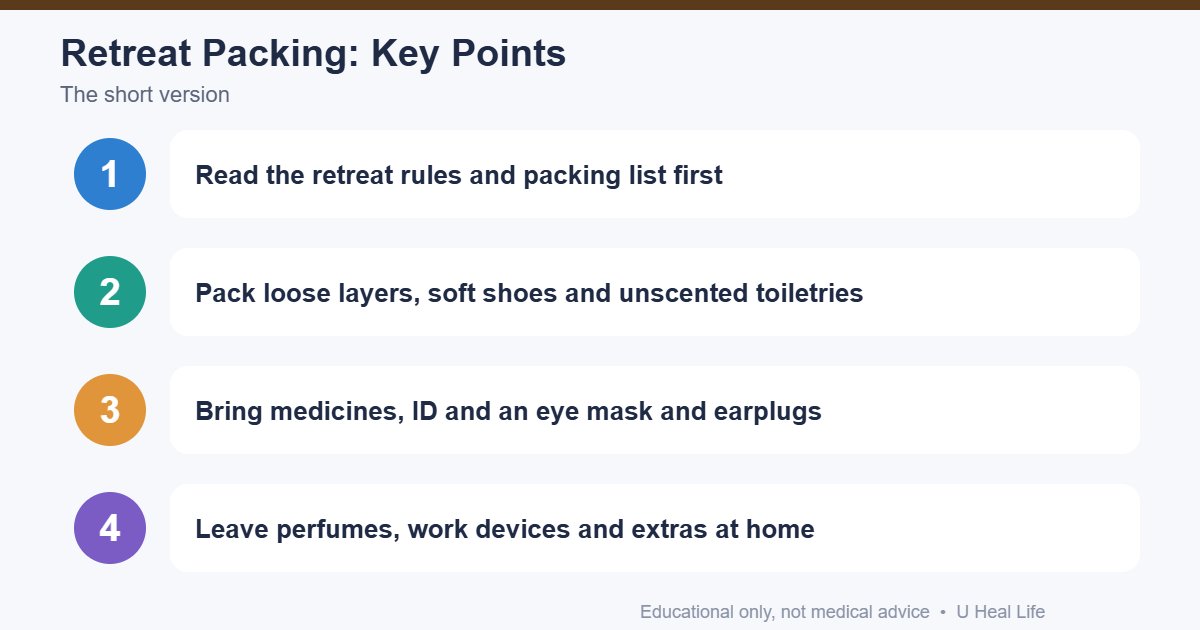
Quick answer: For a wellness or silent retreat, pack loose comfortable layers, soft shoes, basic toiletries, a water bottle, any medicines, an eye mask and earplugs. Check the retreat’s rules first: some silent retreats do not allow phones, books, writing or exercise gear, and many ask for unscented products.

What to pack for a wellness retreat key points: read the rules, loose layers, unscented toiletries, leave extras at home
Key points at a glance.

First, Read the Retreat’s Packing List and Rules

Every retreat is different. Before you pack, read the “what to bring” page and the code of conduct. Strict silent courses, such as 10-day Vipassana retreats, ask students to give up phones, reading and writing, so check what is allowed. When in doubt, email the organizer.

What to Pack: Checklist

Clothing

  • Loose, comfortable clothes you can move and sit in
  • Layers for morning and evening (a sweater or shawl)
  • Modest clothing if the center asks for it
  • Comfortable socks and slip-on shoes (you may remove shoes often)
  • Walking shoes if there are hikes
  • Swimwear if the retreat has a pool, sea or hot springs

Rest and Comfort

  • Eye mask and earplugs
  • Small pillow or cushion if you want extra comfort
  • Light blanket or scarf
  • Reusable water bottle

Toiletries and Health

  • Basic toiletries, preferably unscented (many retreats ask for this)
  • Any prescribed medicines in original packaging
  • Sunscreen, lip balm and hand cream
  • Basic first-aid items and any personal health items

Documents and Money

  • ID, booking confirmation and travel insurance details
  • Some cash for tips or small purchases
  • Emergency contact details written on paper

Optional

  • Journal and pen (only if allowed)
  • A mat or yoga towel (many retreats provide mats)
  • Reusable bag and a small flashlight for evening walks

What to Leave at Home

ItemWhy
Strong perfumesMany retreats ask for scent-free products
Work laptopHelps you really switch off
Books and notebooks (for strict silent retreats)Some courses do not allow reading or writing
Valuables and lots of jewelryYou do not need them
Heavy snacks or outside foodSome centers have food rules

What About Your Phone?

Rules vary. Some retreats ask you to hand in your phone for the whole stay. Others allow it in your room. Tell family and work in advance that you will be offline, and share the retreat’s contact number for emergencies. If you struggle to unplug, our 10-minute evening routine to reduce stress can help you practice at home first.

Before You Go

  1. Practice 10 to 20 minutes of daily meditation. Try our simple mindfulness exercises.
  2. Sleep well in the week before you travel
  3. Tell the organizer about health needs and allergies
  4. Plan how you will get home calmly
  5. Read what is a silent retreat if this is your first time

Frequently Asked Questions About What to Pack for a Wellness Retreat

Should I bring a yoga mat?

Many retreats provide mats. Check the packing list.

Can I bring my phone to a silent retreat?

Often not. Strict courses ask students to give up phones. Always check.

What should I wear?

Loose, comfortable, modest layers that are easy to move in.

Do I need to bring food?

Usually not. Meals are normally included, and outside food may not be allowed.

What if I forget something?

Most retreats can help with basics, but ask before you go.

Helpful resource: Strict silent courses publish their rules, for example on dhamma.org.

Disclaimer: This article is for general information only and is not medical or mental health advice. Prices, programs and availability change, so please check current details with each provider. If you are in crisis or thinking about harming yourself, call or text 988 (the Suicide & Crisis Lifeline in the US) or your local emergency number right away.
How much does a wellness retreat cost: price ranges from budget to luxury
How Much Does a Wellness Retreat Cost? Price Ranges and What Is Included (2026)

How much does a wellness retreat cost? The honest answer is that it depends a lot on length, location, room type and what is included. A simple weekend can cost a few hundred dollars, while a week at a luxury resort can cost many thousands. This guide breaks down the main costs, what is included, what costs extra and how to save money.

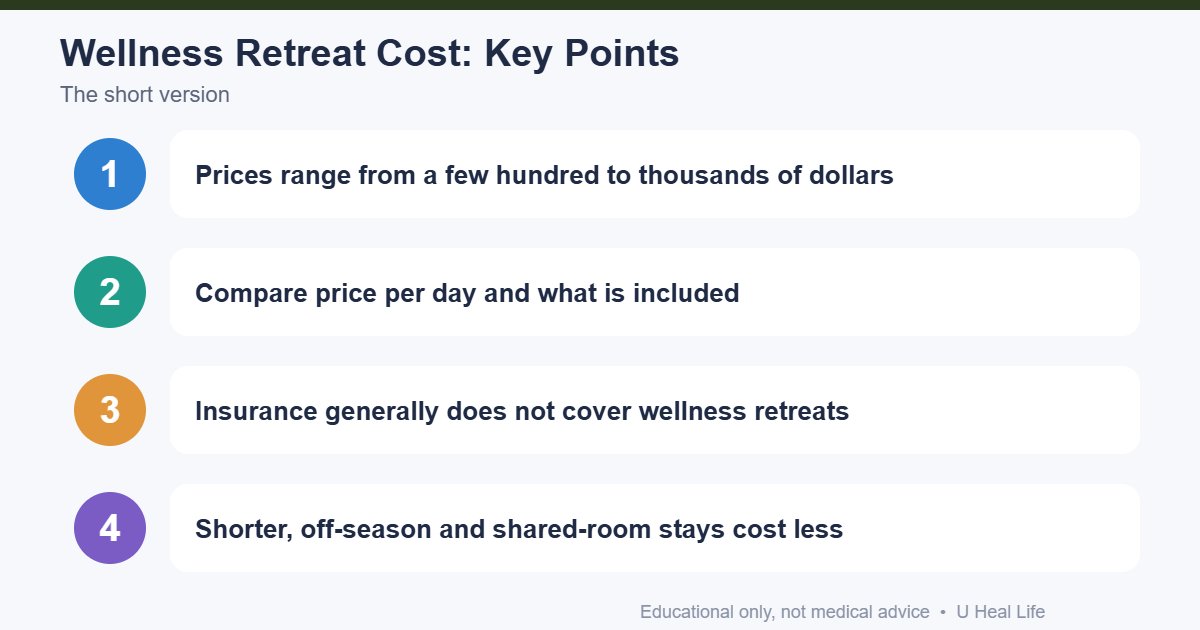
Quick answer: Wellness retreat prices range widely. Travel guides report simple yoga or wellness retreats from about $150 to $500 for a short stay, around $500 to $1,800 for a typical week, and luxury resorts from about $700 to more than $1,500 per person per night. Health insurance generally does not pay for wellness retreats. Prices change, so check current rates.

Wellness retreat cost key points: prices vary widely, check what is included, insurance usually does not pay, ways to save
Key points at a glance.

Wellness Retreat Cost: Typical Price Ranges

Type of retreatReported price rangeNotes
Simple yoga or wellness weekendFrom about $150 to $600Often shared rooms
Typical week-long retreatAround $500 to $1,800One 2026 cost guide’s average
Budget centers in the US (like Kripalu)Roughly $150 to $450 per nightIncludes meals and classes, per travel guides
Luxury resort retreatsAbout $700 to $1,500+ per nightCanyon Ranch lists from about $950 per night
Top-end programsAround $10,000 for 7 nightsSmall groups, high service
Vipassana silent coursesDonation-basedYou may give a donation after the course

These numbers come from travel guides and the providers themselves and are only a rough guide.

What Affects the Price?

  • Length of stay: compare the price per day, not just the total
  • Group size: small groups cost more per person but give more attention
  • Room type: shared rooms cost less than private rooms
  • Staff: doctors, nutritionists or well-known teachers raise the price
  • Location: resort towns and islands often cost more
  • What is included: meals, classes, transfers, spa treatments

What Is Usually Included?

Lodging, meals, the daily program (movement, meditation, talks), some activities and sometimes airport transfers.

What Often Costs Extra?

  • Spa treatments and massages
  • Private coaching or health consultations
  • Taxes, resort fees and tips
  • Flights and local transport
  • Optional excursions

Always ask for a written list of what is and is not included.

Does Insurance Pay for a Wellness Retreat?

Health insurance generally does not pay for wellness retreats. Some clinical mental health programs may be covered, but those are different. See mental health retreat: how to choose and our insurance coverage guide. Ask your plan if an HSA or FSA can be used.

How to Save Money

  1. Choose a shorter or off-season stay
  2. Pick a shared room
  3. Look at retreat centers and non-profit programs, not only resorts
  4. Book early and compare packages
  5. Skip optional add-ons you will not use
  6. Check cancellation rules, and consider travel insurance

Is It Worth the Cost?

A retreat is worth it if it matches your goal and you keep a few new habits afterward. If you only want rest, a simple, low-cost retreat or even a quiet staycation can help. Start by reading what is a wellness retreat.

Frequently Asked Questions About Wellness Retreat Cost

What is the average cost of a wellness retreat?

One 2026 guide puts a typical week between $500 and $1,800, but prices vary widely.

Are wellness retreats worth the money?

They can be, if you choose one that fits your goals and use what you learn afterward.

Why are some retreats so expensive?

Small groups, high-end rooms, expert staff and all-inclusive service raise the price.

Is a silent retreat cheaper?

Some, like Vipassana courses, are donation-based. Others at private centers charge normal prices. See what is a silent retreat.

Can I use an HSA for a wellness retreat?

Ask your plan administrator. Rules vary.

Helpful resource: For an example of a donation-based program, see dhamma.org, and for luxury rates, check a resort such as Canyon Ranch.

Disclaimer: This article is for general information only and is not medical or mental health advice. Prices, programs and availability change, so please check current details with each provider. If you are in crisis or thinking about harming yourself, call or text 988 (the Suicide & Crisis Lifeline in the US) or your local emergency number right away.

Wellness retreat vs mental health retreat vs spa vacation comparison table
Wellness Retreat vs Spa Vacation vs Mental Health Retreat: What Is the Difference?

A spa weekend, a wellness retreat and a mental health retreat can sound alike, but they are very different. Choosing the wrong one can waste money, or leave you without the care you need. This guide compares them side by side in simple words.

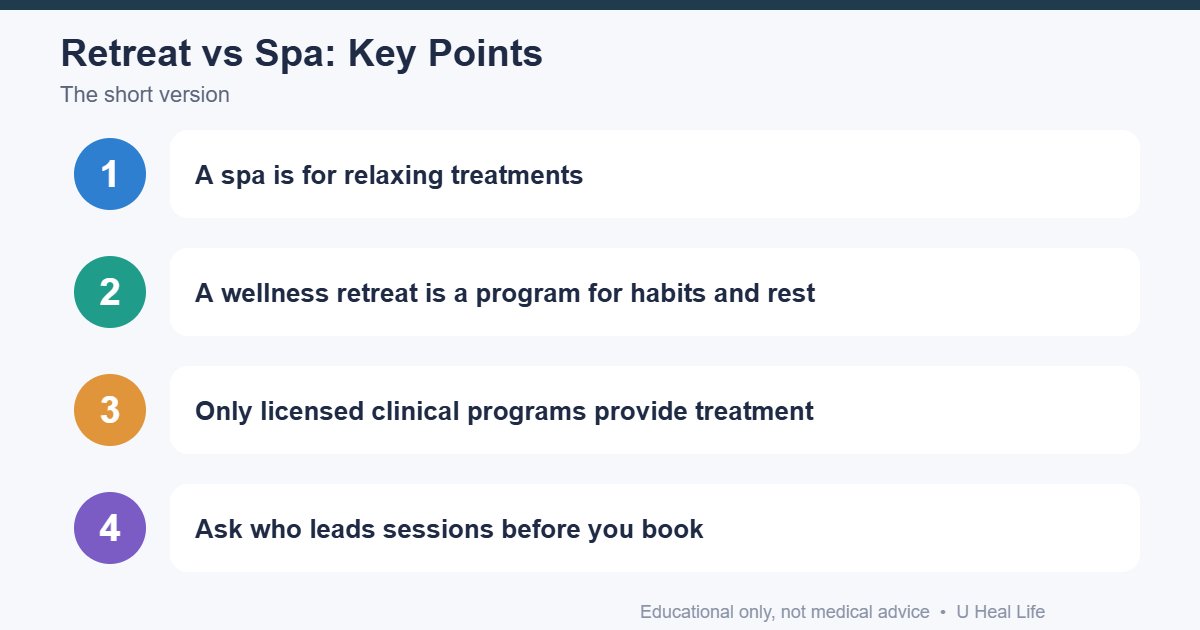
Quick answer: A spa vacation is for relaxing treatments, a wellness retreat is a planned program for healthy habits and rest, and a mental health retreat focuses on emotional wellbeing, either with wellness-style support or with licensed clinicians. Only clinical programs led by licensed professionals provide mental health treatment.

Wellness retreat vs mental health retreat key points: spa for relaxation, wellness retreat for habits, clinical programs for treatment
Key points at a glance.

Wellness Retreat vs Spa vs Mental Health Retreat: Quick Comparison

Spa vacationWellness retreatMental health retreat
Main goalRelaxation and treatmentsHealthy habits, rest, reflectionEmotional wellbeing or treatment
Typical activitiesMassage, facials, poolsYoga, meditation, meals, workshopsTherapy, group work, coping skills
Who leadsSpa therapistsCoaches, teachers, facilitatorsLicensed clinicians (clinical programs)
Medical or clinical careNoRarelyYes, in clinical programs
Length1 to 3 days3 to 7+ daysDays to weeks, or longer
CostPay per treatment or packageOften all-inclusiveVaries widely
InsuranceNoUsually noSometimes, for clinical programs
Best forRest and pamperingA reset and new routinesSupport for stress, mood or trauma

What Is a Spa Vacation?

A spa vacation focuses on treatments such as massage, facials and thermal pools. There is usually no set program. It can help you relax, but it is not designed to build long-term habits. See Florida wellness retreats for resort examples.

What Is a Wellness Retreat?

A wellness retreat is a planned stay with a daily program of movement, mindfulness, healthy meals and talks. It is not medical treatment. Learn more in what is a wellness retreat.

What Is a Mental Health Retreat?

A mental health retreat focuses on emotional wellbeing. Some are wellness-style stays with workshops. Others are clinical programs run by licensed psychologists, therapists or psychiatrists. Always ask who leads sessions. Read how to choose a mental health retreat.

Which One Should You Choose?

  • I am tired and need to relax: a spa vacation or short wellness retreat
  • I want to build healthy routines: a wellness retreat
  • I feel anxious, low or overwhelmed most days: talk to a doctor or licensed therapist first, then consider a clinical program or retreat they support
  • I want deep quiet and reflection: a silent retreat, after reading what is a silent retreat

Common Mistakes

  1. Choosing a wellness retreat when you need treatment
  2. Assuming a “mental health” label means licensed care
  3. Stopping medicine or therapy to “try a retreat”
  4. Not checking what is included before paying

Frequently Asked Questions About Wellness Retreat vs Mental Health Retreat

Can a wellness retreat replace therapy?

No. It can support your wellbeing but does not replace professional care.

Is a mental health retreat the same as rehab?

Not always. Clinical programs may treat mental health or substance use conditions. Wellness-style retreats are not treatment.

Which one is most expensive?

It depends. Luxury spas and retreats can be very expensive, and clinical residential care can also cost a lot.

Can I combine them?

Some people go on a wellness retreat while continuing therapy. Talk to your therapist first.

What if I am in crisis?

Call or text 988 in the US, or your local emergency number. A retreat is not an emergency service.

Helpful resource: Two well-known accreditation bodies for clinical programs are The Joint Commission and CARF International.

Disclaimer: This article is for general information only and is not medical or mental health advice. Prices, programs and availability change, so please check current details with each provider. If you are in crisis or thinking about harming yourself, call or text 988 (the Suicide & Crisis Lifeline in the US) or your local emergency number right away.
Luxury wellness retreat in the USA: all-inclusive resorts, rates and what is included
Luxury Wellness Retreats in the USA: What You Get for the Price (2026)

Luxury wellness retreats promise more than a nice room. They offer expert staff, healthy food, many activities and a lot of privacy. But they can also cost thousands of dollars, so it helps to know what you are paying for. This guide looks at well-known luxury wellness retreats in the USA, the rates travel guides and the resorts themselves have listed, and how to decide if one is worth it.

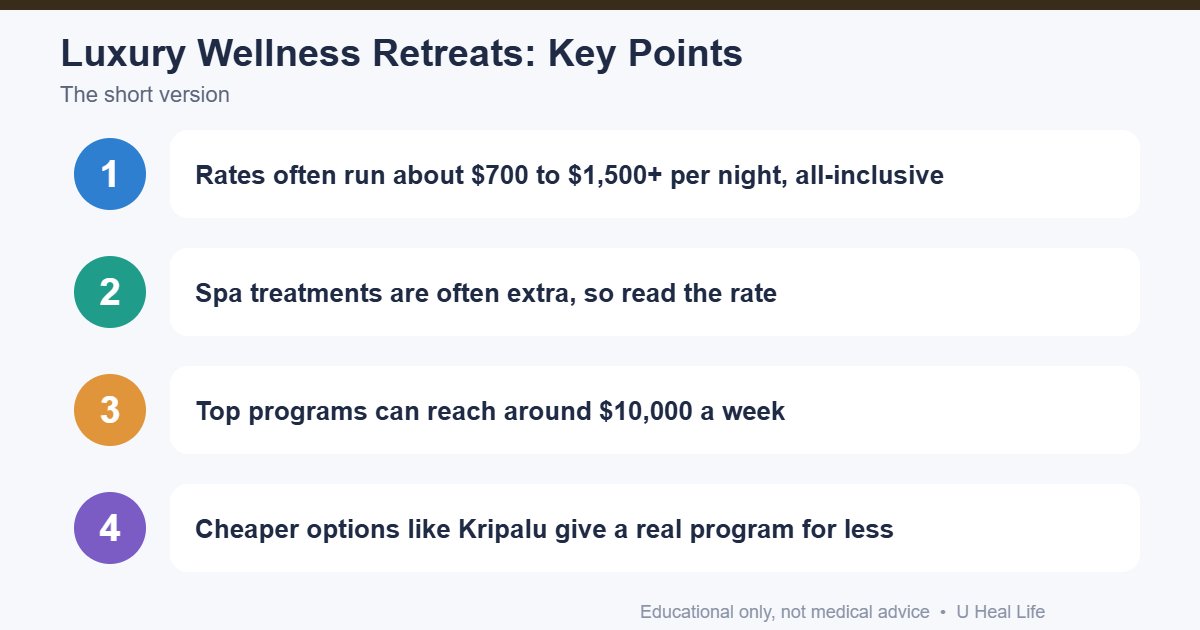
Quick answer: Well-known luxury wellness retreats in the USA include Canyon Ranch (Arizona), Miraval (Arizona), Golden Door (California) and Lake Austin Spa Resort (Texas). All-inclusive rates generally range from about $700 to more than $1,500 per person per night, and top programs can cost around $10,000 for a week. Rates change, so confirm current prices on each resort’s website.

Luxury wellness retreat key points: all-inclusive rates reported from about 700 to over 1500 dollars per night, spa often extra, cheaper options exist
Key points at a glance.

What Makes a Retreat “Luxury”?

  • All-inclusive pricing: meals, classes and many activities are included
  • Expert staff: physicians, nutritionists, trainers and therapists at some resorts
  • Small groups and privacy: some places host only a few dozen guests a week
  • High-end rooms and spas: treatments are often extra
  • Personal plans: custom fitness, food or health programs

Luxury Wellness Retreats in the USA

Canyon Ranch (Tucson, Arizona, and other locations)

Canyon Ranch’s website lists all-inclusive stays from about $950 per guest per night for a single guest and about $855 per guest per night for doubles, with higher rates for special programs. Travel guides describe it as offering fitness classes and access to health professionals such as physicians and nutritionists.

Miraval Arizona Resort and Spa (Tucson, Arizona)

Miraval is an all-inclusive wellness resort known for more than 120 complimentary wellness activities and classes each week. Travel guides report rates starting from roughly $700 to $1,150 per night per person depending on season and package, and spa treatments are often extra.

Golden Door (San Marcos, California)

Golden Door, opened in 1958, hosts only a small number of guests (about 40 per week according to travel guides) on 600 acres. One editors’ guide lists about $10,450 for a 7-night all-inclusive stay, including a daily massage and meals.

Lake Austin Spa Resort (Texas)

Travel guides place rates at about $700 to $1,000 per night, depending on season and room, with a wide choice of activities.

Blackberry Farm (Tennessee)

This is more of a luxury country estate than a wellness program. One editors’ guide lists rates from about $4,000 per night, with meals included and spa treatments extra.

More Affordable Wellness Stays

If you want a real program without luxury prices, travel guides point to centers like Kripalu in Massachusetts (shared rooms roughly $300 to $450 per night including meals and yoga, with lower dorm rates) and Sedona Mago Retreat in Arizona (roughly $200 to $400 per night). Prices change, so confirm before you book.

Is a Luxury Wellness Retreat Worth It?

It may be worth it if:

  • You want privacy, expert staff and a structured plan
  • You value everything being taken care of in one price
  • You can afford it without stress

It may not be worth it if you only want rest and nature. A simple retreat can give you much of the same calm for far less. Read how much a wellness retreat costs to compare.

How to Compare Luxury Retreats

QuestionWhy it matters
What is included in the nightly rate?Spa treatments and tips are often extra
Who is on staff?Doctors and nutritionists are not at every resort
How big is the group?Smaller groups give more attention
What are the cancellation rules?High-priced stays often have strict policies
Is there a minimum stay?Many have 2 to 3 night minimums

Frequently Asked Questions About Luxury Wellness Retreats

Which luxury wellness retreat is the best?

There is no single best. Choose by goal: fitness and health plans, privacy, nature, spa treatments or mindfulness.

Are luxury retreats all-inclusive?

Many are, but spa treatments are usually extra. Check each rate.

Do luxury retreats include medical care?

Some have doctors, nutritionists or health centers, but they are wellness services, not hospital care. See wellness retreat vs mental health retreat.

Will insurance pay for it?

Usually not.

Are there cheaper options?

Yes. Centers like Kripalu and others offer shared rooms and programs at a fraction of the price.

Helpful resource: You can see current rates and programs on the resort websites, for example Canyon Ranch.

Prices in this article come from the resorts and travel guides listed at the time of writing. They change often. We have no paid relationship with any resort mentioned.

Disclaimer: This article is for general information only and is not medical or mental health advice. Prices, programs and availability change, so please check current details with each provider. If you are in crisis or thinking about harming yourself, call or text 988 (the Suicide & Crisis Lifeline in the US) or your local emergency number right away.