Racing thoughts, a tight chest, and a mind that won’t switch off are something almost everyone experiences at some point. The good news is that you don’t need an hour of meditation or a weekend retreat to feel calmer. Many simple techniques can help settle your nervous system in about five minutes or less.
Below are 12 practical, research-informed ways to calm your mind. Try a few and keep the ones that work best for you.
Quick answer: To calm your mind in 5 minutes, slow your breathing (try box breathing or a longer exhale), ground yourself with the 5-4-3-2-1 exercise, take a short walk, or write your thoughts down. Pick one or two techniques and practice them for 2 to 5 minutes.
1. Box Breathing
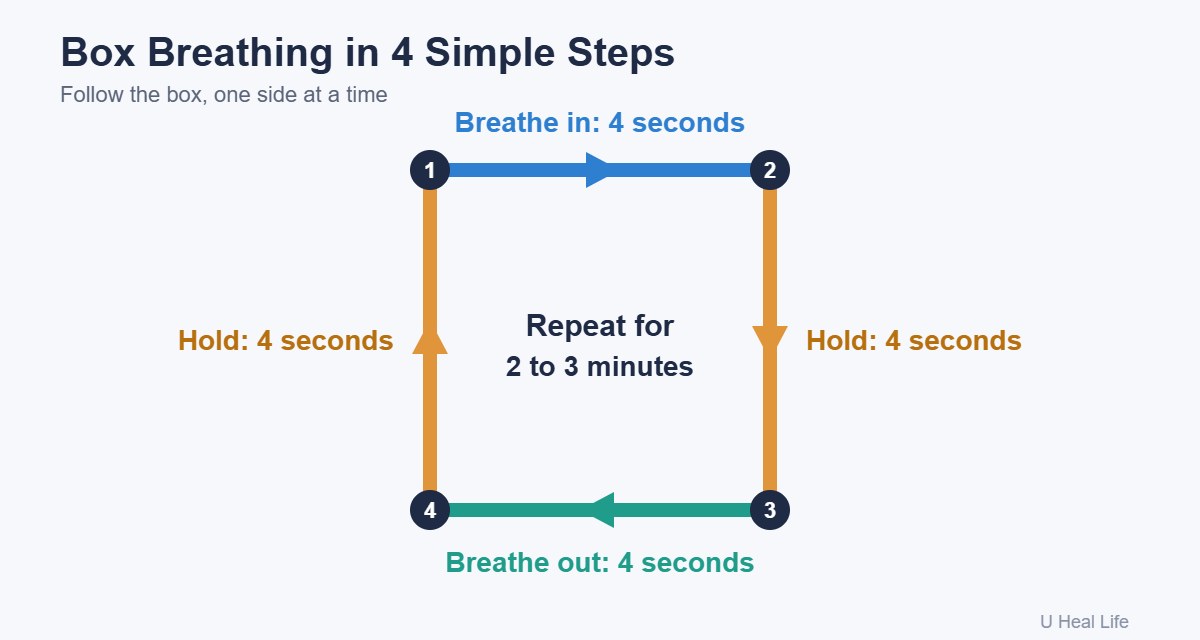
Breathe in for four seconds, hold for four, breathe out for four, and hold for four. Repeat for two to three minutes. The steady rhythm gives your mind something simple to focus on and can slow your heart rate.
Box breathing: four equal steps, repeated for two to three minutes.
2. Extend Your Exhale
Breathe in through your nose for a count of four, then out slowly for a count of six to eight. Longer exhales are commonly used to help activate the body’s relaxation response.
3. The Physiological Sigh
Take a deep breath in through your nose, add a second short inhale on top of it, then let out a long, slow breath through your mouth. A 2023 Stanford-led study found that a few minutes a day of this kind of “cyclic sighing” improved mood and reduced breathing rate over time.
4. The 5-4-3-2-1 Grounding Exercise
Look around and name five things you can see, four you can touch, three you can hear, two you can smell, and one you can taste. This pulls your attention out of anxious thoughts and back into the present moment.
5. Splash Cold Water on Your Face
Cold water on your face or wrists can briefly slow your heart rate and interrupt a spiral of stress. It’s quick, free, and works almost anywhere.
6. Progressive Muscle Relaxation
Starting with your feet and moving upward, tense each muscle group for five seconds, then release. Noticing the contrast between tension and relaxation helps your body let go of stress it may be holding without you realizing it.
7. Do a Quick Brain Dump
Grab a pen and write down everything that’s on your mind for three to five minutes without editing. Getting worries out of your head and onto paper can make them feel more manageable and less overwhelming.
8. Take a Short Walk
Even five minutes of walking, especially outdoors, can lift your mood and clear mental clutter. If you can, leave your phone behind or keep it in your pocket.
9. Try a One-Minute Mindfulness Check-In
Close your eyes and focus on the sounds around you, or on the feeling of your feet on the floor. When your mind wanders, gently bring it back. You don’t have to empty your mind; you just practice noticing where it is.
10. Listen to Slow, Calming Music
Slow-tempo music without lyrics can help lower tension and make it easier to breathe more slowly. Keep a short calming playlist ready for stressful moments.
11. Name the Emotion
Silently say, “I’m feeling anxious” or “I’m feeling overwhelmed.” Putting a label on what you feel, sometimes called affect labeling, has been linked in research to reduced emotional intensity.
12. Reach Out to Someone
A quick call or message to a friend or family member can remind you that you’re not alone. You don’t have to talk about the problem; sometimes just hearing a familiar voice is enough to settle you.
Make Calm a Daily Habit
These techniques work best when you practice them regularly, not only when you’re overwhelmed. Try pairing a breathing exercise with something you already do each day, such as brushing your teeth or making your morning coffee. Small, consistent habits can make it easier to stay calm when stress spikes. If constant scrolling is adding to your stress, our guide to social media anxiety offers more ideas.
When It’s More Than Everyday Stress
If racing thoughts, panic attacks, or constant worry are interfering with your sleep, work, or relationships, it’s worth talking with a doctor or a licensed mental health professional. Our guides to mental health insurance coverage and online therapy costs can help you figure out your options. If you ever have thoughts of harming yourself, call or text 988 (the Suicide & Crisis Lifeline in the US) or contact local emergency services right away.
Frequently Asked Questions
How can I calm my mind in 5 minutes?
Choose one simple technique and practice it for 2 to 5 minutes. Slow breathing (such as box breathing or a longer exhale), the 5-4-3-2-1 grounding exercise, or a short walk are easy places to start.
What is the fastest way to calm a racing mind?
Many people find that slowing their breathing is one of the quickest ways to settle. Try breathing in for 4 seconds and out for 6 to 8 seconds. If your thoughts are still racing, writing them down in a quick brain dump can help.
Does box breathing really work?
Many people find box breathing helpful for feeling calmer because it gives the mind a simple rhythm to follow. It is a helpful tool for everyday stress, but it is not a treatment for anxiety disorders or other medical conditions.
What is the 5-4-3-2-1 technique?
It is a grounding exercise that brings your attention to the present moment. You notice 5 things you can see, 4 you can touch, 3 you can hear, 2 you can smell, and 1 you can taste.
How do I stop overthinking?
Try writing your thoughts down, slowing your breathing, and giving your mind a calm routine. Our guide on how to stop overthinking at night has more simple steps.
When should I talk to a professional?
If worry, panic, or racing thoughts happen often or interfere with your sleep, work, or relationships, it is a good idea to speak with a doctor or licensed mental health professional.
If you’ve scrolled through social media or listened to a podcast lately, chances are you’ve heard someone say, “Let them.” The idea, popularized by author and podcast host Mel Robbins in her 2024 book The Let Them Theory, has struck a chord with millions of people who are tired of exhausting themselves trying to manage what other people think, say, and do.
But what does the “Let Them” theory actually mean, does it have any basis in psychology, and when does it fall short? Let’s break it down.
What Is the “Let Them” Theory?
At its core, the theory is simple: when someone does something you can’t control, like canceling plans, forgetting your birthday, judging your choices, or not texting back, you stop trying to change or manage their behavior and instead say to yourself, “Let them.”
The second half of the idea is just as important. Once you’ve let go of what you can’t control, you turn your attention to what you can control, your own response. Some people call this the “Let me” step: Let me decide how I want to spend my time, what I want to say, and what I want to do next.
Why It Resonates With So Many People
Trying to control other people’s reactions is draining. We replay conversations, overthink messages, and rearrange our lives to avoid conflict or disapproval. The “Let Them” mindset gives people permission to stop carrying that weight.
It also echoes ideas that have been around for a long time. Stoic philosophy distinguishes between what is and isn’t within our control, and acceptance-based approaches in modern therapy encourage people to stop fighting reality and focus on values-based action. The theory isn’t brand new, but it packages those ideas in a simple, memorable phrase.
Everyday Examples of the “Let Them” Theory
A friend keeps canceling plans.Let them. Then decide how much effort you want to put into the friendship going forward.
A family member disapproves of your choices.Let them. You can still make the decision that’s right for you.
Someone you like isn’t replying as quickly as you’d hoped.Let them. Their pace tells you something about their priorities, and you can decide what to do with that information.
A coworker has a different working style.Let them. Focus on doing your own work well and communicating clearly.
How to Practice It in 4 Steps
Notice the urge to control. Pay attention to the moment you start rehearsing arguments, over-explaining, or trying to change someone’s mind.
Say “Let them.” Name what is outside your control, whether that’s their opinion, mood, or choice.
Ask “What’s in my control?” Your response, your boundaries, and where you put your time and energy are all yours.
Choose an action. That might be a calm conversation, a boundary, a decision to invest less, or simply moving on with your day.
When the “Let Them” Theory Falls Short
Like any simple mantra, it has limits, and it works best when it’s not used as an excuse to avoid hard conversations.
It isn’t a substitute for boundaries. “Let them” doesn’t mean tolerating disrespect, manipulation, or harm. Letting someone be who they are can also mean deciding you no longer want them close to you.
It doesn’t replace communication. In healthy relationships, you still need to share your needs and listen to theirs.
It doesn’t apply to unsafe situations. If you’re experiencing abuse or feel unsafe, it’s not about letting go. Reach out to a trusted person or a professional for support.
It can become avoidance. If “let them” becomes a way to dodge every uncomfortable conversation, it may be hurting your relationships rather than helping them.
Can It Help With Anxiety and Overthinking?
Many people who struggle with people-pleasing, social anxiety, or overthinking find the idea helpful because it shifts focus from other people’s reactions to their own actions. It’s not a treatment for anxiety, though. If worry about what others think is affecting your daily life, it may be worth exploring with a licensed therapist. Our articles on social media anxiety and mental health insurance coverage can help you understand your options.
The Bottom Line
The “Let Them” theory isn’t magic, but it’s a practical reminder that you can’t control other people, and you don’t have to. Used thoughtfully, alongside clear boundaries and honest communication, it can free up a surprising amount of mental energy and make your relationships feel lighter.
This article is for general educational purposes and is not a substitute for professional mental health advice.
Most of us don’t think twice about calling in sick when we have a fever or a migraine. But when what’s worn down is your mind rather than your body, it’s much easier to push through, tell yourself it’s “not that bad,” and keep going until something gives.
A mental health day is a planned break from work, school, or daily obligations so you can rest, reset, and look after your emotional well-being. It isn’t a cure for anxiety, depression, or chronic burnout, but it can interrupt a downward spiral before it gets worse. Here are eight signs it may be time to take one.
Quick answer: You may need a mental health day if you feel exhausted even after sleep, get irritated easily, cannot focus, dread everyday responsibilities, feel physically tense, or no longer enjoy things. A day to rest can help you reset, but if these signs last for weeks, please talk to a professional.
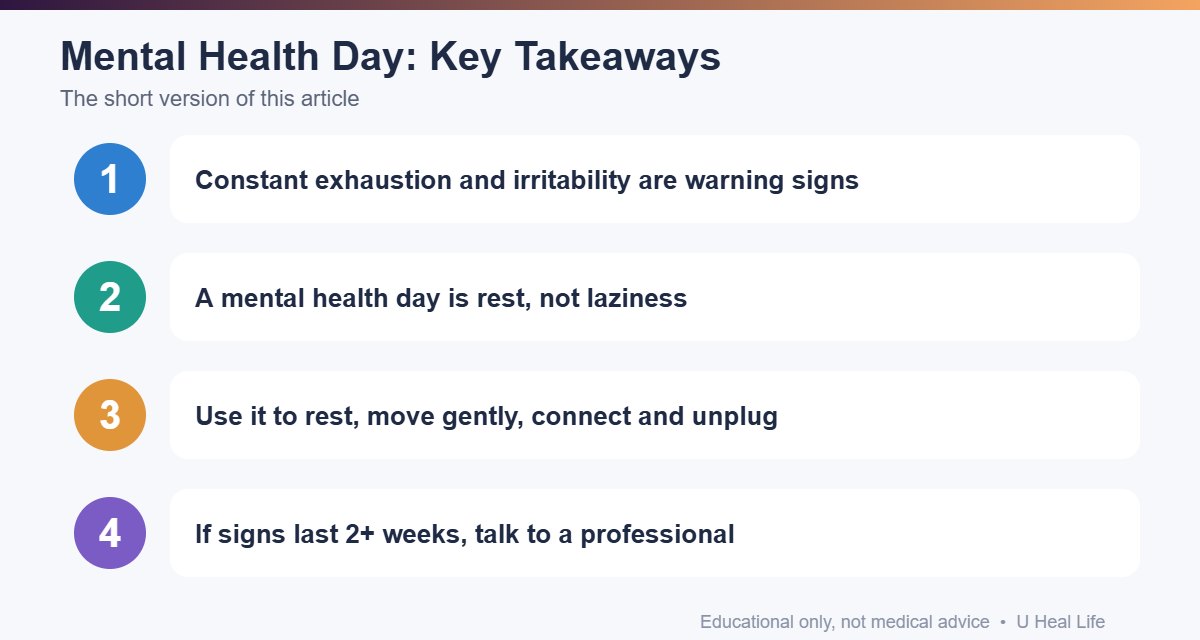
The key points at a glance.
1. You’re Exhausted Even After Sleeping
Fatigue that doesn’t improve with a full night’s rest is one of the most common signals of mental overload. When stress stays high for weeks, your body stays in a state of alert, and sleep stops feeling restorative.
2. Small Things Set You Off
If a slow driver, a noisy coworker, or an unanswered text suddenly feels unbearable, your stress tolerance may be running on empty. Irritability is often the first thing others notice before we notice it ourselves.
3. You Can’t Concentrate
Reading the same email three times, forgetting simple tasks, or staring at a screen without taking anything in are signs your brain is overloaded. Chronic stress can interfere with attention and memory, which is why “brain fog” and burnout often go hand in hand.
4. You Dread Work or Everyday Responsibilities
Everyone has bad Mondays. But if dread about work, school, or home life shows up most days, or starts creeping in on the weekend, it’s worth paying attention to.
5. Your Body Is Sending Signals
Stress doesn’t stay in the mind. Frequent headaches, stomach trouble, tight shoulders, a clenched jaw, changes in appetite, and getting sick more often can all be physical signs that you’re running on too little rest and too much pressure.
6. Things You Usually Enjoy Feel Flat
When hobbies, favorite shows, or time with friends stop feeling enjoyable, your mind may be asking for a break. Losing interest in things you normally like is also a symptom commonly linked with depression, so keep an eye on how long it lasts.
7. You’re Pulling Away From People
Canceling plans, ignoring messages, or avoiding conversations because you simply have no energy left is a classic sign of emotional overload. A day to rest can help you show up for the people you care about with more to give.
8. You’re Leaning on Coping Crutches
More caffeine to get going, more alcohol to wind down, endless scrolling to avoid thinking, or comfort eating to get through the day can all be signs you’re coping rather than recovering. If you notice the pattern, it’s a good moment to pause.
What a Good Mental Health Day Looks Like
A mental health day works best when it’s genuinely restful, not just a day off spent catching up on chores or doom-scrolling. A few ideas:
Disconnect on purpose. Mute work email and chat notifications for the day.
Let yourself rest. Sleep in if you can, or take a nap without guilt.
Move gently. A walk outside, light stretching, or yoga can lower tension without draining you.
Do something restorative. Cook a meal you enjoy, read, draw, listen to music, or spend time in nature.
Connect with someone safe. A short call with a friend or family member can lift your mood more than staying isolated.
Name what’s weighing on you. Write down what’s been draining you, then pick one small thing you can change this week.
How to Ask for a Mental Health Day
Policies vary by employer and by state, so check your company handbook or HR guidelines. Many workplaces allow sick leave to be used for mental health reasons, and in most cases you don’t have to share details. A simple message such as “I’m not feeling well and need to take a sick day” is usually enough.
When One Day Off Isn’t Enough
A mental health day is a short-term reset, not a long-term solution. If you’ve felt this way most days for two weeks or longer, or if your sleep, appetite, work, or relationships are being affected, it’s a good idea to talk with your doctor or a licensed mental health professional. If you’re not sure how to afford care, our guide to mental health insurance coverage and our breakdown of online therapy costs can help you plan next steps. You may also find our article on social media anxiety useful if constant scrolling is adding to your stress.
If you ever have thoughts of harming yourself, call or text 988 (the Suicide & Crisis Lifeline in the US) or contact your local emergency services right away.
Sponsored
Thinking about talking to someone?
If you often feel drained or overwhelmed, talking to someone can be a good next step. Online-Therapy.com offers CBT-based online therapy programs for individuals and couples.
Learn moreThis link will redirect you to a third-party website. We may earn a commission from links you follow.
Frequently Asked Questions
What is a mental health day?
It is a day you take off to rest and recover from stress, burnout or emotional overload, in the same way you would take a sick day for physical illness.
How do I know if I need one?
Common signs include constant tiredness, irritability, trouble focusing, dread about work, physical tension and losing interest in things you enjoy.
What should I do on a mental health day?
Rest, spend time outside, move gently, eat well, limit screens and do something that calms you. Avoid filling the day with chores or work.
How often can I take a mental health day?
There is no fixed number. If you need them very often, that is a sign to look at your workload, sleep and stress, and to talk with a professional.
Is a mental health day the same as a sick day?
Many workplaces treat them the same, but policies differ. Check your company policy before you ask.
When should I get professional help?
If you have felt this way most days for two weeks or longer, or if sleep, appetite, work or relationships are affected, speak with a doctor or licensed mental health professional.
This article is for general information only and is not medical or mental health advice. If you are struggling, please speak with a qualified professional.
You open an app “just for a minute,” and 40 minutes later you feel tense, behind in life and strangely drained. If that sounds familiar, you are not alone. Social media anxiety is the stress, worry or unease many people feel before, during or after using social platforms. It is not an official diagnosis on its own, but it is a very real experience, and there are practical things you can do about it.
Quick answer: Social media anxiety is the worry, pressure or unease some people feel while using social media, or when they are away from it. Signs include constant checking, comparing yourself with others and feeling worse after scrolling. Notification audits, time limits, a cleaner feed and regular breaks can help.
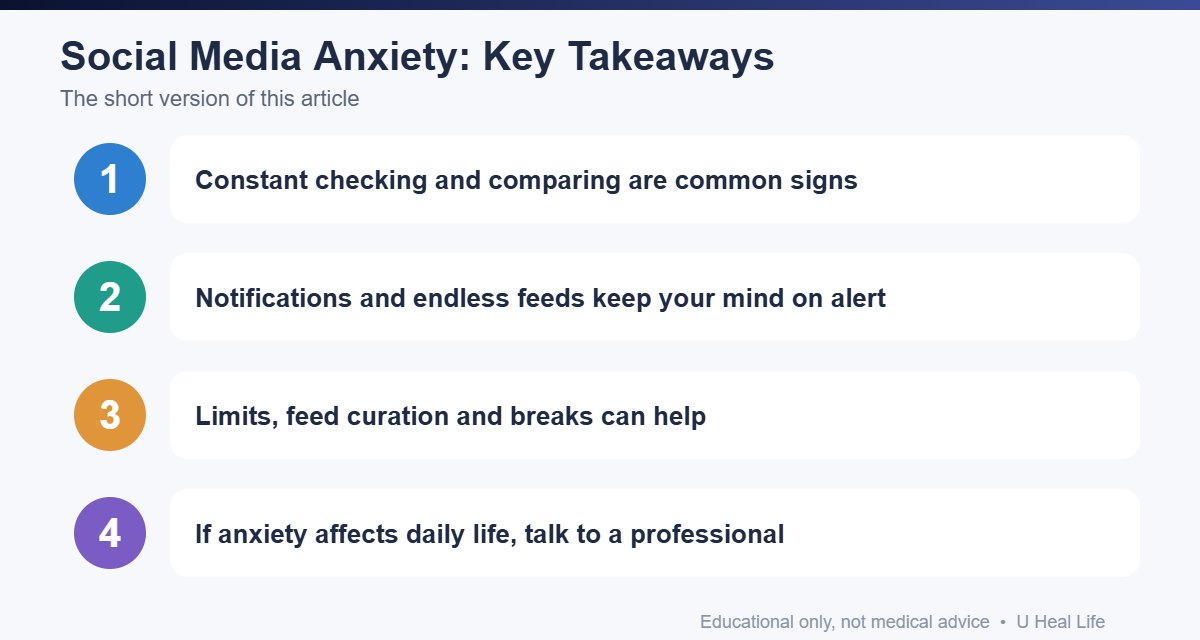
The key points at a glance.
What Is Social Media Anxiety?
Social media anxiety describes feelings of nervousness, pressure or dread connected to social platforms. For some people it is about how they appear to others: worrying about likes, comments or what to post. For others it is about what they see: constant comparison, bad news, or the fear of missing out (FOMO). It can also show up as an urge to keep checking, even when checking makes you feel worse.
9 Signs You May Have Social Media Anxiety
You feel uneasy when you cannot check your phone. Leaving it at home or running out of battery creates a spike of worry.
You compare yourself constantly. Other people’s highlights make your own life feel small.
You overthink every post. You rewrite captions, delete posts or worry for hours about reactions.
You feel worse after scrolling. You close the app more tired, irritable or low than when you opened it.
You struggle with FOMO. Seeing events you were not part of leaves you anxious or left out.
Notifications raise your stress. Every buzz creates a small jolt of tension.
You doomscroll. You keep reading distressing news even though it increases your worry.
Your sleep suffers. Late-night scrolling delays bedtime and leaves your mind racing.
You avoid real-life activities. You spend less time with friends, hobbies or work because of time spent online, or because of worry about what you will see.
Having one or two of these now and then is common. If several apply to you most days, it is worth taking the steps below.
Why Does Social Media Make Some People Anxious?
Social comparison. We tend to compare our everyday life with other people’s best moments.
Variable rewards. Likes and new notifications arrive unpredictably, which keeps us checking.
Endless feeds. There is no natural stopping point, so scrolling can run on much longer than planned.
Negative content. Algorithms often surface emotional or alarming posts because they get attention.
Less sleep and movement. Time online can crowd out rest, exercise and face-to-face contact, all of which protect mental health.
7 Practical Ways to Reduce Social Media Anxiety
1. Do a notification audit
Turn off all non-essential notifications, such as likes, suggestions and “someone posted” alerts. Keep only messages from people you actually need to hear from. You decide when to check, rather than the app deciding for you.
Use the built-in screen time tools on iPhone or Android to set a daily limit for each app. Start generous, for example 45 to 60 minutes, then reduce gradually. Small, steady changes work better than a dramatic cold turkey attempt.
3. Curate your feed
Mute or unfollow accounts that leave you feeling anxious, inadequate or angry. Follow more accounts that teach you something, make you laugh or genuinely support your goals. Your feed is something you can design.
4. Create phone-free zones and times
Try keeping your phone out of the bedroom, and avoid screens for the last 30 to 60 minutes before bed. Charge it across the room and use a basic alarm clock. Better sleep alone often reduces anxiety noticeably.
5. Take a short digital detox
Try a weekend, or even one social-media-free evening a week. Notice how you feel without the constant input. Many people find that a short break makes it clear which parts of social media they value and which they do not.
6. Replace scrolling with something else
Often the habit is about filling a gap: boredom, stress or waiting. Keep a simple replacement ready, such as a short walk, a few minutes of deep breathing, a book, music or messaging a friend directly.
7. Practice mindful checking
Before opening an app, pause and ask: “Why am I opening this? How do I feel right now?” After closing it, check in again. This small habit builds awareness of which apps and moments help you and which do not.
When to Seek Professional Help
Consider talking to a doctor, licensed therapist or counselor if:
Anxiety is affecting your work, school, relationships or sleep for more than a few weeks
You are unable to cut back even though you want to
You have panic attacks, constant worry or feelings of hopelessness
Therapies such as cognitive behavioral therapy (CBT) are commonly used for anxiety. If you are in the United States and are in crisis or having thoughts of harming yourself, call or text 988 to reach the 988 Suicide & Crisis Lifeline, available 24/7. If you are elsewhere, please contact your local emergency number or crisis service.
Sponsored
Thinking about talking to someone?
If social media leaves you anxious, talking to a professional can help. Online-Therapy.com offers CBT-based online therapy programs for individuals and couples.
Learn moreThis link will redirect you to a third-party website. We may earn a commission from links you follow.
Frequently Asked Questions
Is social media anxiety a real condition?
It is not a separate formal diagnosis, but anxiety linked to social media use is widely discussed by researchers and clinicians, and the feelings are very real. A mental health professional can help you work out what is going on for you.
How long does it take to feel better after reducing social media?
It varies. Some people notice a difference within days, such as better sleep and calmer evenings, while others need a few weeks of consistent changes.
Do I have to quit social media completely?
No. For most people the goal is a healthier relationship with it: fewer triggers, set limits and more intention, rather than quitting entirely.
Can teens experience social media anxiety?
Yes. Teens may feel strong pressure around appearance, popularity and responses from peers. Open, judgment-free conversations with a trusted adult can help, and a pediatrician or school counselor is a good starting point.
Final Thoughts
Social media itself is not “good” or “bad.” What matters is how it makes you feel and how much space it takes in your life. Start with just one or two changes this week, such as switching off notifications and keeping your phone out of the bedroom, and notice what shifts. Small, consistent steps add up to calmer, more intentional days.
Disclaimer: This article is for general information only and is not medical advice. If you are struggling with your mental health, please speak with a qualified healthcare professional. If you are in crisis or thinking about harming yourself, call or text 988 (the Suicide & Crisis Lifeline in the US) or your local emergency number right away.
Affiliate disclosure: This article contains an affiliate link. If you buy through it, we may earn a commission at no extra cost to you. We only write about products we have researched, and this review is not medical advice.
Testosterone naturally drifts down as men move past 30. Lower energy, slower recovery after workouts, a softer midsection and a flatter drive are common complaints, and they send a lot of men searching for a supplement. Testodren by PrimeGENIX is one of the products that comes up in those searches. In this review we look at what it contains, what the manufacturer claims, what independent research on its key ingredient actually shows, and who it may (and may not) suit.
What Is Testodren?
Testodren is a once-daily dietary supplement for men. Each capsule holds 500 mg of a patented, standardized extract of fenugreek (Trigonella foenum-graecum), and each bottle contains 30 capsules, which is a one-month supply. It is a single-ingredient formula, so there is no long proprietary blend to decode. The brand positions it for men roughly 30 to 60+ who want to support healthy testosterone levels as they age.
What Does the Manufacturer Claim?
According to the brand, the formula is designed to support:
Daily energy levels
Workout performance and muscle building
Body composition (reducing body fat)
Focus, motivation and drive
Sexual health and libido
The brand also reports that its clinical study showed a 72.87% increase in free testosterone over 12 weeks. Keep in mind this is a manufacturer-reported figure from a study on its own ingredient, so treat it as a promising claim rather than a guaranteed result for every man.
What Does the Research on Fenugreek Say?
Fenugreek is one of the more studied herbal ingredients in the testosterone space, but the evidence is mixed and honest reviews should say so.
A 2020 meta-analysis of four randomized trials in Phytotherapy Research found that fenugreek extract was associated with a significant rise in total testosterone in men.
A 2020 systematic review in Advances in Nutrition listed fenugreek seed extract (along with ashwagandha) as one of the herbal ingredients with positive effects on testosterone in men.
A newer 2026 meta-analysis of randomized placebo-controlled trials (Frontiers in Nutrition) found only a small favorable effect on total testosterone, while the result for free testosterone was imprecise and inconsistent between studies.
At least one recent randomized trial reported no boost in testosterone from fenugreek.
Bottom line: fenugreek may modestly support testosterone and sexual function in some men, but results vary with the extract used, the dose, the study length and the men tested. It is not a replacement for medical testosterone therapy, and it will not work miracles.
Who Might Consider Testodren?
Men aged 30+ who notice lower energy, drive or workout recovery and want a simple, single-ingredient option.
Men who already sleep well, eat well and strength-train, and want to add a supplement on top of a healthy routine.
People who prefer a plant-derived extract over multi-ingredient “testosterone booster” blends.
Who Should Be Careful?
Men on blood-thinning or diabetes medication. Fenugreek can affect blood sugar and may interact with these drugs.
Anyone with a known hormone-related condition, prostate concerns, or fertility plans.
Men with symptoms of very low testosterone. Fatigue and low libido can also come from poor sleep, stress, thyroid issues, depression or other conditions, so get a blood test and speak to a doctor first.
Anyone allergic to fenugreek, chickpeas or peanuts (they belong to the same plant family).
Possible side effects of fenugreek can include stomach upset, gas or loose stools in some people. Always follow the label and talk to a healthcare professional before starting any supplement.
Natural Ways to Support Testosterone Alongside Any Supplement
Lift weights 3 to 4 times a week. Compound lifts such as squats and deadlifts are particularly useful.
Sleep 7 to 9 hours. Poor sleep is strongly linked to lower testosterone.
Manage body fat and stress. Excess belly fat and chronic stress both work against healthy hormone levels.
Eat enough protein, healthy fats and micronutrients such as zinc and vitamin D, ideally from food first.
Where Is Testodren Available?
Demand for men’s health and testosterone-support supplements is strongest in markets such as the United States, the United Kingdom, Germany, Saudi Arabia and the UAE, and market research firms expect steady growth in all of them through the early 2030s. Testodren ships to most countries worldwide. The brand lists a small number of restricted destinations (including India, Mexico, Malaysia, Thailand, South Africa, Egypt, Norway, Peru and the Russian Federation, among others), so please check availability for your country on the official page before ordering.
Final Verdict
Testodren is a clean, single-ingredient fenugreek formula with a clear dose and a simple one-capsule-a-day routine. The science behind fenugreek is encouraging but modest, so go in with realistic expectations: think of it as a supporting tool alongside training, sleep and nutrition, not a shortcut. If you decide to try it, start with one bottle, track how you feel and your energy and training over 8 to 12 weeks, and consider re-testing your levels with your doctor.
Studies on fenugreek typically run 8 to 12 weeks, so give any such supplement at least two to three months before judging it.
How do you take Testodren?
The brand recommends one capsule daily as per the label directions. Follow the instructions on the bottle.
Is Testodren a steroid or hormone?
No. It is a plant-derived dietary supplement and does not contain testosterone itself.
Can women take it?
It is marketed for men, so women should speak to a doctor before using it.
These statements have not been evaluated by regulatory authorities. This product is not intended to diagnose, treat, cure or prevent any disease. Results vary from person to person.
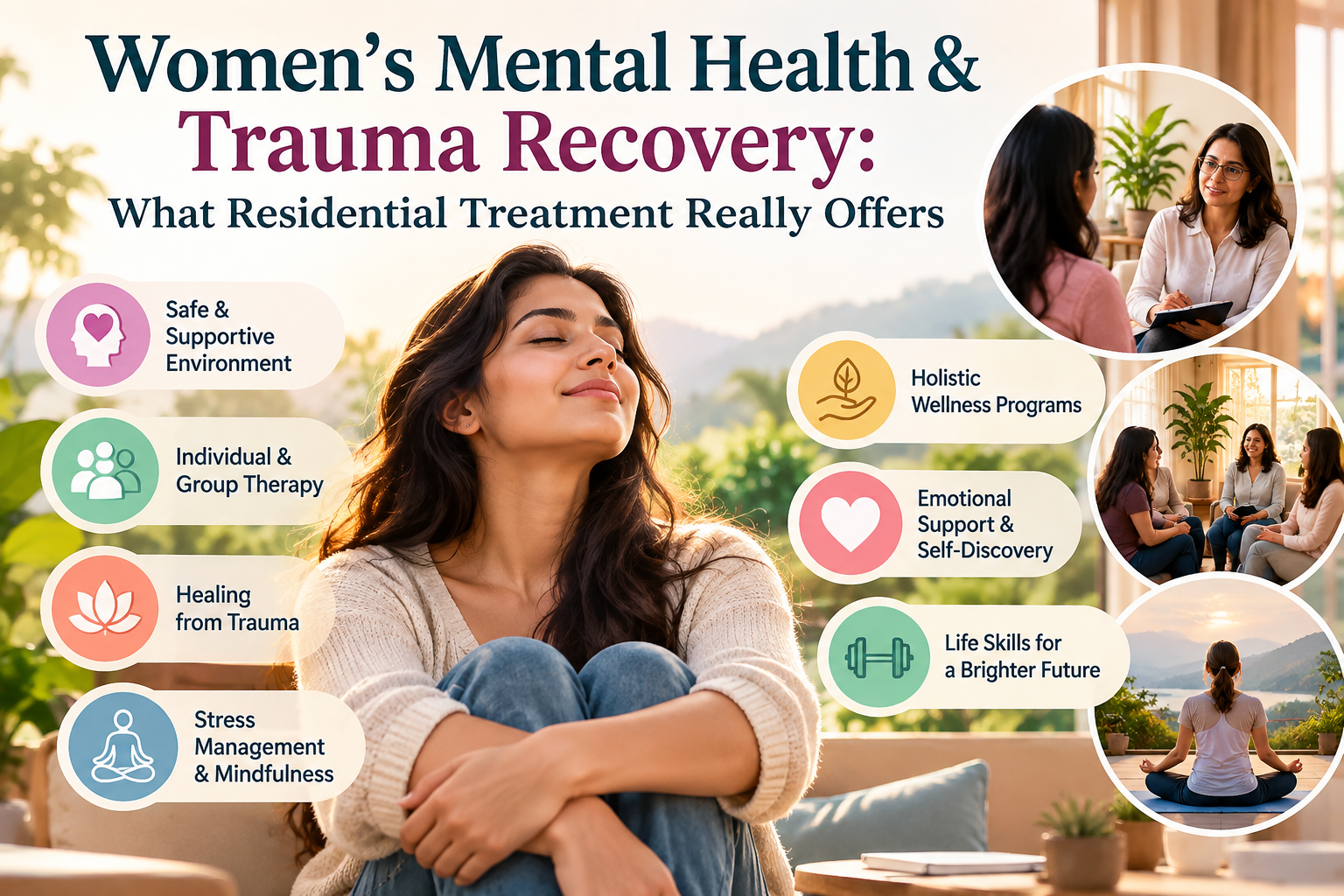
For many women, the breaking point doesn’t arrive all at once. It builds quietly — through years of unprocessed trauma, chronic anxiety, burnout, or a slow slide into substance use as a way to cope. By the time someone starts searching for help, they’re often looking for more than a weekly therapy appointment. They’re looking for a place that can hold the whole picture: the mind, the body, and the life that needs rebuilding.
This is where women’s residential mental health and trauma treatment centers come in — programs like Villa Kali Ma in California, and others like it across the country, that offer immersive, live-in care specifically designed around how women experience trauma, addiction, and recovery differently than men do.
If you’re researching these programs for yourself or someone you love, here’s what to actually know before you choose one.
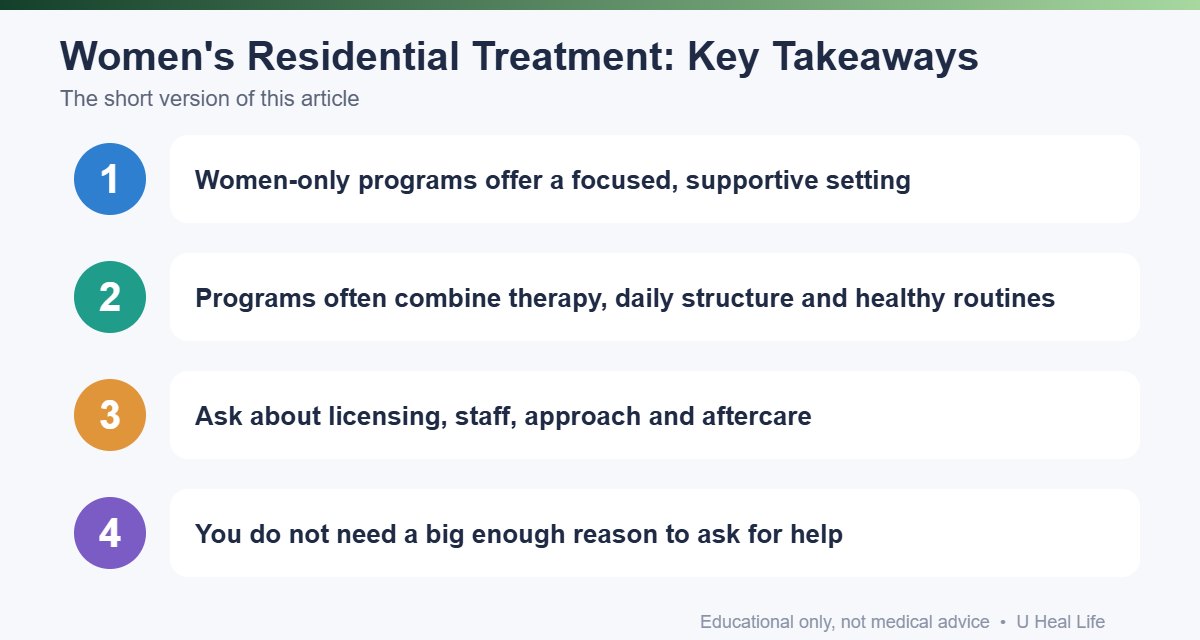
Quick answer: Residential mental health and trauma programs for women offer live-in care that usually combines therapy, daily structure and healthy routines in a supportive, women-only setting. Before choosing, ask about licensing, staff qualifications, treatment approach, aftercare, costs and insurance.
The key points at a glance.
Why Women-Only Treatment Programs Exist
Trauma doesn’t show up the same way for everyone. Research consistently shows that women are more likely to have experienced interpersonal trauma — abuse, assault, or complex relational wounds — and are more likely to develop co-occurring anxiety, depression, or eating patterns alongside substance use. Mixed-gender treatment settings can sometimes recreate the very dynamics — power imbalances, unsafe attention, difficulty being vulnerable — that contributed to the trauma in the first place.
Women-only residential programs are built to remove that barrier. The goal isn’t exclusion; it’s creating a setting where someone can actually let their guard down enough to do the deeper work.
What These Programs Typically Include
Most reputable women’s residential mental health and trauma centers combine several layers of care rather than relying on one method alone:
Clinical mental health treatment Licensed psychiatrists and therapists assess and treat co-occurring conditions — PTSD, anxiety, depression, and substance use disorders together, not in isolation. This is often called a “dual diagnosis” or “co-occurring disorders” approach, and it matters because treating addiction without treating the underlying trauma rarely holds long-term.
Somatic and body-based therapy Talk therapy alone often isn’t enough when trauma is stored in the nervous system, not just in memory. Many programs use somatic release work, nervous system regulation techniques, and body-based practices to help process trauma that words can’t fully reach.
Holistic and experiential practices Yoga, breathwork, art or movement therapy, and time in nature are common additions — not as a replacement for clinical care, but as a way to help the body reconnect with a sense of safety.
Structured community Living alongside other women going through similar struggles, in a home-like rather than clinical setting, is often cited by former residents as one of the most meaningful parts of recovery — the sense of not being the only one.
Aftercare and stepped-down support Good programs don’t end at discharge. They typically offer outpatient step-down options (like an Intensive Outpatient Program, or IOP) and connect residents to ongoing support groups so recovery doesn’t stop the moment treatment does.
Questions to Ask Before Choosing a Program
If you’re comparing options — whether it’s a well-known name like Villa Kali Ma or a smaller local program — these are the questions worth asking directly:
Is the facility licensed by the state’s Department of Health Care Services (or equivalent)? Ask for the license number.
Who is overseeing medical and psychiatric care — is there a licensed physician or psychiatrist on staff, not just counselors?
Does the program treat co-occurring conditions (trauma + addiction, or trauma + anxiety/depression) together, or only one at a time?
What does a typical day actually look like — how much is clinical therapy versus holistic/experiential work?
What insurance plans are accepted, and what happens if coverage runs out before treatment is complete?
What does aftercare look like once residential treatment ends?
Can you speak to the intake team before committing, and can family be involved in the process if appropriate?
A program that’s confident in its care will answer these clearly and without pressure tactics.
A Note on Cost and Insurance
Residential mental health and trauma treatment is a significant financial and time commitment — often 30 days or more, and not always fully covered by insurance. Many centers, including larger names in this space, work with major insurers (such as Health Net-affiliated plans) as in-network or out-of-network providers. Before enrolling anywhere, get a clear, written breakdown of what’s covered, what isn’t, and what the total out-of-pocket cost could look like.
One of the most common things women say after starting treatment is that they waited too long because they didn’t think their pain was “bad enough” to deserve help. Trauma isn’t a competition, and burnout, chronic anxiety, and quiet substance dependence are just as valid reasons to seek residential-level care as a single dramatic crisis point.
If you’re not sure whether your situation calls for residential treatment versus outpatient therapy, that’s a conversation worth having with a licensed mental health professional rather than deciding alone.
This article is for general educational purposes and isn’t a substitute for professional medical or psychiatric advice. If you or someone you know is in immediate crisis, please contact a local emergency service or a crisis line such as the 988 Suicide & Crisis Lifeline (call or text 988 in the US).
https://www.uheallife.com/ SEO BLOG
Created by you
Frequently Asked Questions
What is residential trauma treatment?
It is a live-in program where you receive structured mental health care, usually including therapy and support, away from everyday triggers and stresses.
Why choose a women-only program?
Some women feel safer and more able to open up in a setting without men, especially after trauma. Programs may also focus on issues that affect women.
How long do programs last?
Length varies widely. Ask each program about typical stays, how they decide on length and what aftercare they provide.
Does insurance cover residential treatment?
Coverage depends on your plan and the program. Call your insurer and the program to ask about benefits, authorization and out-of-pocket costs.
How do I choose a program?
Check licensing, staff qualifications, the treatment approach, safety practices, family involvement and aftercare. Ask to speak with an admissions counselor and take your time.
What if I need help right now?
If you are in crisis or thinking about harming yourself, call or text 988 (the Suicide & Crisis Lifeline in the US) or your local emergency number right away.
Disclaimer: This article is for general information only and is not medical advice. If you are struggling with your mental health, please speak with a qualified healthcare professional. If you are in crisis or thinking about harming yourself, call or text 988 (the Suicide & Crisis Lifeline in the US) or your local emergency number right away.
Search for “supplements to boost metabolism” and you will find hundreds of products promising to burn fat and speed up your calorie burn. The honest answer is more modest. No pill can reliably “fire up” your metabolism, and most research on these supplements shows small effects or mixed results. This guide looks at seven popular supplements, what the evidence says, who should be careful, and what actually supports a healthy metabolism.
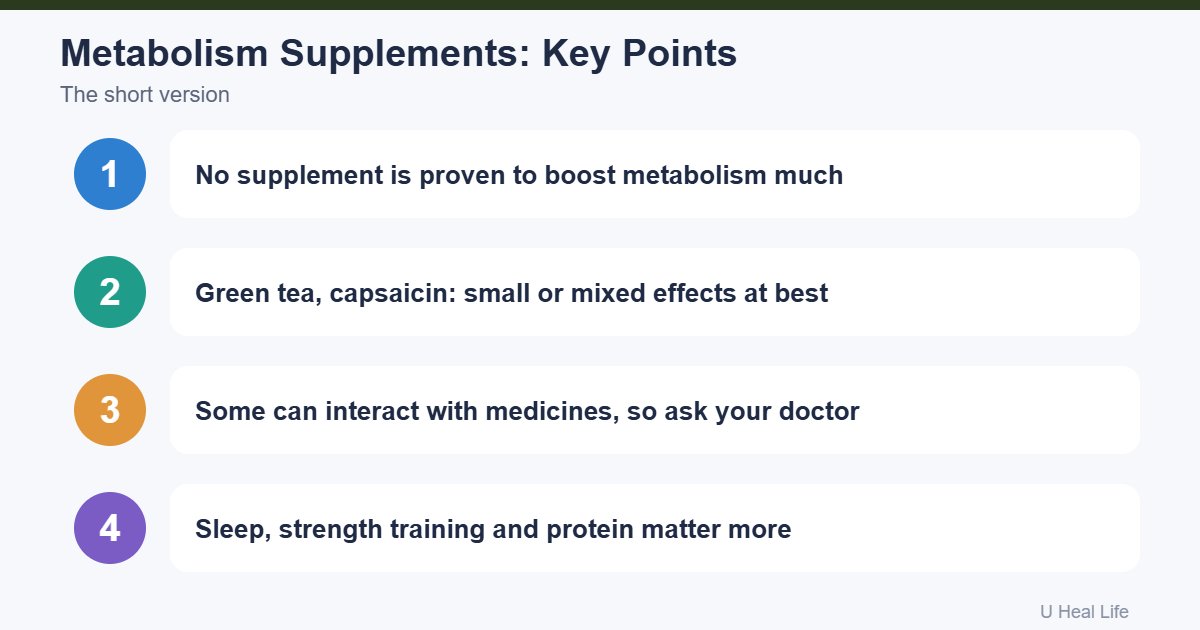
Quick answer: There is no proven supplement that significantly boosts metabolism. Green tea extract, capsaicin and a few others show small or mixed effects in studies, while B vitamins, magnesium, CoQ10 and omega-3s support normal body functions but are not shown to speed up metabolism if you are not low in them. Sleep, strength training, enough protein and an active day matter far more. Talk to your doctor before taking any supplement.
Key points at a glance.
Table of Contents
By the U Heal Life editorial team. Last updated: October 2026. We are not doctors, and this article is general information based on public health sources, not medical advice. This page contains one affiliate link, explained clearly near the end. If you buy through it, we may earn a commission at no extra cost to you.
How Metabolism Really Works
Your metabolic rate is the number of calories your body uses in a day. It is commonly described in three parts:
Basal metabolic rate (BMR): the energy you use just to stay alive. This is the biggest part, often described as about 60 to 70 percent of daily use.
Thermic effect of food: the energy used to digest and absorb food, often described as about 10 percent.
Physical activity: everything from walking to workouts, often described as about 20 to 30 percent.
Body size, muscle mass, age, sex and genetics play the main roles. Muscle uses more energy than fat, which is one reason strength training helps.
The 7 Supplements at a Glance
Supplement
What people hope it does
What the evidence suggests
Main cautions
Green tea extract
Small boost to calorie burn
Small or mixed effects on weight
Rare liver injury reported with concentrated extracts; caffeine
L-carnitine
Help the body use fat for energy
Limited evidence for weight loss
Stomach upset; may interact with some medicines
Capsaicin
Slightly raise calorie burn and reduce appetite
Small effects in some short studies
Stomach discomfort
B vitamins
Support energy metabolism
Helpful if you are low, not a booster otherwise
Very high doses of some B vitamins can cause problems
CoQ10
Support cell energy
Not shown to boost metabolism
May interact with blood thinners such as warfarin
Magnesium
Support many body reactions
Helpful if you are low, not shown to boost metabolism
High supplement doses can cause diarrhea
Omega-3 fatty acids
Support heart health and reduce inflammation
Good for heart-related goals, not a metabolism booster
May increase bleeding risk at high doses
What the Evidence Says, One by One
1. Green Tea Extract
Green tea contains caffeine and plant compounds called catechins, including EGCG. Reviews of studies have found at most a small effect on weight, and some reviews found no meaningful effect. Concentrated green tea extracts have been linked to rare cases of liver injury, especially at high doses and on an empty stomach. If you are sensitive to caffeine, pregnant, or have liver problems, ask your doctor first.
2. L-Carnitine
Your body makes L-carnitine, and it helps move fatty acids into cells to be used for energy. Taking more has not been shown to cause meaningful weight loss in healthy people. Side effects can include nausea and stomach upset.
3. Capsaicin
Capsaicin is the compound that makes chili peppers hot. Some short studies suggest a small rise in calorie burn and a small drop in appetite, but the effects are modest and may fade over time. It can irritate the stomach.
4. B Vitamins
B vitamins help your body turn food into energy. If you are low in a B vitamin, such as B12, you may feel tired, and fixing the shortage can help. If your levels are normal, extra B vitamins are not expected to speed up metabolism.
5. CoQ10
CoQ10 is involved in making energy inside cells. It is popular for general health, but there is no strong evidence that it boosts metabolism or causes weight loss. It may reduce the effect of blood thinners such as warfarin.
6. Magnesium
Magnesium takes part in many body processes, and many people do not get enough from food. Correcting a low level is useful. It is not shown to raise metabolism in people who are not low. High supplement doses can cause diarrhea, so follow label limits and ask your doctor.
7. Omega-3 Fatty Acids
Omega-3s from fish oil are well studied for heart health and for lowering triglycerides. They are not a proven metabolism booster. High doses may increase bleeding risk, so talk to your doctor if you take blood thinners.
Ingredients and Products to Be Careful With
“Fat burners” with many stimulants: these can raise heart rate and blood pressure.
Bitter orange (synephrine): safety concerns have been raised, especially for the heart.
Raspberry ketones: there is little good evidence in humans.
Chromium picolinate: results are mixed, and any benefit appears small.
Ephedra: the FDA banned ephedra supplements in the US because of safety risks.
Anything promising fast, easy fat loss: the FDA has warned about weight-loss products that secretly contain drugs.
Dietary supplements in the US are not approved by the FDA before they are sold, so quality and claims can vary.
What Actually Supports a Healthy Metabolism
Build and keep muscle. Strength training two or more days a week helps.
Eat enough protein and enough food overall. Crash diets can slow your progress.
Sleep well. Poor sleep affects appetite and energy.
Move through the day. Walking and everyday activity add up.
Get tested if something feels off. Fatigue, sudden weight change or a racing heart can have medical causes, including thyroid conditions. See our guide on overactive thyroid symptoms in men.
How to Choose a Supplement More Safely
Talk to your doctor or pharmacist first, especially if you take medicines, are pregnant or have a health condition
Look for independent testing marks such as USP or NSF on the label
Check the dose and stay within label limits
Start with one product at a time, and stop if you feel unwell
Be careful with miracle claims and “before and after” photos
A Note About the Product Link on This Page
Some readers ask about specific products. The link below is an affiliate link: if you buy through it, we may earn a commission at no extra cost to you. We have not tested this product, we make no claims about results, and we are not recommending it over the careful steps above. Please check the ingredients, doses and safety information yourself and ask your doctor first.
Disclaimer: This article is for general information only and is not medical advice. Dietary supplements are not intended to diagnose, treat, cure or prevent any disease. Talk to a qualified healthcare professional before taking any supplement.
If cost is the only thing standing between you and starting therapy, you’re far from alone. Nearly 1 in 5 U.S. adults live with a mental illness, and cost remains the most commonly cited barrier to getting treatment. The good news: most health insurance plans are legally required to cover therapy. The confusing part is figuring out exactly what that means for your specific plan, your specific therapist, and your specific bill.
This guide walks through what’s actually covered, what it costs in 2026, and how to check your own benefits before you book a first session.
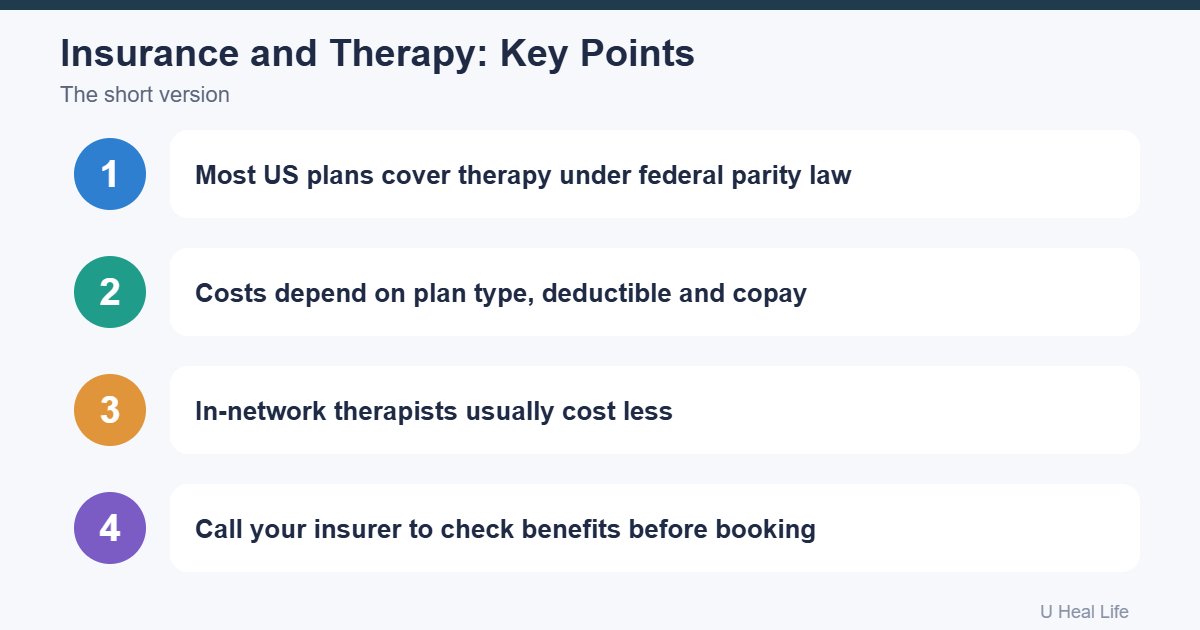
Quick answer: Yes. Most health insurance plans in the U.S. cover therapy, and federal law (the Mental Health Parity and Addiction Equity Act of 2008) requires most plans to treat mental health coverage similarly to medical coverage. What you pay depends on your plan type, deductible, copay and whether your therapist is in-network, so check your own benefits before booking.
Key points at a glance.
Table of Contents
The Short Answer
Yes — most health insurance plans in the U.S. cover therapy. This isn’t just common practice; it’s federal law. Under the Mental Health Parity and Addiction Equity Act (MHPAEA) of 2008, insurers that offer mental health benefits must cover them on equal terms with physical health care — meaning your plan can’t quietly impose a lower session cap, a higher copay, or a stricter approval process for therapy than it does for, say, a visit to your primary care doctor.
The Affordable Care Act (ACA) went a step further in 2010, classifying mental health and substance use treatment as one of ten “essential health benefits” that all ACA-marketplace and most employer plans must include — and ACA-compliant plans cannot place annual or lifetime dollar limits on mental health coverage.
That’s the legal floor. What you actually pay still depends heavily on your specific plan, so let’s break that down by coverage type.
What Counts as “Therapy” for Insurance Purposes
Most plans group therapy under “mental health services” or “behavioral health benefits,” and typically include:
Individual psychotherapy (talk therapy)
Group therapy
Family therapy
Psychiatric visits, including medication management
Substance use disorder counseling
Coverage is generally tied to the provider’s license rather than the specific therapy technique — so whether your therapist uses CBT, DBT, EMDR, or another evidence-based approach usually doesn’t change whether it’s covered, as long as the provider type (licensed psychologist, licensed clinical social worker, licensed counselor, psychiatrist, etc.) is one your plan recognizes.
One detail that trips people up: most insurers require a documented mental health diagnosis before they’ll pay. Your therapist typically handles this as part of standard intake, but it’s worth knowing it’s happening.
Coverage by Plan Type
Employer-Sponsored Insurance
If you get insurance through a job, and your employer has 50 or more employees, your plan is required to follow MHPAEA parity rules whenever it offers mental health benefits at all. Self-funded employer plans (common at larger companies) also have to comply with MHPAEA, though they’re not subject to the same state-level insurance regulations as fully-insured plans.
ACA Marketplace Plans
If you bought your plan through healthcare.gov or a state exchange, mental health and substance use coverage is legally mandatory — it’s one of the ACA’s essential health benefits, and your plan can’t carve it out or cap it the way some older plans could.
Medicare
Medicare Part B covers outpatient psychotherapy when a provider documents medical necessity. In 2026, you’re responsible for 20% co-insurance after meeting the $283 annual Part B deductible — and there’s no hard cap on the number of sessions as long as ongoing treatment is documented as medically necessary. One change worth knowing: as of late January 2026, Medicare telehealth therapy generally requires an in-person visit within the prior six months, under a new CMS rule.
Medicaid
Medicaid covers mental health services in all 50 states and Washington, D.C., though the specific services and cost-sharing vary state by state. Medicaid expansion — which covers low-income adults earning up to 138% of the federal poverty level — is active in 40 states and D.C. as of 2026. For kids, coverage is even broader: under the EPSDT benefit, children on Medicaid are entitled to all medically necessary mental health services regardless of how a particular state structures its plan.
Short-Term and Catastrophic Plans
This is the gap worth knowing about. Short-term health plans are generally exempt from the ACA’s mental health mandate, meaning therapy coverage can be limited or excluded entirely. Catastrophic plans (carrying a $10,600 deductible in 2026, available mainly to people under 30 or those with a hardship exemption) technically include mental health as an essential benefit, but the high deductible means you may be paying full price out of pocket until you hit it.
What You’ll Actually Pay
Coverage existing on paper and coverage being affordable in practice are two different things — here’s where the real cost sits:
Average therapy session cost without insurance: roughly $100–$200, varying by location, therapist experience, and session type
Typical marketplace plan copay (in-network): around $15–$30 per session
Some plans now offer $0 behavioral health copays for in-network outpatient visits, and certain insurers offer no-cost telehealth therapy as part of virtual care programs
Out-of-network costs: significantly higher, and one of the biggest sources of surprise bills — therapy patients are reportedly far more likely than other specialists’ patients to end up seeing an out-of-network provider, often without realizing it ahead of time
The single most cost-determining factor isn’t your diagnosis or your plan tier — it’s whether your therapist is in-network. In-network providers have pre-negotiated rates with your insurer, which is what actually drives your copay or coinsurance down. Out-of-network providers either get paid less by your plan or, in some HMO-style plans, not at all outside of emergencies.
How to Check Your Own Coverage (Before Your First Session)
Pull up your Summary of Benefits and Coverage (SBC) — every plan is required to provide this in plain language, and it will spell out your mental health cost-sharing structure directly.
Call the member services number on your insurance card. Have your card and your prospective therapist’s name ready. Ask specifically:
What is my mental health deductible, and have I met it?
What is my copay or coinsurance for outpatient therapy?
How many sessions are covered per year, and is reauthorization required after a certain point?
Do I need a referral from a primary care doctor first?
Is telehealth therapy covered the same as in-person?
Verify network status directly through your insurer’s portal — not just the therapist’s own website, since provider directories are notoriously prone to listing therapists as in-network when they no longer are.
Keep a record of the call — the representative’s name, the date, and any reference number. If a claim gets denied later, this becomes useful for an appeal.
Does Insurance Cover Psychiatry and Medication Management?
Usually yes. Psychiatrists are medical doctors, and most plans cover psychiatric evaluations and follow-up visits in a way similar to other specialist visits. Medication management visits are typically covered too. The medicines themselves fall under your plan’s prescription drug benefit, so what you pay depends on the plan’s drug list and tier. Your cost is usually lower if the psychiatrist is in network.
What Mental Health Services Are Usually Covered?
Plans differ, but therapy covered by insurance often includes:
Individual therapy with a licensed provider
Group therapy and, when it is part of treatment, family therapy
Psychiatric evaluations and medication management
Intensive outpatient and partial hospitalization programs, when medically necessary
In-Network, Out-of-Network and Behavioral Health Networks
In-network providers have a contract with your plan and usually cost less. Out-of-network care can cost more, and some plans do not cover it. If you see an out-of-network therapist, ask for an itemized receipt (sometimes called a superbill) and check whether your plan reimburses part of the cost.
Some insurers hand mental health benefits to a separate company, often called a managed behavioral health organization. If so, your insurance card may list a different phone number for behavioral health, and your provider search may be on a different site. Managed Health Network (MHN) is one example of a behavioral health benefits company that manages these benefits for some plans. Whether it applies to you depends on your own plan, so check your member ID card and plan documents.
Mental Health Parity: What the Law Says
Under the federal Mental Health Parity and Addiction Equity Act, most plans that cover mental health benefits must apply comparable copays, deductibles and visit limits to them as they do for medical and surgical care. Plans can still use medical necessity rules. Learn more in what behavioral health means.
If Your Plan Doesn’t Cover Enough
Even with solid coverage on paper, real barriers show up often enough that it’s worth knowing the workarounds:
Employee Assistance Programs (EAPs) — many employers offer a set number of free counseling sessions through an EAP, completely separate from your regular health plan
Sliding-scale therapists — many independent therapists adjust their fee based on income, particularly useful if you’re paying out-of-network or uninsured
Community mental health centers — often provide low-cost or free care based on financial need, regardless of insurance status
HSA/FSA funds — therapy is an eligible expense under most Health Savings and Flexible Spending Accounts, which means you can pay with pre-tax dollars you’ve already set aside
Online therapy platforms — services like BetterHelp and Talkspace sometimes offer more flexible payment structures, and some now accept insurance directly
If a claim is denied because your insurer doesn’t consider the treatment “medically necessary,” you have the right to appeal — first through your insurer’s internal appeals process, and if that fails, to your state insurance regulator or, for ERISA-governed employer plans, the U.S. Department of Labor.
Sponsored
Thinking about talking to someone?
If cost or convenience is stopping you from starting therapy, online therapy is one option to look at. Online-Therapy.com offers CBT-based online therapy programs for individuals and couples.
Learn moreThis link will redirect you to a third-party website. We may earn a commission from links you follow.
Frequently Asked Questions: Does Insurance Cover Therapy
Does health insurance cover therapy in 2026? Yes. Most employer-sponsored plans, ACA marketplace plans, Medicare, and Medicaid all cover therapy, though your specific copay, deductible, and session limits depend on your individual plan.
Is therapy covered at 100% by insurance? Rarely. Most plans require you to meet your deductible first, then pay a copay or coinsurance per session. Some higher-tier marketplace plans cover 100% of approved costs after the deductible is met, but this isn’t the norm.
Do I need a diagnosis for insurance to cover therapy? In most cases, yes. Insurers typically require a documented mental health diagnosis to establish “medical necessity” before they’ll pay for sessions. Your therapist usually handles this during intake.
Is online therapy covered by insurance the same as in-person therapy? Often, yes — telehealth therapy coverage expanded significantly and has remained widespread, with virtual sessions now accounting for a large share of all therapy claims. Coverage specifics still vary by plan, so it’s worth confirming directly.
What if my insurance doesn’t cover enough sessions? Most plans allow additional sessions beyond an initial cap if your provider documents continued medical necessity. If you’re approaching a session limit, ask your therapist about submitting this documentation before you’re cut off.
Can my insurance deny mental health coverage that it provides for physical health? No — this is exactly what the Mental Health Parity and Addiction Equity Act prohibits. If you believe your plan is applying stricter limits to mental health benefits than to comparable medical care, you can file an appeal.
This article is for general informational purposes and isn’t a substitute for advice from your insurance provider or a licensed financial or healthcare professional. Coverage details vary by plan, state, and insurer, and benefit rules can change — always confirm specifics directly with your insurance company before assuming a service is covered.
If you’re currently struggling with your mental health and cost is a barrier to getting help, the 988 Suicide & Crisis Lifeline (call or text 988) is free, confidential, and available 24/7 regardless of insurance status.
Does insurance cover psychiatry? Usually yes. Psychiatric visits and medication management are generally covered like other specialist care, and your cost depends on whether the psychiatrist is in network.
Is therapy covered by insurance if I do not have a diagnosis? Many plans need a diagnosis code to pay for therapy, because of medical necessity rules. Ask your plan and your therapist how they handle this before your first visit.
Does Managed Health Network (MHN) cover therapy? MHN is a company that manages mental health benefits for some health plans. Whether therapy is covered, and what you pay, depends on your specific plan, so check your member ID card or call the behavioral health number on it.
Does insurance cover couples therapy? Often not, unless it is part of treatment for a diagnosed condition. Read how much couples therapy costs.
How do I find a therapist covered by my insurance? Use your plan’s provider search, then call the office to confirm they are in network and taking new clients. See how to find a therapist.
Helpful resources: You can compare plan details at HealthCare.gov and read about Medicare coverage at Medicare.gov. If you are in crisis, call or text 988 (the Suicide and Crisis Lifeline) in the US.
Disclaimer: This article is for general information only and is not insurance, legal or medical advice. Coverage varies by plan and state, so please confirm details with your insurer.
This post contains affiliate links. We may earn a commission if you purchase through links on this page, at no extra cost to you.
If you’ve spent any time researching anti-aging skincare, you’ve probably noticed the same problem we did: most “collagen creams” make big promises and back them up with nothing. So when we looked into Kollagen Intensiv™, a topical anti-aging cream built around a patented Swiss peptide technology, we wanted to know one thing — is there anything real behind the claims, or is this just another jar of hope?
Here’s what we found, including where the marketing oversells it and where the science actually checks out.
What Is Kollagen Intensiv™?
Kollagen Intensiv™ is a topical anti-aging cream made by Skinception, designed for daily morning and evening use. Unlike collagen supplements you drink or swallow, this is applied directly to the skin — the idea being that you support collagen production at the surface level where wrinkles actually form, rather than relying on collagen absorbed through digestion.
The product centers on a single active ingredient: SYN-COLL® (palmitoyl tripeptide-5), a patented synthetic peptide developed in Switzerland.
The Science Behind SYN-COLL: What’s Real and What’s Marketing
This is where we need to slow down, because the marketing claim attached to this product is bold: a “354% wrinkle reduction.” We dug into the actual peptide research behind SYN-COLL to see if that number holds up — and it’s worth being upfront about what we found.
What the research actually shows: Independent studies on palmitoyl tripeptide-5 (the active compound in SYN-COLL) suggest it can increase Type I collagen production through stimulation of TGF-β, a growth factor involved in skin repair. In controlled testing using surface topography measurement, the peptide showed meaningfully better wrinkle-reduction results than a placebo — researchers described it as several times more effective than control formulations. A separate 84-day study with twice-daily use reported measurable improvements in skin roughness and wrinkle depth compared to a placebo group.
What we couldn’t verify: A specific “354%” figure as an independent, peer-reviewed result. The number traces back to the ingredient manufacturer’s own formulation documentation rather than a third-party clinical trial we could independently confirm. That doesn’t mean the ingredient doesn’t work — the underlying mechanism (boosting Type I collagen via TGF-β stimulation while inhibiting the enzymes that break collagen down) is real and documented in peptide research. But we’d treat the specific percentage as a marketing figure rather than a guaranteed outcome, and we think you should too.
Bottom line: SYN-COLL has genuine science behind how it might work. The exact how much is less certain than the bottle suggests. That’s a meaningfully different (and more honest) claim than “doesn’t work at all” — which is more than we can say for a lot of products in this category.
What’s Actually in the Formula
Based on the product’s own documentation, Kollagen Intensiv™ combines:
SYN-COLL® (Palmitoyl Tripeptide-5) — the core active peptide, intended to stimulate collagen synthesis and slow collagen breakdown
A single daily cream format — used both morning and evening, rather than separate day/night formulas
The simplicity here is worth noting both ways: it’s easier to use consistently (a real factor in whether any skincare product actually works, since consistency matters more than almost anything else), but it also means you’re relying on one active ingredient rather than a multi-peptide complex some competitors use.
Pricing, Guarantee, and Shipping
A few practical details that matter when you’re deciding whether to try it:
Price: $59.95 USD for a one-month supply, with multi-month package options available
Shipping: Free shipping across North America (US and Canada)
Guarantee: A 67-day satisfaction guarantee — if you don’t see a difference in skin smoothness and texture, you can return the jar for a full refund (shipping costs excluded)
The 67-day window is longer than the industry-standard 30-day return policy, which gives you enough time to actually judge results — most peptide-based skincare needs at least 4-8 weeks of consistent use before changes become visible, so a shorter guarantee window wouldn’t be enough time to fairly evaluate it anyway.
Topical Cream vs. Collagen Supplements: Do You Need Both?
This is a question worth answering honestly, because it affects how you should actually use a product like this.
Topical peptide creams and oral collagen supplements work through different mechanisms, and most dermatology-focused sources treat them as complementary rather than interchangeable:
Topical peptides (like SYN-COLL) work at the skin’s surface and upper dermis, signaling skin cells to produce more collagen locally.
Oral collagen supplements (collagen peptides you drink or take as capsules) are digested and broken down into amino acids, which your body then redistributes — including to skin, but also to joints, bones, and other tissues. The effect is more systemic and generally takes longer to show in the skin specifically.
If your goal is specifically targeting visible facial wrinkles, a topical peptide cream is the more direct tool. If you’re also interested in broader skin elasticity, joint support, or hair and nail benefits, pairing a topical cream with a daily collagen supplement is a reasonable, commonly recommended combination — neither replaces the other, and there’s no real conflict in using both.
Who This Product Makes Sense For
Based on what the product actually is and what the research on its core ingredient supports, Kollagen Intensiv™ is a reasonable option if:
You want a single, simple daily cream rather than a multi-step routine
You’re looking for a peptide-based option with documented (if not “354%”) research behind the active ingredient
You want a long return window to actually test whether it works for your skin specifically
You’re in the US or Canada, where shipping is free and straightforward
It’s probably not the right fit if you’re looking for a multi-ingredient formula with retinoids, multiple peptide complexes, or other actives layered together — this is intentionally a simpler, single-active product.
Frequently Asked Questions
Does Kollagen Intensiv™ really reduce wrinkles by 354%? That specific figure comes from the ingredient manufacturer’s own formulation materials rather than an independent clinical trial we could verify. Independent peptide research on the active ingredient (SYN-COLL) shows real, documented wrinkle-reduction effects compared to a placebo, but at more modest levels than the marketing figure suggests. Treat the 354% number as a marketing claim, not a guaranteed result.
How long does it take to see results? Most peptide-based skincare, including SYN-COLL specifically, shows initial improvements within a few weeks of consistent twice-daily use, with more noticeable results typically reported around the 8-12 week mark. The product’s 67-day guarantee window roughly matches this realistic timeline.
Can I use a collagen cream and a collagen supplement together? Yes. They work through different mechanisms (topical vs. ingested) and are generally considered complementary rather than redundant. Using both isn’t necessary, but it isn’t counterproductive either.
Is Kollagen Intensiv™ available in the US and Canada? Yes — the product ships free across North America.
What if it doesn’t work for my skin? The product includes a 67-day satisfaction guarantee, allowing a full refund (excluding shipping) if you don’t see improvement in smoothness and texture within that window.
Disclaimer: This article is for informational purposes only and is not a substitute for professional dermatological advice. Individual results vary. If you have sensitive skin or known allergies, patch-test any new skincare product and consult a dermatologist with questions specific to your skin.
Men are paying more attention to their testosterone levels than ever before—and for good reason. From maintaining muscle mass and skyrocketing energy to keeping a sharp mental edge, testosterone is the core engine of male vitality.
But when the engine starts to stall, men face a critical crossroad: Do you go the synthetic route, or do you fix the problem naturally? In recent years, synthetic testosterone replacement therapy (TRT) and anabolic steroids became popular quick fixes. However, as we move through 2026, the tide is turning. Men are becoming hyper-aware of the long-term health risks associated with artificial hormones. Enter the new era of high-performance natural supplementation, led by a breakout formula: Testosil.
Here is exactly why the industry is shifting away from synthetics and why Testosil is being hailed as the natural game-changer of 2026.
The Dark Side of Synthetic Testosterone
Synthetic testosterone comes in many forms—injections, gels, patches, and illegal anabolic steroids. While they undeniably inject exogenous (outside) hormones into your bloodstream for rapid results, they come with a hefty, often dangerous, price tag.
When you introduce synthetic testosterone into your body, your endocrine system goes into shock. Your brain senses the artificial surplus and signals your testes to shut down natural production completely.The Risks of the Synthetic Route:
Testicular Atrophy: Because your body stops making its own testosterone, the testes shrink.
Lifelong Dependency: Once you start TRT, getting off it is notoriously difficult. If you stop, your natural levels will crash lower than where they started.
Cardiovascular Risks: Synthetic testosterone can thicken the blood (polycythemia), elevating blood pressure and increasing the risk of strokes or heart attacks.
Severe Mood Swings: Artificial hormone spikes can lead to aggressive behavior, followed by deep depressive crashes when the dosage wears off.
The Natural Alternative: Working With Your Body
Natural testosterone boosters do not contain actual testosterone. Instead, they are formulated with vitamins, minerals, amino acids, and herbal extracts that stimulate your body’s endogenous (internal) production.
Rather than replacing your hormonal system, natural boosters repair it. They give your body the exact raw materials it needs to signal the brain (specifically the hypothalamus and pituitary gland) to ramp up the production of luteinizing hormone (LH), which tells the testes to create more testosterone naturally.
There are no shrinking testes, no blood-thickening nightmares, and no lifelong dependencies. You simply optimize the machine you were born with.
Why Testosil is the Game-Changer of 2026
For years, the natural T-booster market was plagued by under-dosed proprietary blends and “snake oil” marketing. Testosil shattered that mold by taking a clinical, transparent approach to formulation.
Here is why Testosil is dominating the 2026 market as the ultimate natural alternative to synthetics:
1. The KSM-66® Ashwagandha Advantage
As the cornerstone of the Testosil formula, KSM-66 is arguably the most extensively researched natural adaptogen on the planet. Instead of just trying to force testosterone production, KSM-66 aggressively lowers cortisol (the stress hormone). Because cortisol physically blocks testosterone production, lowering it opens the floodgates for natural T-levels to rise.
2. Full-Spectrum Hormonal Support
Testosil doesn’t just stop at Ashwagandha. It attacks low T from multiple physiological angles using clinically studied doses of:
D-Aspartic Acid (DAA): An amino acid proven to trigger the release of luteinizing hormone (LH), directly instructing the testes to produce more testosterone.
Fenugreek Extract: A powerful herb that prevents your body’s existing testosterone from converting into estrogen.
ZMA Synergy (Zinc, Magnesium, Vitamin B6): The ultimate trifecta for deep sleep, energy production, and testosterone synthesis.
Panax Ginseng & L-Arginine HCL: Included to boost nitric oxide, supporting explosive muscle pumps in the gym and enhancing stamina and circulation.
3. Zero Proprietary Blends
In 2026, consumers are smarter. Testosil thrives because of its 100% transparent label. You know exactly what you are putting into your body, manufactured in FDA-registered U.S. facilities.
Synthetic vs. Natural (Testosil): The Quick Comparison
Feature
Synthetic Testosterone (TRT/Steroids)
Natural T-Booster (Testosil)
Source of Hormone
Artificial/Exogenous
100% Natural/Endogenous
Natural Production
Shuts it down completely
Enhances and optimizes it
Side Effects
High risk (Atrophy, heart issues, mood swings)
Extremely low risk (Natural ingredients)
Dependency
High (Requires lifelong use)
None (Can be cycled safely)
Prescription Required?
Yes (often requires doctor visits/bloodwork)
No (Available online)
Export to Sheets
The Verdict: Upgrading Your Vitality Safely
The days of risking your long-term health for a synthetic hormonal spike are over. The science of natural supplementation has simply gotten too good to ignore.
If you are experiencing the classic symptoms of low testosterone—stubborn belly fat, loss of muscle, chronic fatigue, and a plummeting drive—you don’t need a synthetic band-aid. You need to fix the root of the problem.
By utilizing clinically proven ingredients like KSM-66 Ashwagandha, D-Aspartic Acid, and Fenugreek, Testosil proves that the smartest way to reclaim your male vitality in 2026 is by working with your body, not against it.
> Author’s Note: Ready to make the switch? Always ensure you are buying natural supplements from their official website to avoid counterfeit products and take advantage of money-back guarantees.