

How Much Does Couples Therapy Cost? Price Ranges and Insurance (2026)
Couples therapy can feel like a big investment, so it helps to know the price before you start. Costs depend on where you live, the therapist and the format. This guide explains typical US prices for couples therapy, whether insurance helps, what online options cost and ways to pay less.
By the U Heal Life editorial team. Last updated: November 2026. This is general information, not medical, legal, tax or insurance advice. We are not licensed clinicians. We have not tested the services mentioned.
Quick answer: Without insurance, couples therapy in the US commonly costs about $100 to $250 per session, with some sources reporting a typical range of $75 to $250 and others $150 to $300. Insurance often does not cover relationship counseling unless it is tied to a diagnosed condition and your plan allows it. Online options, sliding scale therapists and nonprofit networks can cost less. Ask about fees, session length and cancellation rules before you book.
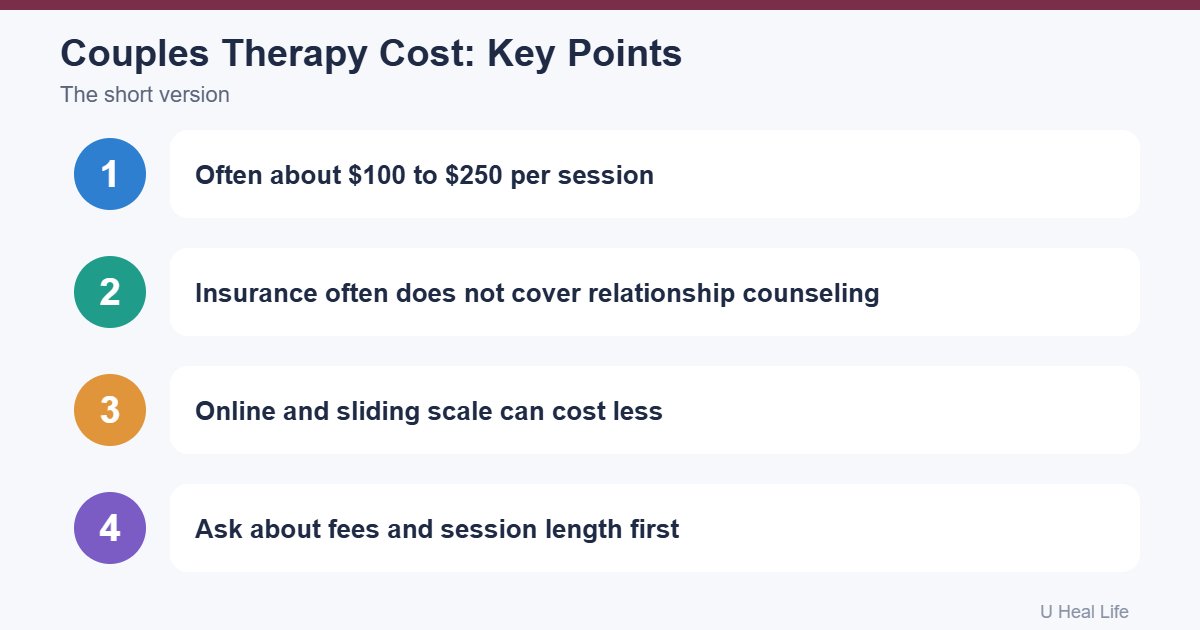
Table of Contents
Typical Price Ranges
Figures below come from public cost guides and vary widely.
| Option | Typical cost |
|---|---|
| In-person couples therapist (self-pay) | About $100 to $250 per session, some report up to $300 |
| Online couples therapy | Reported from about $65 to $275 per session, depending on the platform |
| Sliding scale therapist | Often lower, based on income |
| Open Path Collective (couples and family) | At the time of writing, about $40 to $80 per session plus a one-time membership fee |
Sessions usually last 50 to 60 minutes. Some therapists charge more for longer sessions.
How Many Sessions Will You Need?
It varies a lot. Some couples come for a short block of sessions, while others stay longer. A therapist can give you a rough plan after the first few visits. Ask what to expect so you can budget.
Does Insurance Cover Couples Therapy?
Often not. Many plans do not cover relationship counseling on its own. Coverage may be possible when therapy is part of treatment for a diagnosed condition and your plan allows it, so ask your insurer. Some Employee Assistance Programs offer a few free sessions. See what an EAP is. Our insurance coverage guide explains how to check.
Can You Use an HSA or FSA?
Marriage or relationship counseling often does not count as a medical expense unless it is medical treatment. Check with your plan administrator. Read can you use an HSA or FSA for therapy.
Ways to Pay Less
- Ask about a sliding scale
- Try Open Path Collective
- Look at community clinics and training clinics. See free and low-cost therapy options
- Compare online options. See how much online therapy costs
- Ask about package or payment plans
- Check your EAP for free sessions
How to Choose a Couples Therapist
Look for a licensed professional with training in couples or family therapy, such as a marriage and family therapist. The AAMFT therapist locator can help. Ask about their approach, experience with your situation and fees. Read how to find a therapist.
If you or your partner feel unsafe, contact local emergency services or a local support line right away.
Frequently Asked Questions: How Much Does Couples Therapy Cost
How much is couples therapy per session?
Often about $100 to $250 in the US without insurance, though prices differ by area and therapist.
Is online couples therapy cheaper?
Sometimes. Prices vary by platform and plan, so compare what is included.
Does insurance pay for marriage counseling?
Usually not on its own. Ask your insurer about your specific plan.
Is there free couples counseling?
Some community programs, faith-based groups and EAPs offer free or low-cost options.
What about a couples retreat?
A retreat is not therapy. See wellness retreats for couples.
Helpful resource: Open Path Collective lists lower-fee therapists, including for couples.
Related Reading
- How Much Does Therapy Cost Without Insurance?
- How Much Does Online Therapy Cost?
- Can You Use an HSA or FSA for Therapy?
- Free and Low-Cost Therapy Options in the USA
- Wellness Retreats for Couples
Disclaimer: This article is for general information only and is not medical, mental health, tax or insurance advice. Prices, rules and availability change, so please confirm details with each provider or plan. If you are in crisis or thinking about harming yourself, call or text 988 (the Suicide and Crisis Lifeline in the US) or your local emergency number right away.