By the U Heal Life editorial team. Last updated: October 2026. We have not personally tested the products or supplements discussed here, and we are not doctors. Read how we review supplements.
Affiliate disclosure: This article contains affiliate links. If you buy through our links, we may earn a commission at no extra cost to you. Our content is educational and based on public product information and published research, not personal testing.
There are hundreds of nootropic supplements on the market. How does BrainPill compare? Instead of declaring a winner, this guide gives you a fair way to compare any two products.
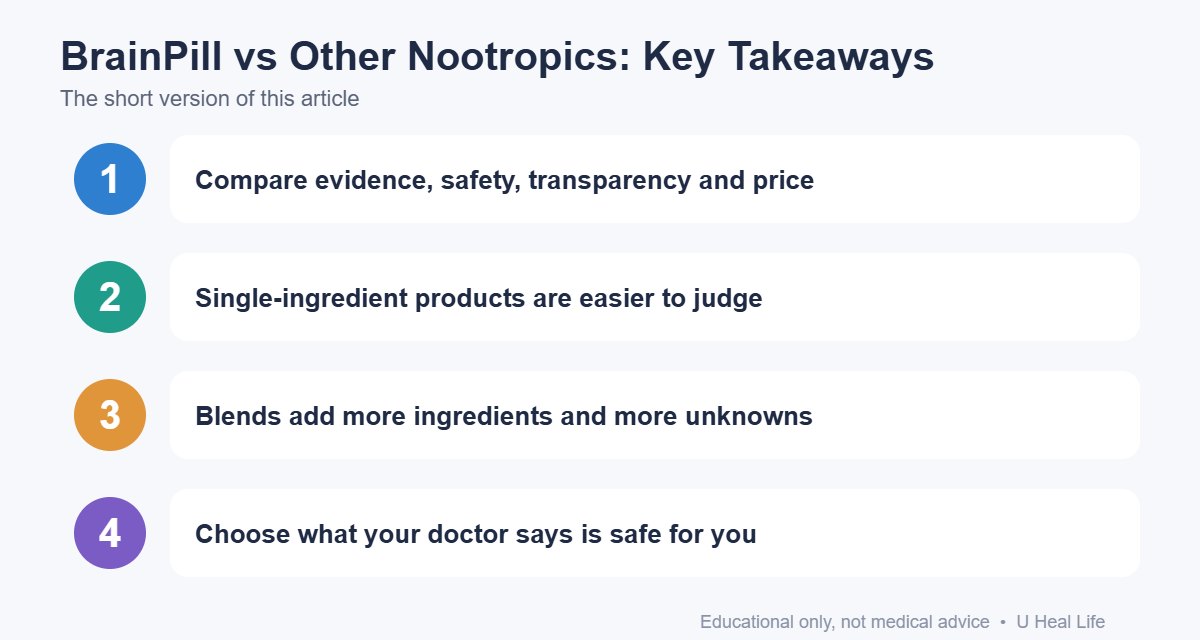
Quick answer: We are not aware of any head-to-head trials comparing BrainPill with other nootropics, so no one can honestly name a “best” product. Compare products on evidence, safety, label transparency, price and refund terms, and choose what a healthcare professional says is safe for you.
Quality and strength can vary; some interact with medicine
Multi-ingredient nootropic blends
Many ingredients, such as BrainPill
One product with many ingredients
Hard to know which part does what; more safety checks needed
Where BrainPill Fits
BrainPill is a multi-ingredient blend. The manufacturer lists 13 ingredients, including citicoline, bacopa, L-theanine, tyrosine, ginkgo, huperzine A, vinpocetine, DHA and B vitamins. It also offers a published 60-day money-back guarantee.
The main trade-offs are that more ingredients mean more things to check for safety, and the evidence for the finished blend is limited. Details are in our guides to BrainPill ingredients and BrainPill side effects.
7 Questions to Compare Any Two Products
Evidence: Were the ingredients, and ideally the finished product, tested in good human studies?
Doses: Does the label show the exact amount of each ingredient?
Safety: Are there known warnings, such as pregnancy or medicine interactions?
Quality: Is there third-party testing, and who makes the product?
Price: What does it cost per month of use, including shipping?
Refunds: Are the return terms clear and fair?
Fit: Does it suit your health, medicines and goals?
Red Flags to Avoid
Claims like “limitless” or “genius in 30 days”
Saying a supplement is “FDA approved” for memory
Fake doctor endorsements or too-good-to-be-true reviews
Pressure tactics, such as “only 3 left”
No ingredient amounts on the label
Claims to treat or cure ADHD, anxiety or dementia
Which Type May Suit You?
You want a simple, low-risk start: a single ingredient your doctor approves, or just better sleep and routines.
You may have a deficiency: ask for a blood test before buying vitamins.
You like a multi-ingredient product: compare labels closely and check every ingredient for safety.
Paid affiliate link. We may earn a commission from qualifying purchases.
Frequently Asked Questions: BrainPill Vs Other Nootropics
Is BrainPill better than other nootropics?
No one can say, because there are no direct comparison studies that we know of. Compare the label, evidence, safety and price for yourself.
Is a supplement with more ingredients better?
Not necessarily. More ingredients can mean more risk and less clarity on what works.
Are there prescription alternatives?
Doctors may prescribe medicine for conditions such as ADHD. Do not self-treat with supplements. See a professional for a proper diagnosis.
What is the safest way to try a nootropic?
Talk to a doctor, change one thing at a time, follow the label, and stop if you have side effects.
Final Thoughts
The best nootropic is the one that is safe for you, honest about what it can do, and supported by good habits. For more on our view of this product, read the full BrainPill review.
Disclaimer: This article is for educational purposes only and is not medical advice. Dietary supplements are not intended to diagnose, treat, cure, or prevent any disease. Talk to a qualified healthcare professional before using supplements, especially if you take medicine, are pregnant or breastfeeding, or have a health condition.
By the U Heal Life editorial team. Last updated: October 2026. We have not personally tested the products or supplements discussed here, and we are not doctors. Read how we review supplements.
Affiliate disclosure: This article contains affiliate links. If you buy through our links, we may earn a commission at no extra cost to you. Our content is educational and based on public product information and published research, not personal testing.
Before you try any supplement, you should know the possible side effects. This guide covers the main safety points for BrainPill in clear, simple language.
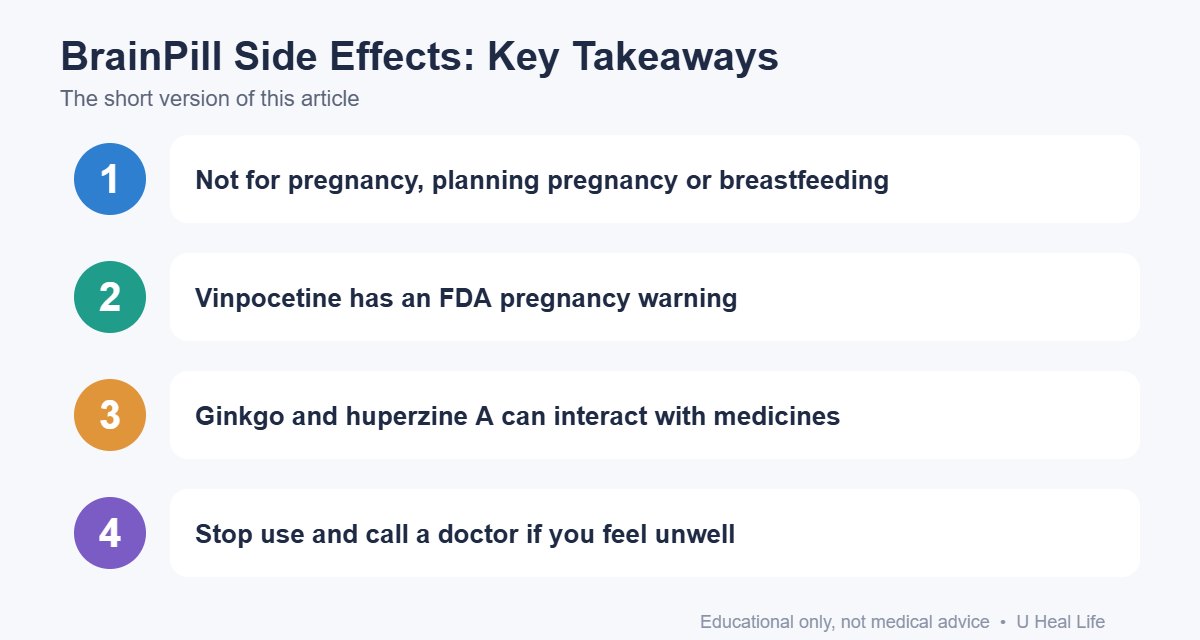
Quick answer: The manufacturer says not to use BrainPill if you are pregnant, planning to become pregnant, or breastfeeding. The FDA has warned about one of its ingredients, vinpocetine, and others such as ginkgo and huperzine A can interact with medicines. We did not find published safety trials of the finished product, so ask a doctor or pharmacist before use.
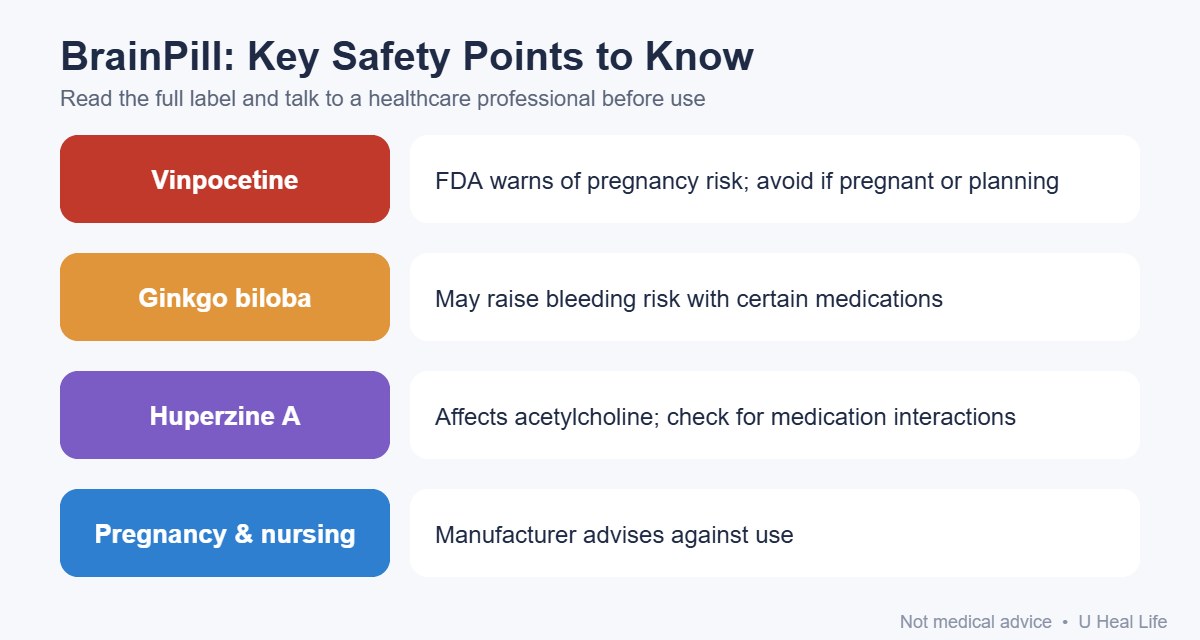
The key points at a glance.
An Honest Note About the Evidence
We could not find published studies that measure how often side effects happen with BrainPill itself. What we can do is look at the manufacturer’s warning and the known safety information for its ingredients. This does not tell you how likely side effects are. It tells you what to watch for.
The Manufacturer’s Warning
The official website says not to use the product if you are pregnant, plan to become pregnant, or are breastfeeding, and to consult a doctor or pharmacist. Take this seriously.
Ingredient-by-Ingredient Safety Points
Ingredient
Possible concerns
Vinpocetine
FDA has warned it may cause miscarriage or harm fetal development
Ginkgo biloba
May raise bleeding risk, especially with blood thinners
Huperzine A
Affects acetylcholine; possible interactions with some medicines; may cause nausea or dizziness
Bacopa monnieri
Stomach cramps, nausea or loose stools in some people
Citicoline
Headache or stomach upset in some people
Tyrosine
Ask a pharmacist if you take thyroid medicine or certain antidepressants
DHA (omega-3)
Fishy aftertaste; may affect blood clotting at high doses
Vitamin B6
Very high long-term doses can harm nerves
Folic acid
High amounts can hide a vitamin B12 deficiency
Possible Mild Side Effects
With supplements that combine many active ingredients, people sometimes report:
Headache or dizziness
Nausea or an upset stomach
Trouble sleeping or restlessness
Allergic reactions such as a rash or itching
This is a list of possibilities, not a statement about how often they happen with BrainPill.
Who Should Avoid BrainPill?
Please do not use it without medical advice if you:
Are pregnant, planning pregnancy, or breastfeeding
Take blood thinners or have a bleeding disorder
Take prescription medicine for memory, mood, thyroid, or blood pressure
Have a serious health condition or are scheduled for surgery
Are under 18
Have symptoms like ongoing memory loss, which need a proper medical check
Medicine Interactions to Ask About
Show the complete ingredient label to your doctor or pharmacist and ask about:
Blood thinners and aspirin (ginkgo, high-dose DHA)
Medicines that act on acetylcholine (huperzine A)
Thyroid medicine and certain antidepressants (tyrosine)
Any other supplements you take, so you do not double up on vitamins
What to Do If You Feel Unwell
Stop taking the product.
Get medical help for serious symptoms such as trouble breathing, chest pain, swelling or fainting.
Paid affiliate link. We may earn a commission from qualifying purchases.
Frequently Asked Questions: BrainPill Side Effects
Is BrainPill safe?
That depends on the person. It contains ingredients with real cautions, and it is not suitable for everyone. There are no published safety trials of the finished product that we could find.
Can BrainPill make me anxious or jittery?
Reactions differ from person to person. If you notice restlessness, poor sleep or a racing heart, stop and talk to a doctor.
Is it safe to take long term?
We have no long-term safety data on the finished product. Ask a doctor before using any supplement for months.
Can I take it with coffee?
Mixing supplements with caffeine can change how you feel. Ask a pharmacist if you are unsure.
Final Thoughts
Safety matters more than any claimed benefit. If you are pregnant, take medicine, or have a health condition, speak to a professional first. For the complete picture of the product, read our BrainPill review.
Disclaimer: This article is for educational purposes only and is not medical advice. Dietary supplements are not intended to diagnose, treat, cure, or prevent any disease. Talk to a qualified healthcare professional before using supplements, especially if you take medicine, are pregnant or breastfeeding, or have a health condition.
By the U Heal Life editorial team. Last updated: October 2026. We have not personally tested the products or supplements discussed here, and we are not doctors. Read how we review supplements.
Affiliate disclosure: This article contains affiliate links. If you buy through our links, we may earn a commission at no extra cost to you. Our content is educational and based on public product information and published research, not personal testing.
What is actually inside BrainPill? This guide explains each ingredient in simple words: what it is, what research suggests, and what to watch out for.
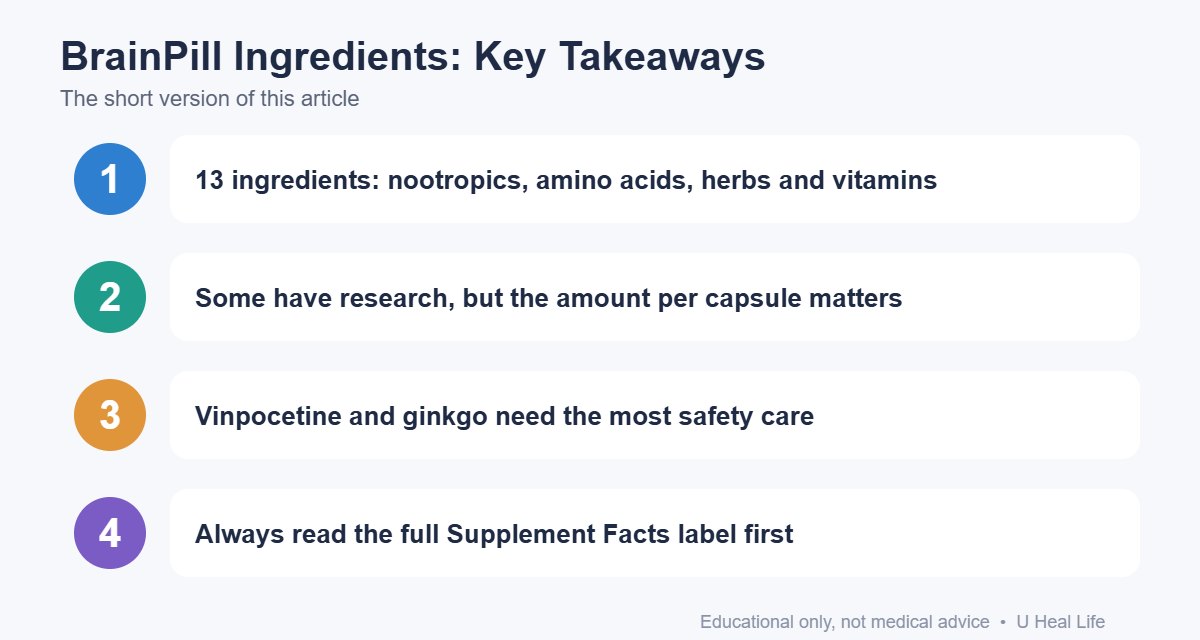
Quick answer: BrainPill’s official ingredient page lists 13 ingredients, including citicoline (Cognizin), Bacopa monnieri (Synapsa), L-theanine, phosphatidylserine, tyrosine, ginkgo biloba, huperzine A, vinpocetine, DHA and several B vitamins. Some have research behind them, but research on one ingredient does not prove the whole formula works.
The key points at a glance.
How the Formula Is Organized
The manufacturer groups the ingredients into two ideas. The first is a “focus and cognitive energy” group built around citicoline, tyrosine, phosphatidylserine, L-theanine and B vitamins. The second is a “memory” group built around Bacopa monnieri, huperzine A, folic acid, vinpocetine, ginkgo biloba and DHA.
These groups are marketing categories, not scientific ones. It is better to look at each ingredient on its own.
The 13 Ingredients at a Glance
Ingredient
What it is
What research suggests
Safety note
Citicoline (Cognizin)
A nutrient involved in brain cell membranes
Small studies on attention and memory
Generally well tolerated; mild stomach upset or headache can occur
Tyrosine
An amino acid
Possible help with thinking under stress or lack of sleep
Ask a pharmacist if you take thyroid medicine or certain antidepressants
Phosphatidylserine
A fat found in cell membranes
Mixed results, mostly in older adults
Can cause stomach upset in some people
Vitamin B12
An essential vitamin
Matters most if you are low in it
Low risk at normal amounts
L-theanine
An amino acid found in tea
May support relaxation and attention
Usually well tolerated
Vitamin B6
An essential vitamin
Needed for normal brain function
Very high long-term doses can harm nerves
Vitamin B5
An essential vitamin
Helps the body make energy
Low risk at normal amounts
Bacopa monnieri (Synapsa)
A traditional herb
Some trials suggest memory benefits after weeks of use
Can cause nausea or stomach cramps
Huperzine A
A compound from a moss called Huperzia serrata
Studied for memory problems, not proven for healthy adults
Can affect acetylcholine; check medicine interactions
Folic acid (B9)
A form of folate
Needed for normal brain and blood health
High amounts can hide a B12 deficiency
Vinpocetine
A lab-made compound based on a plant chemical
Studied for blood flow in the brain
FDA warns it may harm a pregnancy
Ginkgo biloba
A herbal extract
Evidence for memory in healthy adults is uncertain
May raise bleeding risk with some medicines
DHA complex
An omega-3 fat
Important for brain structure
May affect blood clotting at high doses
Ingredients With the Most Research Interest
Citicoline and Bacopa monnieri get the most attention in focus and memory research. Studies are mostly small, and results depend on dose, time and who was tested. Bacopa trials usually last 12 weeks or more, so a short trial of a product does not tell you much.
L-theanine is often studied together with caffeine, which makes it hard to say what it does alone. Phosphatidylserine has mostly been studied in older adults.
Vitamins and Omega-3
B vitamins and DHA are real nutrients your brain needs. The NIH Office of Dietary Supplements has fact sheets on vitamin B12, vitamin B6 and omega-3 fatty acids. If your diet already gives you enough, extra amounts may not make you sharper.
Ingredients That Need Extra Caution
Three ingredients deserve a careful look:
Vinpocetine: The FDA has warned that it may cause miscarriage or harm fetal development.
Ginkgo biloba: The NCCIH says it has not been shown to prevent or slow dementia, and it may increase bleeding risk with some medicines.
Huperzine A: It affects a brain chemical, so ask a pharmacist about interactions if you take prescription medicine.
The manufacturer also states that the product should not be used during pregnancy, while planning pregnancy, or while breastfeeding.
What the Ingredient List Cannot Tell You
Knowing the names is not enough. Before you decide, check the Supplement Facts label for:
The exact amount of each ingredient per serving
Serving size and number of servings per bottle
Allergen information
Whether any ingredient is hidden inside a “blend” without amounts
Paid affiliate link. We may earn a commission from qualifying purchases.
Frequently Asked Questions: BrainPill Ingredients
How many ingredients are in BrainPill?
The manufacturer says it is a blend of 13 nootropic ingredients.
Are the ingredients natural?
Some are herbs or plant extracts, some are vitamins and amino acids, and vinpocetine is a lab-made compound inspired by a plant chemical.
Which ingredient is the most important?
None has been proven to be the key one. The evidence is stronger for some than for others, but none proves the formula works.
Can I get these nutrients from food?
Partly. Fish gives DHA, tea gives L-theanine, and a balanced diet gives B vitamins. A doctor can tell you if you need a supplement.
Final Thoughts
Understanding the ingredients is the best way to judge any supplement. BrainPill has a mix of well-known and debated ingredients, and a few that need real caution. To see how we weigh it all together, read our full BrainPill review.
Disclaimer: This article is for educational purposes only and is not medical advice. Dietary supplements are not intended to diagnose, treat, cure, or prevent any disease. Talk to a qualified healthcare professional before using supplements, especially if you take medicine, are pregnant or breastfeeding, or have a health condition.
By the U Heal Life editorial team. Last updated: October 2026. We have not personally tested the products or supplements discussed here, and we are not doctors. Read how we review supplements.
Affiliate disclosure: This article contains affiliate links. If you buy through our links, we may earn a commission at no extra cost to you. Our content is educational and based on public product information and published research, not personal testing.
If you are searching for “does BrainPill really work,” you probably want a straight answer. Many reviews online are written to sell, so this guide looks at the evidence in a calm, balanced way.
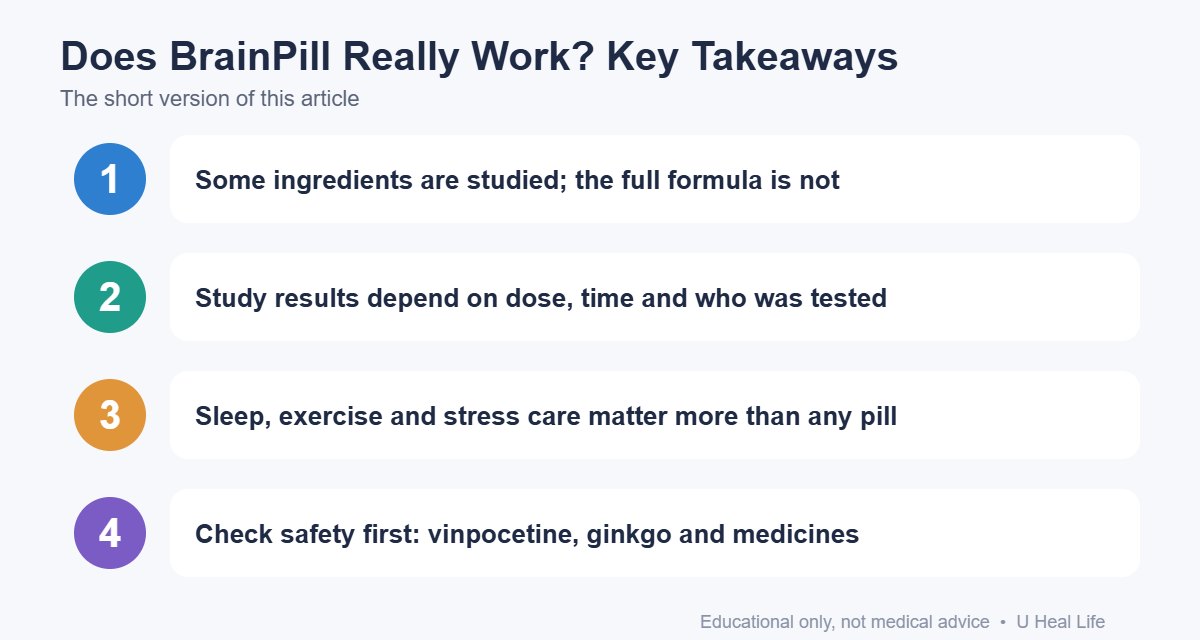
Quick answer: We cannot say that BrainPill works. Several of its ingredients have been studied, but we found no independent, placebo-controlled trial of the finished product showing better memory or focus. Results from ingredient studies cannot simply be applied to a multi-ingredient blend.
The key points at a glance.
Does BrainPill Really Work? What “Work” Actually Means
A supplement “works” if it does more than a sugar pill, in people like you, at the dose in the product, and without causing harm. In real life that means:
A noticeable improvement in focus or memory
A benefit that is larger than the placebo effect
Results that other researchers can repeat
Good safety for the people who use it
What the Manufacturer Says
BrainPill is made by Leading Edge Health. Its ingredient page describes a blend of 13 nootropics and uses strong words such as “clinically proven” for some ingredients. It says the formula can support focus, concentration, memory and mental stamina.
At the bottom of the same website there is the standard notice that these statements have not been evaluated by the FDA and that the product is not meant to diagnose, treat, cure, or prevent any disease. That notice is important. Marketing claims on a supplement page are not the same as approved medical claims.
What Independent Research Says
Here is a simple overview of what is known about the main ingredients. It is a summary, not a full scientific review.
The Gap Between Ingredient Studies and the Finished Product
Even when an ingredient looks promising, the finished product can behave differently. That is why the question “does BrainPill really work” cannot be answered by ingredient studies alone. Here is why:
Dose: A study may use a higher or lower amount than a capsule contains.
Combination: Mixing many ingredients can change how each one acts, and it becomes hard to know which one, if any, causes an effect.
People tested: Many studies are in older adults or people with a health condition, not busy, healthy adults.
Time: Some ingredients were tested for weeks or months, not days.
Outcome: A small change on a lab test does not always mean a real change in daily life.
Why Some People Feel Better
Many users say they feel sharper. Does BrainPill really work for them, or is something else going on? This can have normal explanations:
The placebo effect. Expecting to feel better can improve how you feel and perform.
Other changes made at the same time, such as better sleep or less stress.
Natural ups and downs in energy and focus.
A real benefit if the person was low in a nutrient, such as vitamin B12.
None of this means the product is useless. It means personal stories are not proof.
How to Test Any Supplement Fairly
Talk to a doctor or pharmacist first, especially if you take medicine.
Fix the basics first: sleep, food, water, movement and stress.
Change only one thing at a time so you know what caused a change.
Keep a short daily note on focus, mood and sleep for 8 to 12 weeks.
Stop and speak to a professional if you notice side effects.
Use any refund window carefully and read the terms.
The manufacturer’s site describes a 60-day guarantee. Returns must reach the warehouse within a set number of days after delivery, shipping costs are not refunded, and refunds are limited to one order per customer. Terms can change, so read the current policy before you order. A refund policy lowers your money risk, but it does not prove that a supplement works.
Frequently Asked Questions
Is there clinical proof that BrainPill works?
The manufacturer points to research on individual ingredients. We did not find an independent, placebo-controlled trial of the finished product in healthy adults.
How long does BrainPill take to work?
There is no reliable timeframe. Some ingredient studies lasted around 12 weeks, but that does not mean you should expect the same result.
Is BrainPill like a prescription focus medicine?
No. It is a dietary supplement. It has not been tested as a replacement for prescription treatment for ADHD or any other condition.
Is it safe with other medicines?
Ask a doctor or pharmacist. Ingredients such as ginkgo and huperzine A can interact with some medicines.
Final Thoughts
So, does BrainPill really work? BrainPill contains ingredients that scientists find interesting, but “interesting” is not the same as “proven.” If you decide to try it anyway, go in with realistic expectations, check the label, and keep your daily habits strong. For the full picture, read our complete BrainPill review.
Disclaimer: This article is for educational purposes only and is not medical advice. Dietary supplements are not intended to diagnose, treat, cure, or prevent any disease. Talk to a qualified healthcare professional before using supplements, especially if you take medicine, are pregnant or breastfeeding, or have a health condition.
By the U Heal Life editorial team. Last updated: October 2026. We have not personally tested the products or supplements discussed here, and we are not doctors. Read how we review supplements.
Updated: October 2026
Affiliate disclosure: This article contains affiliate links. If you purchase through our links, we may earn a commission at no additional cost to you. Our analysis is based on publicly available product information and scientific research, not personal testing of BrainPill.
Medical disclaimer: This article is for educational purposes only and is not medical advice. Consult a qualified healthcare professional before using dietary supplements, especially if you take medication or have an existing medical condition.
Maintaining concentration throughout a busy workday isn’t always easy. Between constant notifications, demanding schedules, poor sleep, and everyday stress, many adults struggle to stay mentally focused.
BrainPill is a dietary supplement marketed to people looking for support with memory, focus, concentration, and mental performance.
But does BrainPill actually work? Are its ingredients supported by scientific research? And what should you know about its safety before considering it?
In this independent BrainPill review, we’ll examine the formula, potential benefits, research limitations, possible side effects, pricing considerations, and important precautions.
What Is BrainPill?
BrainPill is a cognitive-support dietary supplement marketed by Leading Edge Health.
The manufacturer promotes it as a nootropic formula designed to support:
Focus and concentration
Memory and recall
Mental alertness
Cognitive endurance
Productivity during demanding tasks
Nootropics are substances marketed or studied for their possible effects on cognitive functions such as attention, learning, and memory.
Some nootropic ingredients have been evaluated in human studies, but the quality and strength of evidence vary considerably.
Important distinction: Evidence supporting an individual ingredient does not automatically prove that a finished supplement containing multiple ingredients delivers the same results.
BrainPill should not be considered a treatment for ADHD, anxiety disorders, depression, dementia, or other medical conditions.
BrainPill Ingredients: What’s Inside?
According to the manufacturer’s ingredient page, BrainPill combines vitamins, botanical extracts, and other compounds associated with cognitive function.
The advertised formula includes citicoline, Bacopa monnieri, L-theanine, phosphatidylserine, tyrosine, ginkgo biloba, huperzine A, vinpocetine, DHA, and several B vitamins.
The ingredients deserve individual consideration because their mechanisms, evidence, and safety profiles differ.
1. Citicoline (Cognizin)
Citicoline is involved in processes related to phospholipid production and cellular function.
Researchers have investigated citicoline for potential effects on attention, memory, and other cognitive outcomes.
Some studies have reported encouraging findings in particular populations, but results cannot automatically be generalized to every healthy adult.
The amount used, study population, duration, and measured outcomes all matter.
Our assessment: Citicoline is a relevant ingredient for cognitive-health research, but its inclusion alone does not establish BrainPill’s effectiveness.
2. Bacopa Monnieri (Synapsa)
Bacopa monnieri is a botanical ingredient traditionally used in Ayurvedic medicine.
It has attracted scientific interest because of possible effects on memory and information processing.
Some controlled trials have suggested benefits on selected memory measures after sustained supplementation.
However, studies differ in extract standardization, dosage, participant characteristics, and methodology.
Bacopa can also cause gastrointestinal discomfort in some individuals.
Our assessment: Bacopa has some promising research, but it is not an instant solution for memory difficulties or poor concentration.
3. L-Theanine
L-theanine is an amino acid naturally present in tea.
Researchers have investigated its possible effects on relaxation, attention, and responses to stress.
Some studies have examined L-theanine together with caffeine, making it important not to attribute every observed effect to L-theanine alone.
BrainPill is marketed as a caffeine-free supplement.
Our assessment: L-theanine is an interesting ingredient, but the evidence does not establish that BrainPill will reliably improve focus.
4. Phosphatidylserine
Phosphatidylserine is a phospholipid found in cell membranes, including those of brain cells.
It has been studied for potential effects on cognitive performance, particularly in certain older populations.
The evidence is mixed and depends on the formulation and population being studied.
Our assessment: Its biological role is established, but clinical benefits from supplementation should not be assumed.
5. Tyrosine
Tyrosine is an amino acid involved in producing several important signaling molecules.
Research has explored whether supplementation may influence cognitive performance under demanding conditions, such as acute stress or sleep deprivation.
Findings from specialized laboratory conditions do not necessarily translate into meaningful improvements during ordinary daily activities.
6. Ginkgo Biloba
Ginkgo biloba is widely marketed for memory and brain health.
However, evidence for improving cognitive performance in healthy adults remains uncertain.
The National Center for Complementary and Integrative Health reports that ginkgo has not been shown to prevent or slow dementia.
Ginkgo may also increase bleeding risk, particularly when combined with certain medications.
Our assessment: Ginkgo should not be treated as a proven memory enhancer.
7. Huperzine A
Huperzine A is a compound studied for its effects on acetylcholinesterase, an enzyme involved in the breakdown of acetylcholine.
Because it can affect neurotransmitter activity, it deserves particular attention when evaluating medication interactions and side effects.
Research into selected cognitive conditions does not establish that huperzine A improves everyday performance in healthy adults.
8. Vinpocetine
Vinpocetine is one of the most important ingredients to consider from a safety perspective.
The U.S. Food and Drug Administration has warned that vinpocetine may cause miscarriage or harm fetal development.
The FDA has also questioned its regulatory status as a dietary supplement ingredient.
People who are pregnant or could become pregnant should avoid products containing vinpocetine.
BrainPill’s manufacturer separately warns against use during pregnancy, when planning pregnancy, or while breastfeeding.
9. DHA and B Vitamins
DHA is an omega-3 fatty acid involved in normal brain function.
Vitamins B5, B6, B9, and B12 contribute to various metabolic and neurological processes.
Correcting a nutritional deficiency can be important for health and cognitive function.
However, taking additional vitamins when nutritional status is already adequate does not necessarily produce better memory or concentration.
Excessive intake of certain vitamins can also create health risks.
Does BrainPill Really Work?
This is the central question for anyone researching BrainPill.
The manufacturer makes several claims about focus, memory, and cognitive performance.
Some individual ingredients have been studied in humans, but ingredient-level findings are not equivalent to evidence from rigorous clinical trials of the complete commercial formula.
To establish that BrainPill itself produces meaningful improvements, ideally researchers would conduct well-designed, randomized, placebo-controlled trials using the marketed formulation and clearly defined cognitive outcomes.
Important questions include:
Was the complete formula tested?
How many participants were included?
Were participants healthy adults or people with specific conditions?
Was the study randomized and placebo-controlled?
Were outcomes clinically meaningful?
Were findings independently replicated?
Were adverse events systematically monitored?
The manufacturer’s published ingredient explanations and research references are useful starting points, but they should not be treated as independent proof of every advertised benefit.
Our verdict on effectiveness: BrainPill contains several ingredients of scientific interest, but the publicly reviewed evidence is insufficient to conclude that the finished product reliably improves memory, focus, or productivity in healthy adults.
Potential BrainPill Benefits: What Is Reasonable to Expect?
Focus and concentration
Some ingredients have been investigated for effects on attention.
However, BrainPill should not be expected to produce a predictable improvement for every user.
Memory support
Certain ingredients have been studied for memory-related outcomes.
The research varies in quality, and results cannot automatically be applied to the complete BrainPill formula.
Mental fatigue
The manufacturer markets BrainPill for mental endurance.
However, fatigue may result from poor sleep, stress, nutritional deficiencies, medication effects, or medical conditions.
A supplement should not replace identifying and addressing the underlying cause.
Productivity
Productivity depends on multiple factors, including sleep, work environment, workload, habits, and mental well-being.
There is not sufficient evidence to promise that BrainPill will make someone more productive.
BrainPill Side Effects and Safety Concerns
No dietary supplement should be assumed to be completely free of side effects.
BrainPill contains multiple active ingredients, making individual tolerance and possible interactions important considerations.
Depending on the ingredients, potential concerns may include:
Headaches or dizziness
Digestive discomfort
Allergic reactions
Medication interactions
Bleeding-related concerns associated with ginkgo
Reproductive safety concerns associated with vinpocetine
Key safety points to review before considering BrainPill.
This is not a complete list of possible adverse effects, and it does not establish the frequency of side effects from BrainPill itself.
The FDA’s warning about vinpocetine is particularly significant.
Do not use BrainPill if you are pregnant, planning to become pregnant, or breastfeeding, consistent with the manufacturer’s warning.
If you take prescription medications, have a chronic health condition, or are considering multiple supplements, discuss the complete ingredient label with a healthcare professional before use.
Who Should Avoid BrainPill?
BrainPill may be inappropriate for several groups, including:
Pregnant individuals or those who could become pregnant: Vinpocetine has specific FDA safety warnings.
People who are breastfeeding: The manufacturer advises against use.
People taking certain medications: Some botanical ingredients may interact with prescription drugs.
People with unexplained or worsening cognitive symptoms: Persistent brain fog, memory changes, or difficulty concentrating deserve appropriate medical assessment.
People seeking treatment for a diagnosed condition: BrainPill is not a substitute for evidence-based medical care.
BrainPill Price and Where to Buy
BrainPill is promoted through its official website.
Pricing, package discounts, shipping terms, and availability may change, so readers should check the current product page rather than rely on an outdated price quoted in a review.
Paid affiliate link. We may earn a commission from qualifying purchases.
BrainPill Refund Policy
The manufacturer advertises a 60-day satisfaction guarantee.
Its published terms describe return conditions and a deadline for receiving returned products, with shipping and handling generally excluded from refunds.
Readers should verify the current terms directly before ordering, including which opened and unopened containers qualify.
A refund policy can reduce some financial uncertainty, but it does not establish that a supplement is safe or effective.
BrainPill Pros and Cons
Potential advantages
Includes several ingredients that have been investigated in cognitive-health research
Manufacturer provides ingredient information
Marketed as caffeine-free
Offers a published refund policy
Provides an option for readers interested in researching multi-ingredient nootropic supplements
Limitations
The complete formula’s effectiveness has not been adequately established by the evidence reviewed here
Ingredient research does not prove product-level benefits
Contains vinpocetine, which carries significant reproductive safety concerns
Some ingredients may interact with medications
Results cannot be predicted for individual users
A multi-ingredient formula makes it harder to identify which ingredient, if any, is responsible for an effect
BrainPill vs. Other Cognitive Supplements
When comparing BrainPill with another nootropic product, don’t focus only on the number of ingredients or marketing claims.
Consider these factors:
Comparison factor
What to look for
Ingredient transparency
Complete ingredient names and quantities
Clinical evidence
Human studies on the actual finished formula
Safety
Known risks, contraindications, interactions
Quality
Manufacturing and independent testing information
Price
Cost per serving and total monthly expense
Refunds
Clear written conditions
Suitability
Your medical history and individual needs
A product with fewer ingredients and clearer evidence may be easier to evaluate than a complex blend.
Natural Alternatives for Better Focus and Mental Clarity
Before purchasing a cognitive supplement, consider foundational habits that influence concentration and mental performance.
1. Prioritize consistent sleep
Sleep plays an important role in attention, learning, and memory.
Maintain a regular sleep schedule and address ongoing sleep problems rather than relying on supplements to compensate for insufficient rest.
2. Exercise regularly
Regular physical activity supports overall health and can benefit aspects of cognitive and emotional well-being.
Choose activities appropriate for your fitness level and medical circumstances.
3. Reduce unnecessary distractions
Try working in focused blocks, silencing nonessential notifications, and creating a distraction-reduced environment.
4. Eat a balanced diet
Adequate nutrition supports normal brain function.
If you suspect a deficiency, discuss appropriate testing with a healthcare professional instead of assuming that a supplement will help.
5. Manage everyday stress
Mindfulness exercises, regular breaks, social support, and reasonable workloads can help make daily demands more manageable.
6. Investigate persistent brain fog
Ongoing concentration problems may have medical, psychological, sleep-related, or medication-related causes.
A clinician can help determine whether further evaluation is appropriate.
Is BrainPill Worth It in 2026?
BrainPill may attract people interested in cognitive-support supplements because it combines several well-known nootropic ingredients.
However, the decision should not be based on marketing promises alone.
The most important limitation is the gap between research on individual ingredients and reliable evidence that the complete BrainPill formula improves real-world cognitive performance.
The presence of vinpocetine also raises a meaningful safety consideration, especially for people who are pregnant or could become pregnant.
Our conclusion: BrainPill is a product worth researching carefully, not a proven shortcut to sharper memory or better productivity. We cannot recommend it as a reliable cognitive enhancer based on the evidence reviewed here.
Anyone considering it should first evaluate the complete label, potential interactions, personal health circumstances, and available alternatives.
Paid affiliate link. Purchases through this link may generate a commission for UHealLife.
Frequently Asked Questions
Is BrainPill FDA-approved?
BrainPill is marketed as a dietary supplement, not an FDA-approved medication for improving memory or treating cognitive disorders. Dietary supplements are generally not approved by the FDA for safety and effectiveness before marketing.
Does BrainPill help with brain fog?
The manufacturer promotes BrainPill for brain fog, but there is insufficient independent evidence reviewed here to conclude that the finished product reliably improves this symptom.
Persistent brain fog should be evaluated for possible underlying causes.
How long does BrainPill take to work?
The manufacturer suggests sustained use may be necessary. However, there is no well-established timeframe in which consumers can reliably expect cognitive improvements from the finished product.
Is BrainPill safe for everyone?
No. The product contains ingredients with potential risks and interactions. The manufacturer advises against use during pregnancy, when planning pregnancy, or while breastfeeding.
Can BrainPill treat ADHD or anxiety?
No reliable evidence establishes BrainPill as a treatment for ADHD, anxiety disorders, or other medical conditions. It should not replace professional assessment or prescribed treatment.
Is BrainPill caffeine-free?
The manufacturer describes BrainPill as caffeine-free. Check the current product label to confirm the formulation before purchasing.
Does BrainPill offer a money-back guarantee?
The manufacturer advertises a 60-day guarantee, subject to its current return conditions. Verify those conditions before ordering.
Final Thoughts
Better focus and mental clarity are worthwhile goals, but the best approach starts with understanding why concentration is difficult in the first place.
BrainPill contains ingredients that have attracted scientific interest, yet that does not establish that the combined product will work as advertised.
Consumers should balance possible benefits against uncertainty, safety concerns, cost, and more established approaches to cognitive well-being.
At UHealLife, our goal is to help readers make informed wellness decisions through balanced information rather than exaggerated promises.
Editorial note: This article is an independent desk-based research review. UHealLife has not conducted personal product testing or an independent clinical trial of BrainPill.
Your phone is buzzing. Your to-do list is long. Your mind is jumping from one thing to the next.
Does this sound like your day? If yes, you are not alone. Many people think mindfulness is only for those who have a lot of free time. But the truth is, you can practice mindfulness in just a few minutes, even on the busiest day.
In this guide, you will learn what mindfulness is and 10 simple exercises you can do anywhere.
Quick answer: Mindfulness means paying attention to the present moment, on purpose and without judging. You don’t need a special place or a long time. Even 1 to 5 minutes of slow breathing, mindful walking, or mindful eating can help you feel calmer and more focused.
What Is Mindfulness?
Mindfulness is a simple idea. It means noticing what is happening right now: your breath, your body, your thoughts, and the world around you.
Most of the time, our mind is somewhere else. We replay the past or worry about the future. Mindfulness gently brings your attention back to the present.
You don’t have to stop your thoughts. You just notice them, and then return to the moment.
Why Should Busy People Try Mindfulness?
Mindfulness is not magic, but many people find it helpful. Regular practice may help you:
Feel less stressed and overwhelmed
Focus better on your work
Sleep more peacefully
Manage strong emotions with more calm
Feel more present with family and friends
The key is to practice often, even for a short time. Small habits done daily work better than one long session once in a while.
10 Simple Mindfulness Exercises for Busy People
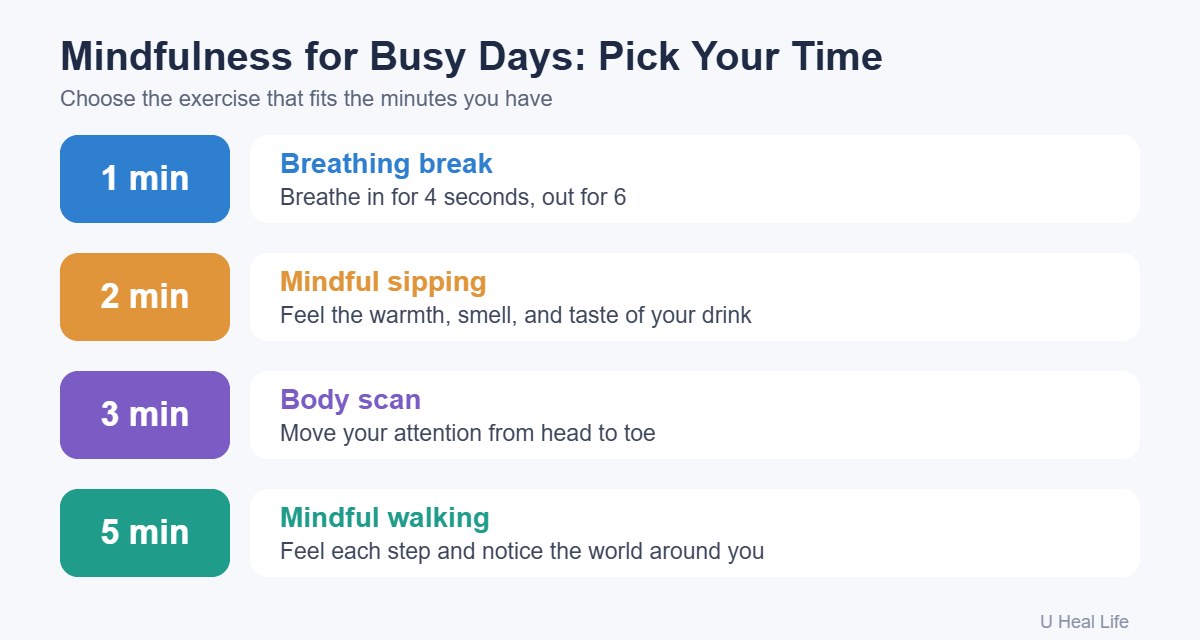
Pick the exercise that fits the minutes you have.
1. The One-Minute Breathing Break
This is the easiest exercise, and you can do it anywhere.
Sit comfortably and relax your shoulders.
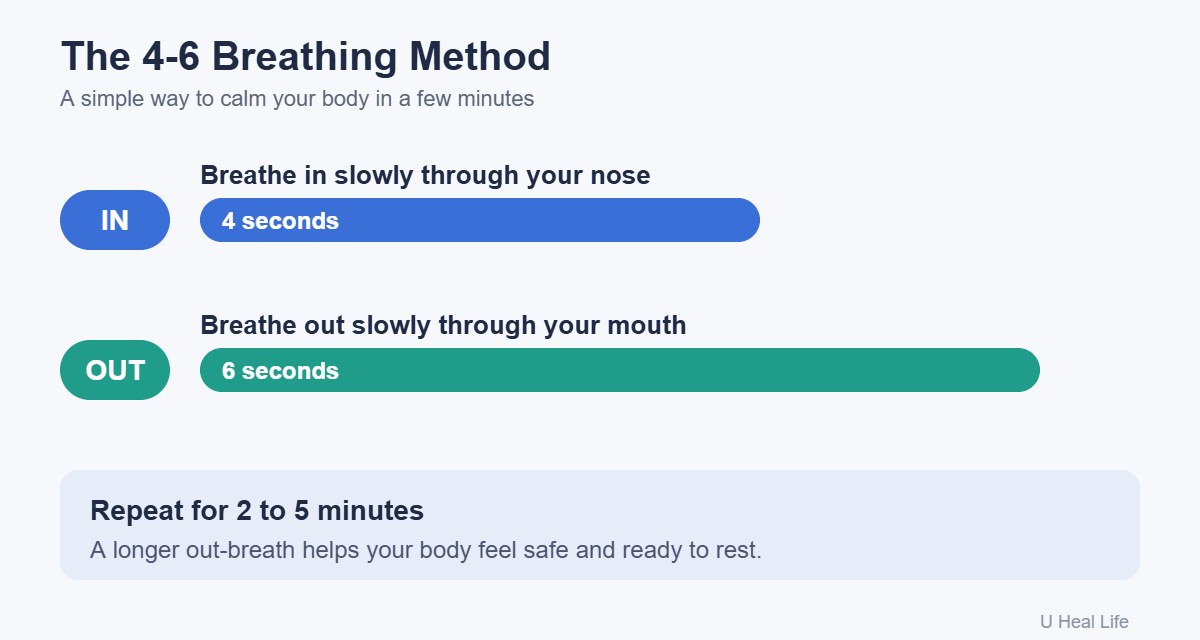
Breathe in slowly through your nose for 4 seconds.
Breathe out slowly through your mouth for 6 seconds.
Focus only on the feeling of your breath.
If your mind wanders, gently bring it back.
Do this for 1 minute. That’s it.
2. The 5-4-3-2-1 Check-In
This exercise brings you back to the present moment quickly. Look around and notice:
5 things you can see
4 things you can touch
3 things you can hear
2 things you can smell
1 thing you can taste
It is very useful when you feel stressed or anxious.
3. Mindful Morning Start
Before you pick up your phone in the morning, take 2 minutes. Sit on your bed, take 3 slow breaths, and ask yourself: “How do I feel today?”
Then set one simple goal for the day, like “I will stay calm” or “I will take breaks.” This gives your day a calmer start.
4. Mindful Sipping
Turn your tea or coffee break into a mini mindfulness break.
Hold the cup and feel its warmth.
Notice the smell.
Take a slow sip and notice the taste.
Put your phone away for these few minutes.
You are already taking this break, so you just add attention.
5. Mindful Walking
You can do this while walking to the bus, to your office, or around your home.
Feel your feet touching the ground.
Notice the speed of your steps.
Look at the trees, sky, or people around you.
Listen to the sounds without judging them.
Even a 3 to 5 minute walk like this can clear your mind.
6. The Body Scan (3 Minutes)
Sit or lie down. Slowly move your attention from your head to your toes. Notice any tightness, warmth, or tingling. You don’t have to fix anything. Just notice.
When you find a tense area, such as your shoulders or jaw, take a slow breath and let it relax.
7. Mindful Listening
The next time someone speaks to you, try giving them your full attention.
Put your phone down.
Look at the person.
Listen without planning what you will say next.
This helps you connect better with others, and it keeps your mind in the moment.
8. Mindful Eating (One Bite at a Time)
Many of us eat while working or watching screens. Try to take just the first 3 bites of your meal with full attention.
Notice the color, smell, texture, and taste. Chew slowly. This can help you enjoy your food more and notice when you feel full.
9. Mindful Pause Before Responding
When you feel angry or stressed, stop for one breath before you reply or react. Take one slow breath in and out.
This tiny pause can help you respond calmly instead of reacting quickly.
10. The Three Good Things Check
Before you sleep, think of 3 small things that went well today. It could be a warm meal, a kind message, or a quiet moment.
This helps your mind end the day with gratitude instead of worry.
How to Make Mindfulness a Daily Habit
It is easy to forget new habits when life is busy. Here are some tips:
Link it to something you already do. For example, take 3 slow breaths every time you wash your hands or wait for the kettle to boil.
Set a gentle reminder. Use a phone alarm or a sticky note on your desk.
Start very small. One minute a day is enough to begin.
Be kind to yourself. If you forget, just start again. There is no “failing” at mindfulness.
Track your progress. Tick off the days you practice in a notebook.
Mindfulness Exercises You Can Do at Work
Situation
Quick Exercise
Before a meeting
3 slow breaths with your feet on the floor
Feeling overloaded
5-4-3-2-1 check-in
Lunch break
Mindful eating for the first 3 bites
After a hard email
Pause for one breath before replying
End of work day
Stretch and take 1 minute of slow breathing
Common Mistakes to Avoid
Trying to stop your thoughts. Thoughts will come. Just notice them and return to your breath.
Expecting instant results. Mindfulness works slowly, like exercise.
Judging yourself. A wandering mind is normal. Bringing it back is the practice.
Doing too much too soon. Start with 1 or 2 minutes.
When Mindfulness Is Not Enough
Mindfulness can be a helpful tool, but it is not a cure for everything. Please speak with a doctor or mental health professional if:
You feel very anxious, sad, or hopeless for many days
You can’t sleep or eat properly
Your stress is affecting your work or relationships
You have thoughts of harming yourself
Getting support is a strong and wise step.
Frequently Asked Questions
How long should I practice mindfulness each day?
Even 1 to 5 minutes a day can help when you do it regularly. You can slowly increase the time if you want to.
Can I practice mindfulness without meditating?
Yes. Mindful walking, eating, and listening are all ways to practice mindfulness without sitting in meditation.
What is the easiest mindfulness exercise for beginners?
The one-minute breathing break is a great start. Breathe in for 4 seconds, breathe out for 6 seconds, and focus on your breath.
Does mindfulness really reduce stress?
Many people find that it helps them feel calmer, and research suggests that regular practice may help with stress. Results are different for each person, and it works best as part of healthy habits like sleep and exercise.
What if my mind keeps wandering?
That is completely normal. Every time you notice and bring your attention back, you are practicing mindfulness.
What is the best time to practice mindfulness?
Any time works. Many people like mornings, work breaks, or before bed. Choose a time that fits your day.
Can children or teens practice these exercises?
Yes. Simple exercises like breathing and the 5-4-3-2-1 check-in are easy for most people to learn. It is best to guide younger children gently.
Final Thoughts
You don’t need a quiet room, a cushion, or an hour of free time to practice mindfulness. You only need a few minutes and a little attention.
Start with one exercise from this list today. Try it for a week. Small moments of calm can add up to a more peaceful life.
Disclaimer: This article is for general information only and is not medical advice. If you are struggling with your mental health, please speak with a qualified healthcare professional.
Some days just feel too heavy. Work was stressful, people were difficult, and your mind is still racing even after you reach home.
If you can’t switch off after a hard day, you are not alone. Stress stays in your body and mind unless you give it a way out.
In this guide, you will find 12 simple ways to calm down after a stressful day. You can try them tonight.
Quick answer: To calm down after a stressful day, slow your breathing, move your body, take a break from screens, do something relaxing, and talk or write about your feelings. Small habits done every day work better than big changes once in a while.
Why Do We Feel So Stressed After a Hard Day?
When you are stressed, your body gets ready to deal with danger. Your heart beats faster, your muscles get tight, and your mind stays alert.
This is useful for a short time. But if you don’t relax afterward, your body may stay in “stress mode.” That is why you may feel tired but still tense, or find it hard to sleep.
Calming down gives your body the signal: “You are safe now. You can rest.”
12 Easy Ways to Calm Down After a Stressful Day
1. Pause and Take 5 Slow Breaths
Before doing anything else, stop for one minute. Breathe in slowly through your nose for 4 seconds, then breathe out for 6 seconds. Do this 5 times.
Slow breathing helps your body relax almost right away.
2. Change Your Clothes and Wash Up
This sounds small, but it works. Changing clothes and washing your face or taking a shower helps your mind feel like the work day is over. A warm shower can also relax tight muscles.
3. Go for a Short Walk
A 10 to 20 minute walk helps release stress energy. Fresh air and sunlight can also lift your mood. You don’t need to walk fast. Just move slowly and notice what is around you.
4. Stretch Your Body
Stress often shows up as tight shoulders, neck, and back. Try:
Rolling your shoulders slowly
Gently turning your neck side to side
Reaching up and then bending forward
Child’s pose or simple yoga stretches
Even 5 minutes can make you feel lighter.
5. Put Your Phone Down for a While
Emails, messages, and social media keep your brain “on.” Try taking 30 to 60 minutes away from your phone. Turn off notifications if you can.
6. Listen to Calming Music
Slow, soft music can help calm your heart rate and thoughts. Choose music that makes you feel peaceful, not music that makes you feel more worked up.
7. Write Down Your Thoughts
Take a notebook and write:
What made today stressful
How you feel right now
One thing that went well today, even a small thing
Writing helps you let go of thoughts so they don’t keep running in your head.
8. Do Something You Enjoy
Give yourself a small treat. It could be:
Reading
Drawing or coloring
Cooking a simple meal
Watching a light, funny show
Playing with a pet
Doing something you love tells your brain that life is not only about work and problems.
9. Talk to Someone You Trust
Sharing your day with a friend or family member can make you feel lighter. You don’t need advice. Sometimes just being heard is enough.
10. Try the 5-4-3-2-1 Method
If your mind is still racing, bring it back to the present moment. Notice:
5 things you can see
4 things you can touch
3 things you can hear
2 things you can smell
1 thing you can taste
11. Eat Something Nourishing and Drink Water
Stress can make us skip meals or reach for too much junk food or caffeine. Try to have a simple, healthy meal and drink enough water. A warm herbal tea, such as chamomile, can be a comforting evening drink.
12. Make a Plan for Tomorrow
If worries about tomorrow keep coming up, spend 5 minutes writing a short to-do list. Choose just the top 3 things. Once it is written, your brain can stop trying to remember everything.
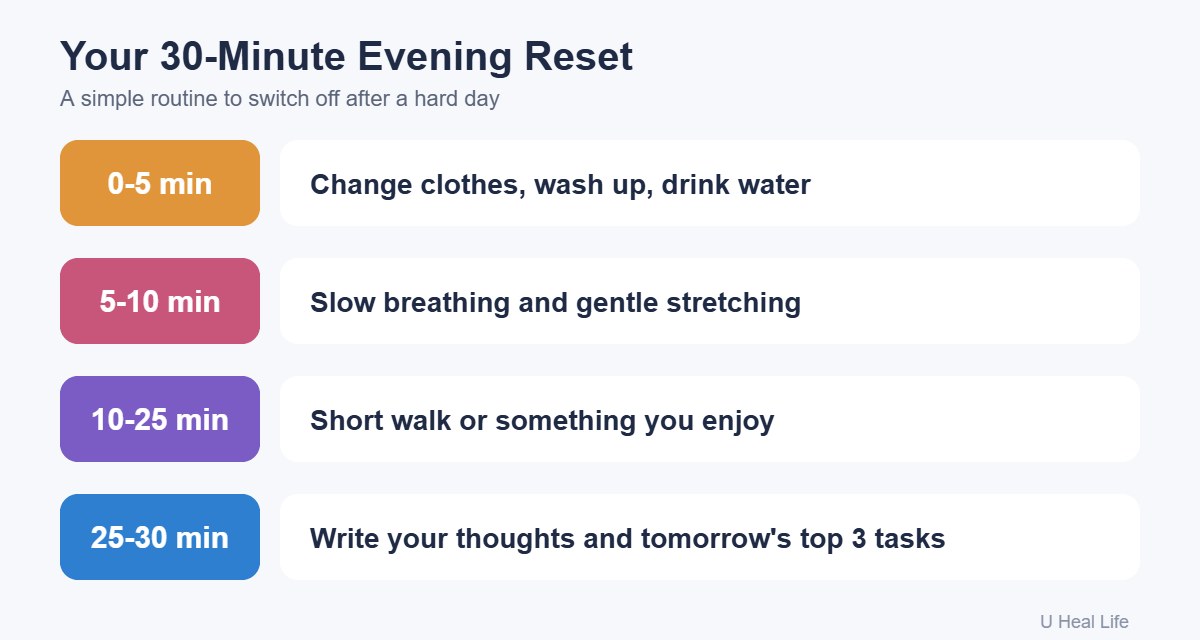
A Simple 30-Minute Evening Reset
If you want an easy routine, try this:
Time
What to Do
0-5 minutes
Change clothes, wash up, drink water
5-10 minutes
Slow breathing and gentle stretching
10-25 minutes
Short walk or something you enjoy
25-30 minutes
Write down your thoughts and tomorrow’s top 3 tasks
A simple 30-minute routine to switch off after a hard day.
Things to Avoid When You’re Stressed
Too much caffeine late in the day
Doom-scrolling news or social media
Drinking alcohol to cope. It may feel relaxing at first but can make stress and sleep worse
Overworking late at night
Being too hard on yourself
How to Stress Less Over Time
Calming down after a hard day is helpful. But it’s also good to lower stress in the long run:
Sleep 7 to 9 hours most nights
Exercise a few times a week
Take short breaks during work
Learn to say “no” when you are overloaded
Spend time with people who support you
Try meditation or mindfulness, even for 5 minutes a day
When to Get Extra Help
Everyone has stressful days. But please talk to a doctor or mental health professional if:
You feel stressed or overwhelmed almost every day
You can’t sleep, eat, or focus properly
You feel hopeless, very sad, or anxious
Stress is affecting your health or relationships
You deserve support, and help is available.
Frequently Asked Questions
How do I calm down quickly after a stressful day?
Start with slow breathing for a minute or two. Then try a short walk, stretching, or listening to calm music.
How long does it take to calm down after stress?
It depends on the person. Some feel better in a few minutes with deep breathing. For others, it may take an hour or more. Practice helps.
What is the best way to relax after work?
There is no single best way. Walking, stretching, music, a warm shower, and talking to a loved one are all good options. Choose what works for you.
Why can’t I relax even after the day is over?
Your body may still be in stress mode. Slow breathing, movement, and a calm evening routine can help your body switch off.
Is it OK to nap after a stressful day?
A short nap of 20 minutes is fine for many people. Long naps late in the day may make it harder to sleep at night.
What foods or drinks help reduce stress?
There is no magic food, but regular meals, water, and calming drinks like herbal tea can help. Try to limit caffeine and alcohol.
Can stress make me physically sick?
Long-term stress can lead to headaches, poor sleep, stomach issues, and tiredness. If you are worried about your health, please see a doctor.
Final Thoughts
You don’t need a perfect routine to feel calm. Even a few small steps, like deep breathing, a short walk, and a screen break, can make a big difference.
Be gentle with yourself. You did your best today, and now it’s time to rest.
Disclaimer: This article is for general information only and is not medical advice. If stress is affecting your health or daily life, please speak with a qualified healthcare professional.
Have you ever felt your heart beating fast, your chest feeling tight, or your mind filled with worry, and you could not say why? Nothing bad happened. Everything seems fine. But you still feel anxious.
This can be confusing and scary. But it is more common than you think.
In this guide, we explain in simple words why this happens, what may be causing it, and what you can do about it.
Quick answer: Anxiety “for no reason” usually does have a reason. It may come from stress that builds up slowly, poor sleep, too much caffeine, health issues, or past worries your mind is still holding on to. Slow breathing, good sleep, and talking to someone can help. If it keeps happening, speak with a doctor or therapist.
What Does Anxiety Feel Like?
Anxiety feels different for each person. Common signs include:
In your mind:
Constant worry or a feeling that “something bad will happen”
Trouble focusing
Feeling restless or on edge
Overthinking
In your body:
Fast heartbeat
Tight chest or shortness of breath
Sweaty hands
Stomach problems or nausea
Shaky or tense muscles
Feeling tired or having trouble sleeping
These feelings can show up even when you are sitting at home doing nothing.
Why Do I Feel Anxious for No Reason? 9 Common Causes
Anxiety without a clear cause is often called “free-floating anxiety.” Here are some reasons it may happen.
1. Stress That Slowly Builds Up
Small stresses like work, money, family, and daily pressure can pile up. You may not notice them, but your body does. One day, you feel anxious and can’t point to why. It is often the “sum” of many small things.
2. Not Enough Sleep
When you don’t sleep well, your brain becomes more sensitive to stress. Even small problems can feel big. Poor sleep and anxiety also feed each other, making both worse.
3. Too Much Caffeine
Coffee, tea, cola, and energy drinks can make your heart beat faster and make you feel jittery. For some people, this feels just like anxiety. If you are sensitive to caffeine, even a small amount can trigger it.
4. Skipping Meals or Low Blood Sugar
When you go too long without eating, your blood sugar can drop. This may cause shaking, dizziness, and a nervous feeling. Eating regular meals can help your body feel steady.
5. Overthinking and Mental Overload
Too much news, social media, work messages, and constant “what if” thoughts keep your brain on alert. It never gets time to rest, so anxiety can build.
6. Past Experiences and Old Worries
Sometimes the mind holds on to old stress, sad memories, or fears, even if you are not thinking about them on purpose. Your body may react before your mind understands why.
7. Hormone and Body Changes
Changes in hormones, such as during periods, pregnancy, or menopause, can affect mood and anxiety in some people.
8. Health Conditions and Medicines
Some medical issues, such as thyroid problems, can cause anxiety-like symptoms. Some medicines can also do this. If your anxiety is new or strong, it is a good idea to get a check-up and rule these out.
9. An Anxiety Disorder
Sometimes anxiety is more than normal stress. Conditions like generalized anxiety disorder or panic disorder can cause strong worry or sudden fear, even when there is no clear danger. These are common and treatable.
What Is a Panic Attack?
A panic attack is a sudden wave of strong fear. It may cause:
Racing heart
Trouble breathing
Chest pain or pressure
Sweating or shaking
Feeling dizzy
Feeling like you are losing control
It can feel very scary, but it usually passes in several minutes. If you have chest pain or trouble breathing and you are unsure of the cause, get medical help right away. It is always better to be safe.
8 Simple Ways to Calm Anxiety
1. Name It
Say to yourself: “I am feeling anxious. This is anxiety. It will pass.” Naming a feeling can make it less scary.
2. Slow Your Breathing
Breathe in through your nose for 4 seconds. Breathe out slowly for 6 seconds. Repeat for a few minutes.
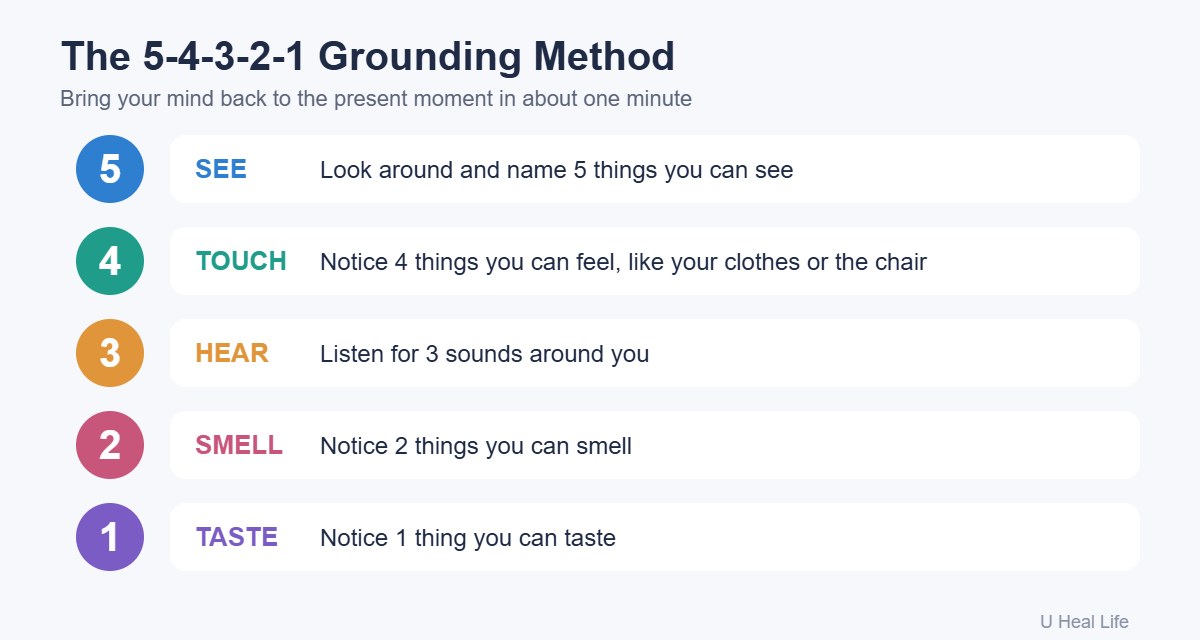
3. Try the 5-4-3-2-1 Method
This brings your mind back to the present moment. Look around and notice:
5 things you can see
4 things you can touch
3 things you can hear
2 things you can smell
1 thing you can taste
The 5-4-3-2-1 grounding method helps bring your mind back to the present.
4. Move Your Body
A short walk, stretching, or light exercise helps burn off stress energy.
5. Cut Down on Caffeine
Try reducing coffee, tea, and energy drinks for a week or two and see if you feel better.
6. Sleep and Eat Regularly
Go to bed and wake up at about the same time. Try not to skip meals.
7. Write It Out
Write down what you are feeling and thinking. Sometimes the reason becomes clearer once it is on paper.
8. Talk to Someone
Speak to a friend or family member you trust. You don’t have to carry everything alone.
When Should You See a Doctor or Therapist?
Please reach out for professional help if:
Anxiety happens often or lasts for weeks
It is hard to control your worry
It affects your sleep, work, studies, or relationships
You have panic attacks
You avoid places or activities because of fear
You feel hopeless or have thoughts of harming yourself
If you are in crisis or in danger, contact your local emergency number or a crisis helpline right away.
Therapy (like cognitive behavioral therapy), lifestyle changes, and sometimes medicine can help a lot. Many people feel much better with the right support.
Sponsored
Thinking about talking to someone?
If anxious feelings keep coming back, talking to a professional can help. Online-Therapy.com offers CBT-based online therapy programs for individuals and couples.
Learn moreThis link will redirect you to a third-party website. We may earn a commission from links you follow.
Frequently Asked Questions
Is it normal to feel anxious for no reason?
Yes, it is common. Many people feel anxious without a clear trigger. Often there is a hidden cause, like stress, poor sleep, or too much caffeine.
Why do I feel anxious all of a sudden?
Sudden anxiety may be caused by stress, caffeine, low sleep, or a panic attack. If it happens often, talk to a doctor.
Can anxiety come from nothing?
Anxiety may seem to come from nothing, but your body and mind may be reacting to stress or other causes you haven’t noticed yet.
How long does anxiety last?
A wave of anxiety often passes in minutes to hours. But anxiety that lasts for weeks or keeps coming back should be checked by a professional.
How do I stop anxiety right now?
Try slow breathing, the 5-4-3-2-1 method, and a short walk. Drink some water and try to relax your shoulders.
Can lack of sleep cause anxiety?
Yes. Poor sleep can make your brain more sensitive to stress and make anxiety stronger.
Can anxiety cause physical symptoms?
Yes. Anxiety can cause a fast heartbeat, stomach issues, headaches, and muscle tension. If you are worried about a symptom, it is a good idea to see a doctor.
Final Thoughts
Feeling anxious for no reason can be upsetting, but it does not mean something is wrong with you. Your body and mind may be trying to tell you that you need rest, support, or change.
Be kind to yourself. Take small steps, and don’t be afraid to ask for help. Anxiety is common, and it can get better.
Disclaimer: This article is for general information only and is not a medical diagnosis or treatment. If you are struggling with anxiety, please talk with a qualified healthcare professional.
You turn off the light. You close your eyes. And then your mind starts running.
“Did I say the wrong thing today?” “What if I fail tomorrow?” “Why did I do that five years ago?”
If this sounds like you, you are not alone. Overthinking at night is very common, and it can make it hard to sleep. The good news is that there are simple things you can do to calm your mind.
In this guide, you will learn why it happens and 10 easy ways to stop it.
Quick answer: To stop overthinking at night, write your thoughts down before bed, slow your breathing, keep screens away, and give your mind a calm routine. If you can’t sleep after 20 minutes, get up and do something quiet until you feel sleepy.
Why Do We Overthink at Night?
Overthinking means thinking about the same worries again and again. It feels hard to stop, and it usually does not solve the problem.
There are a few simple reasons why it gets worse at night:
No distractions. During the day you are busy with work, phone, and people. At night it is quiet, so your thoughts get louder.
You are tired. When you are tired, your brain finds it harder to stay calm and think clearly. Small worries can feel very big.
Unfinished stress. If you did not deal with your stress during the day, it often shows up when you finally stop.
Dark and quiet feels lonely. Many people feel more sensitive and emotional at night.
Remember this: a thought at 2 AM is not always the truth. Problems often feel much bigger at night than they do in the morning.
10 Easy Ways to Stop Overthinking at Night
1. Write It Down Before Bed
Keep a small notebook near your bed. Spend 5 to 10 minutes writing down:
What is worrying you
What you need to do tomorrow
This is sometimes called a “brain dump.” Once your thoughts are on paper, your brain does not feel like it has to hold on to them all night.
2. Set a “Worry Time” During the Day
Pick a time, such as 6 PM, and give yourself 15 minutes to think about your worries. Do it earlier in the evening, not right before bed.
Then, when a worry comes at night, tell yourself: “I will think about this tomorrow at worry time.” It sounds simple, but it helps many people.
3. Slow Down Your Breathing
Slow breathing tells your body that it is safe to relax. Try this:
Breathe in through your nose for 4 seconds.
Breathe out slowly through your mouth for 6 seconds.
Repeat for 2 to 5 minutes.
The 4-6 breathing method: a longer out-breath helps your body relax.
Making your out-breath longer than your in-breath helps your body calm down.
4. Try the “Body Scan”
Lie down and slowly move your attention from your toes to your head. Notice each part of your body and let it relax.
This gives your mind something gentle to focus on instead of your worries.
5. Keep Your Phone Away
Scrolling at night keeps your brain busy. News, social media, and messages can also make you feel stressed or compare yourself with others.
Try to stop using screens at least 30 to 60 minutes before bed. If you use your phone as an alarm, keep it across the room.
6. Create a Calm Bedtime Routine
Your brain loves routine. Do the same calm things each night, such as:
Take a warm shower
Read a few pages of a light book
Listen to soft music
Do some gentle stretching
After a few days, your body will begin to understand: “This is the time to sleep.”
7. Challenge Your Thoughts
When a scary thought comes, ask yourself:
Is this a fact, or is it a fear?
What would I tell a friend who had this thought?
Will this matter in one week? In one year?
You don’t have to push your thoughts away. Just look at them with more calm.
8. Get Up If You Can’t Sleep
If you are lying in bed for more than 20 minutes and still awake, don’t stay there and fight with your mind. Get up. Go to another room, keep the lights low, and do something quiet like reading or stretching. Go back to bed when you feel sleepy.
This helps your brain connect your bed with sleep, not with worry.
9. Watch What You Eat and Drink
Some things can make it harder to relax at night:
Caffeine (tea, coffee, cola, energy drinks) late in the day
Heavy meals right before bed
Too much alcohol, which may help you fall asleep but often disturbs sleep later
Try to have your last caffeine at least 6 to 8 hours before bedtime.
10. Move Your Body During the Day
Walking, yoga, or any light exercise helps your body release stress. Even a 20 to 30 minute walk can make a difference over time. Try to finish hard workouts a few hours before bed.
What NOT to Do When You’re Overthinking at Night
Don’t keep checking the clock. It increases stress about sleep.
Don’t try to force sleep. Trying too hard often makes it worse.
Don’t scroll on your phone to “distract” yourself.
Don’t be hard on yourself. Overthinking does not mean something is wrong with you.
When to Get Help
Occasional overthinking is normal. But please talk to a doctor or mental health professional if:
You are having trouble sleeping most nights for several weeks
Your worries feel too big to control
You feel anxious, sad, or hopeless a lot of the time
Your daily life, work, or relationships are being affected
Asking for help is a sign of strength, not weakness.
Sponsored
Thinking about talking to someone?
If racing thoughts keep you up at night, talking to a professional can help. Online-Therapy.com offers CBT-based online therapy programs for individuals and couples.
Learn moreThis link will redirect you to a third-party website. We may earn a commission from links you follow.
Frequently Asked Questions
Why do I overthink more at night?
At night, it is quiet and you have fewer distractions. You are also tired, so your mind finds it harder to stay calm. This makes worries feel bigger.
How can I stop my mind from racing at night?
Try writing your thoughts down, slowing your breathing, and following a calm bedtime routine. Keeping your phone away before bed also helps.
Is overthinking at night a sign of anxiety?
It can be linked to stress or anxiety, but not always. If it happens often and affects your sleep and daily life, it is a good idea to speak with a professional.
What is the 4-6 breathing technique?
You breathe in for 4 seconds and breathe out for 6 seconds. The longer out-breath helps your body relax.
Can overthinking cause insomnia?
Yes. Racing thoughts can make it hard to fall asleep or stay asleep. Over time, this can lead to poor sleep. Good sleep habits and stress management can help.
Should I take sleeping pills for overthinking?
Please don’t start any sleep medicine on your own. Speak to a doctor first.
Final Thoughts
Overthinking at night is something many people go through. You don’t need to fix all your problems before sleeping. You only need to give your mind a safe, calm place to rest.
Start small. Pick two or three tips from this list and try them for a week. Be patient with yourself. A calmer mind and better sleep are possible.
Disclaimer: This article is for general information only and is not medical advice. If you are struggling with your mental health or sleep, please speak with a qualified healthcare professional.
Red light therapy has gone from a niche clinical treatment to one of the most searched wellness topics online. Celebrities use it, gyms offer it, and home panels and face masks are everywhere. But does it actually work, or is it just another wellness trend?
In this guide, we break down what red light therapy is, what research supports, what is still unproven, who should be careful, and how to use it safely.
Quick answer: Red light therapy has reasonable evidence for some skin concerns, wound healing, and certain types of pain. Evidence for mood, sleep, and stress is promising but still early. It is not a replacement for medical or mental health treatment.
What Is Red Light Therapy?
Red light therapy (RLT) uses low-level wavelengths of red and near-infrared light to stimulate cells in the body. In research it is often called photobiomodulation (PBM) or low-level light therapy (LLLT).
Unlike a tanning bed or sunlamp, RLT does not use ultraviolet (UV) light. It does not tan or burn the skin, and it works through light energy rather than heat.
Two main wavelength ranges are commonly used:
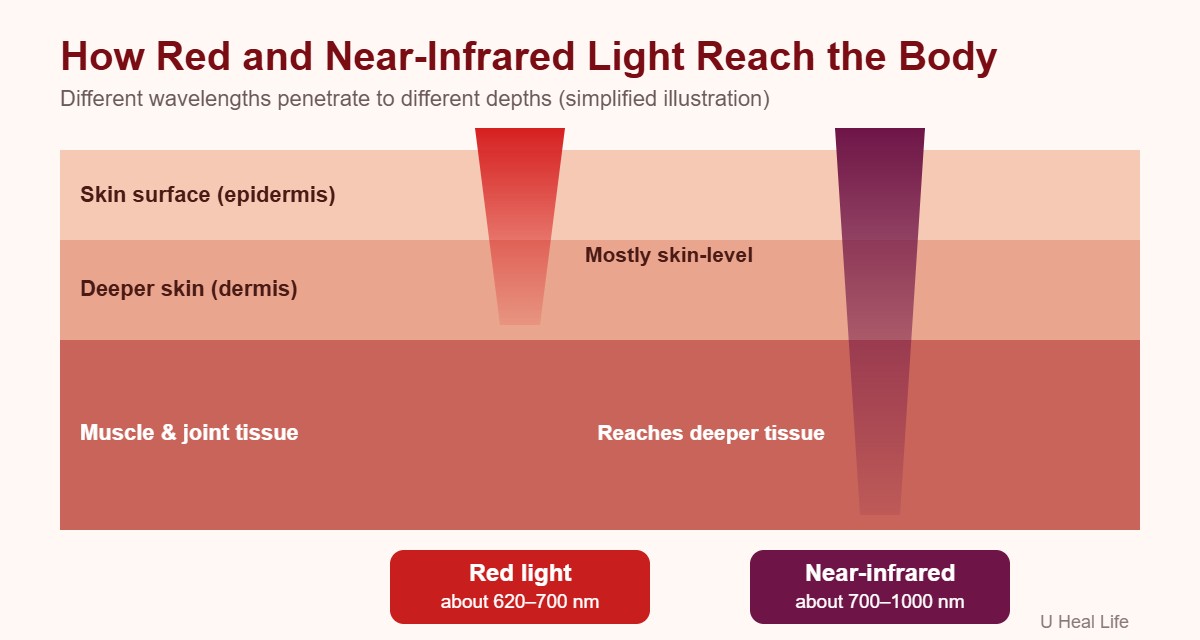
Red light (about 620-700 nm): Absorbed mostly near the skin surface. Common for skin-related goals.
Near-infrared light (about 700-1000 nm): Invisible to the eye and penetrates deeper, toward muscles and joints.
Red light works near the skin surface, while near-infrared light reaches deeper tissue.
How Does Red Light Therapy Work?
The leading theory is that light is absorbed by structures inside our cells, especially the mitochondria, often called the “powerhouse” of the cell. Researchers believe this may increase cellular energy production (ATP) and influence inflammation and tissue repair.
It is important to note that scientists are still studying the exact mechanisms. Results depend heavily on wavelength, dose, session length, and distance from the device, which is why results vary so much between products.
Potential Benefits of Red Light Therapy
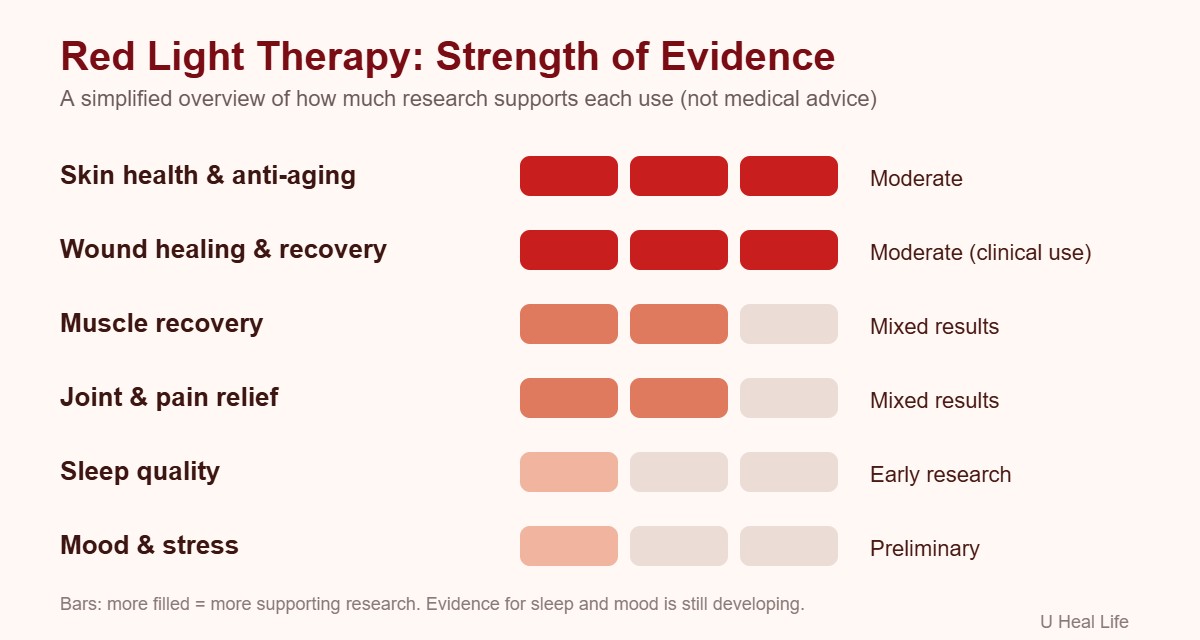
How much research supports each use of red light therapy (simplified overview).
1. Skin Health and Anti-Aging
This is the area with the most consumer interest. Some studies suggest red light may support collagen production and improve the look of fine lines, skin texture, and tone. Certain devices have also been studied for mild to moderate acne, often alongside other treatments.
Results are usually gradual and modest, not dramatic overnight changes.
2. Wound Healing and Recovery
Photobiomodulation has been studied in clinical settings for helping tissue repair. For example, it is used in some healthcare settings for painful mouth sores caused by certain cancer treatments. This is supervised medical use, not the same as using a home panel.
3. Muscle Recovery and Exercise Performance
Athletes and gym-goers use RLT hoping to reduce soreness and speed recovery. Some research suggests possible benefits for muscle fatigue and recovery, but results differ between studies and protocols.
4. Joint and Pain Relief
Near-infrared light has been studied for conditions like osteoarthritis-related joint pain, neck pain, and tendon problems. Some trials show pain reduction, while others show little difference from placebo, so the evidence is mixed.
5. Sleep Quality
Many people search for red light therapy for sleep. Early, small studies suggest that red light exposure may support sleep quality in some groups, and red-toned light in the evening is less disruptive than blue light. However, large, high-quality human trials are still limited.
6. Mood, Stress, and Mental Wellness
This is an exciting but early area of research. Some small studies have explored near-infrared light on the head for low mood and cognitive function, and others have looked at light exposure for seasonal mood changes. The research is preliminary.
Important: Red light therapy is not an approved or proven treatment for depression or anxiety. If you are struggling with your mental health, please speak with a licensed healthcare professional.
What Red Light Therapy Cannot Do
To keep expectations realistic, RLT is not proven to:
Melt body fat or replace diet and exercise
Cure depression, anxiety, or any mental health condition
Treat cancer or serious disease
Replace sunscreen, medication, or doctor-prescribed care
Be cautious of any brand that promises miracle results.
Is Red Light Therapy Safe? Side Effects to Know
For most people, RLT is considered low risk when used as directed. Reported side effects are usually mild and may include:
Temporary skin redness or warmth
Mild headache or eye strain
Skin irritation or dryness
Trouble sleeping if used too late or too intensely
Eye safety matters. Bright light can strain or harm eyes. Use the protective goggles that come with a device and avoid staring into the lights.
Who Should Talk to a Doctor First?
Check with a healthcare provider before using RLT if you:
Are pregnant
Have a history of skin cancer or suspicious moles
Take medications that make skin sensitive to light (photosensitizing drugs)
Have a light-sensitive condition, such as lupus or certain eye conditions
Have a seizure disorder or epilepsy
Plan to use it directly over a tumor, implant, or medical device
Red Light Therapy at Home vs. Professional Treatment
Feature
At-Home Devices
Clinic / Professional
Cost
One-time purchase (varies widely)
Pay per session or package
Power
Usually lower
Usually higher and calibrated
Convenience
Use anytime
Need to book appointments
Supervision
Self-guided
Trained staff
Best for
Maintenance, general wellness
Specific concerns, faster monitoring
How to Use Red Light Therapy Safely
Read the manufacturer’s instructions. Time and distance guidelines differ by device.
Start short. Begin with the lowest recommended session time and increase gradually.
Use clean, bare skin. Remove makeup, lotions, and sunscreen unless the manufacturer says otherwise.
Protect your eyes. Wear the included goggles.
Be consistent. Most studies use multiple sessions per week over several weeks.
Track your results. Take photos or journal changes in skin, sleep, or mood.
Stop if irritation occurs and consult a professional.
How to Choose a Red Light Therapy Device
Not all devices are equal. Look for:
Clearly stated wavelengths (for example, red around 630-670 nm and near-infrared around 810-850 nm)
Published power output (irradiance) rather than just “LED count”
Regulatory clearance where available, such as FDA-cleared for specific uses
Independent testing or third-party reviews
A fair return policy and warranty
Be careful with unrealistic claims, no technical specs, or “cure-all” marketing.
Can Red Light Therapy Help With Mental Wellness?
Many people explore RLT as part of a broader self-care routine. A realistic way to think about it:
It may support relaxation and better evening routines, especially when it replaces bright blue-light screen time.
It may be a helpful addition, but not a substitute, for therapy, medication, exercise, sunlight, social connection, and sleep hygiene.
Pair it with habits that have stronger evidence: regular movement, morning daylight, a consistent sleep schedule, and professional support when needed.
Frequently Asked Questions
Does red light therapy really work?
It appears to work for certain uses, such as some skin concerns, healing support, and some types of pain. Evidence for other claims is still developing, and results depend on the device and consistency.
How long does red light therapy take to work?
Many people use it for several weeks before noticing changes. Skin results are typically gradual, often over 8-12 weeks, though individual results vary.
How often should I use red light therapy?
Most protocols use sessions a few times per week. Follow your device’s guidelines and avoid overuse.
Is red light therapy better than sunlight?
They are different. Sunlight provides vitamin D and supports your body clock but also includes UV. RLT does not provide vitamin D.
Can I use red light therapy every day?
Some devices allow daily use at low doses, but more is not always better. Follow the manufacturer’s instructions and talk to your doctor if unsure.
Does red light therapy help with sleep?
It may help some people, particularly when used as part of an evening wind-down routine. Research is still limited, so it should not replace good sleep habits or medical care for sleep disorders.
Is red light therapy FDA approved?
Specific devices may be FDA-cleared for particular uses, such as certain skin or pain applications. Many wellness devices make general claims without clearance, so check the exact device and its approved use.
Can red light therapy cure depression?
No. It is not a proven treatment for depression. If you feel persistently low, anxious, or hopeless, please contact a licensed mental health professional or your doctor.
Final Thoughts
Red light therapy is not magic, but it is more than just a trend. It shows real promise for skin, recovery, and comfort, while its effects on sleep and mood are still being explored. If you try it, choose a reputable device, use it consistently and safely, and treat it as one tool within a healthy lifestyle, not a cure-all.
Disclaimer: This article is for informational purposes only and is not medical advice. Always consult a qualified healthcare professional before starting any new wellness therapy, especially if you have a medical condition or take medication.