
Citicoline for Cognitive Health: What Research Shows
Affiliate disclosure: This article contains affiliate links. If you buy through our links, we may earn a commission at no extra cost to you. Our content is educational and based on public product information and published research, not personal testing.
Citicoline shows up in many brain supplements. But what is it, and is there real evidence that it helps memory and focus? This guide gives a balanced overview.
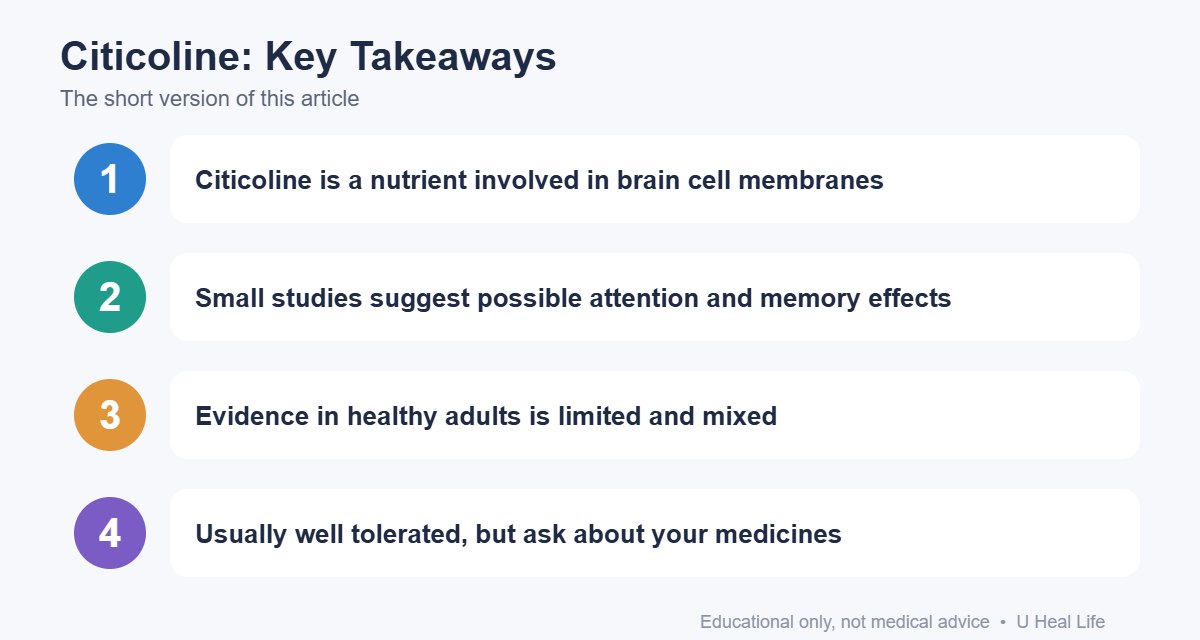
Quick answer: Citicoline is a natural compound that helps build brain cell membranes. Small studies suggest it may help attention and memory in some groups, but evidence in healthy adults is limited and mixed. It is usually well tolerated, but you should ask a professional if you take medicine or are pregnant.
What Is Citicoline?
Citicoline, also called CDP-choline, is a compound your body makes naturally. It takes part in making phosphatidylcholine, an important part of brain cell membranes, and it is linked with the brain chemical acetylcholine. As a supplement, it is sold on its own or in blends. One branded form is Cognizin.
What Does Research Suggest?
Researchers have studied citicoline in several settings:
- Older adults with memory complaints: Some trials suggest small benefits for memory.
- Recovery after stroke or brain injury: Studies have looked at its use alongside medical care, with mixed results.
- Healthy adults: A few small trials looked at attention and mental energy, but they are limited in size and number.
Studies use many different doses and time periods, and the people tested are not always like the general public. That makes it hard to say what to expect if you are a healthy adult looking for sharper focus.
Strength of the Evidence
| Question | Honest answer |
|---|---|
| Is it studied in humans? | Yes, in several small and medium studies |
| Does it clearly improve focus in healthy adults? | Not clearly; results are mixed |
| Is it a proven treatment for memory loss? | No; it should not replace medical care |
| Are results the same for all brands? | Not necessarily |
Possible Side Effects
Citicoline is generally well tolerated. Some people report:
- Stomach upset or loose stools
- Headache
- Trouble sleeping
- Dizziness
There is not enough safety data for pregnancy or breastfeeding, so avoid it unless a doctor says it is fine. Ask a pharmacist if you take medicine for Parkinson’s disease or other brain-related conditions.
Food Sources of Choline
Your body also gets choline from foods such as eggs, fish, poultry, beans and some vegetables. A balanced diet gives you the building blocks without a supplement.
Citicoline in BrainPill
The manufacturer says BrainPill contains citicoline in the form of Cognizin and describes it as a key ingredient. Our review explains why research on one ingredient does not prove that the whole formula works. See our guides to BrainPill ingredients and the full BrainPill review.
See BrainPill’s Official Product Details
Paid affiliate link. We may earn a commission from qualifying purchases.
Frequently Asked Questions
What is citicoline good for?
It is being studied for memory and attention, but it is not a proven treatment for any condition.
How long does citicoline take to work?
Studies run from a few weeks to several months, and there is no guaranteed timeline.
Can I take citicoline every day?
Many studies used daily doses, but you should follow the label and ask a doctor, especially if you take other medicines.
Is citicoline the same as choline?
No. Citicoline is a related compound that contains choline, but they are not identical.
Final Thoughts
Citicoline is an interesting ingredient with some research behind it, but it is not a proven brain booster for healthy adults. Treat it as one possible tool, not a shortcut.
Related Reading
- What Are Nootropics? Benefits, Risks and Evidence
- Bacopa Monnieri for Memory: Benefits and Side Effects
- BrainPill Ingredients Explained: Benefits and Safety
- BrainPill Review 2026: Ingredients, Benefits, Side Effects & Does It Really Work?
Disclaimer: This article is for educational purposes only and is not medical advice. Dietary supplements are not intended to diagnose, treat, cure, or prevent any disease. Talk to a qualified healthcare professional before using supplements, especially if you take medicine, are pregnant or breastfeeding, or have a health condition.