Impact-Site-Verification: 65ebaf0c-2dbc-4200-9d50-11ea7af40e54

Graphic with the text What Are Nootropics?: Benefits, risks and evidence
What Are Nootropics? Benefits, Risks and Evidence

Affiliate disclosure: This article contains affiliate links. If you buy through our links, we may earn a commission at no extra cost to you. Our content is educational and based on public product information and published research, not personal testing.

“Nootropics” is a word you see everywhere online, from social media to supplement ads. But what does it really mean, and do these products work?

Quick answer: Nootropics, sometimes called “smart pills” or cognitive enhancers, are substances that people take hoping to improve memory, focus or mental energy. Some ingredients have been studied, but evidence varies a lot, dietary supplements are not approved by the FDA before sale, and safety depends on the person and the product.
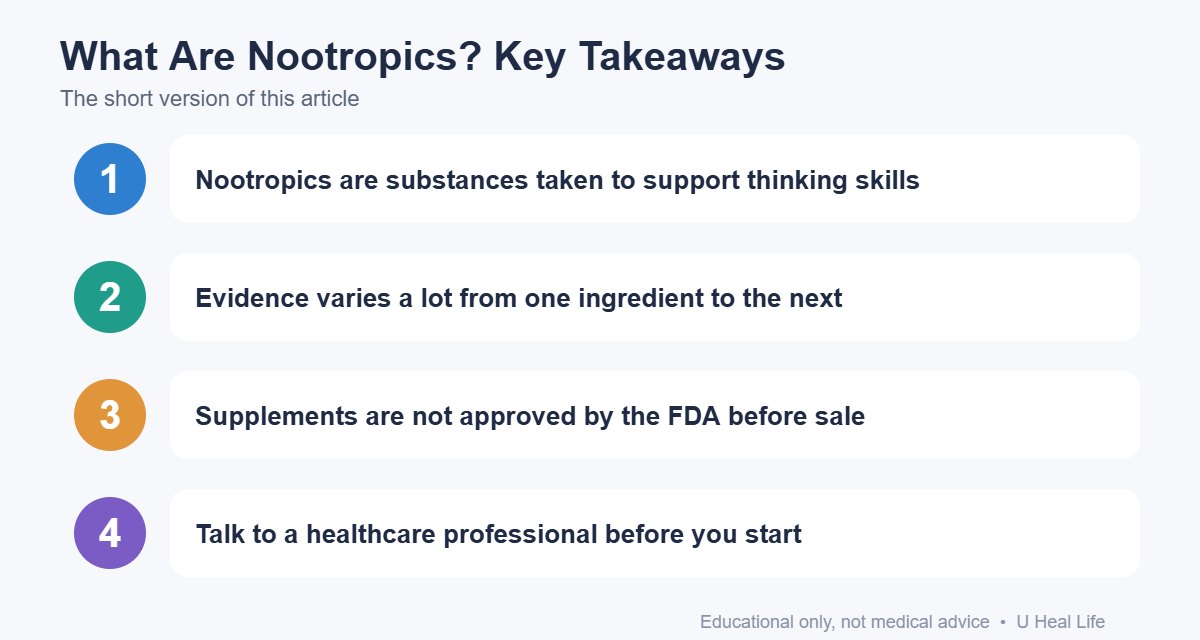
Key takeaways infographic: Nootropics are substances taken to support thinking skills; Evidence varies a lot from one ingredient to the next; Supplements are not approved by the FDA before sale; Talk to a healthcare professional before you start
The key points at a glance.

What Does “Nootropic” Mean?

The word was coined in the 1970s. Today it is used loosely for anything marketed to support thinking skills such as attention, learning and memory. That includes natural substances, supplements and even some prescription medicines.

Main Types of Nootropics

1. Dietary Supplements and Natural Compounds

These include caffeine, L-theanine, omega-3 fats, citicoline, bacopa monnieri, ginkgo biloba and B vitamins. They are sold without a prescription, often in blends.

2. Prescription Medicines

Some medicines, such as stimulants, are prescribed for conditions like ADHD or narcolepsy. They should only be used under medical supervision. Using them without a prescription to “boost” performance is risky and often illegal.

3. Lifestyle “Natural Nootropics”

Good sleep, exercise, a balanced diet and stress care are the best-supported ways to help your brain.

Common Examples and What Is Known

IngredientCommon claimEvidence in brief
CaffeineMore alertnessWell studied for short-term alertness
L-theanineCalm focusModest, often studied with caffeine
Omega-3 (DHA/EPA)Brain healthImportant nutrient; benefits for healthy adults are unclear
CiticolineMemory and attentionSmall studies, mixed results
Bacopa monnieriMemorySome trials show benefit after weeks of use; mixed overall
Ginkgo bilobaMemoryEvidence in healthy adults is uncertain

What Does the Research Really Say?

For most supplement ingredients, studies are small, short, or done in specific groups such as older adults. A result in one group may not apply to you. The US National Center for Complementary and Integrative Health has reviewed the science on supplements and cognitive function and notes that evidence is limited for many products.

Risks and Regulation

  • Not approved before sale. In the US, dietary supplements are not approved by the FDA for safety and effectiveness before they are sold.
  • Quality varies. Strength and purity can differ between brands.
  • Interactions. Ingredients such as ginkgo can interact with medicines such as blood thinners.
  • Special groups. Pregnant or breastfeeding women, children and people with health conditions need extra caution.
  • Hidden extras. Always read the full label.

The NIH Office of Dietary Supplements has a helpful page on what you need to know about supplements.

How to Choose Safely

  1. Talk to a doctor or pharmacist first.
  2. Choose products with a clear Supplement Facts label and exact amounts.
  3. Be careful with big promises or fake “doctor” endorsements.
  4. Try one new product at a time.
  5. Check refund terms and stop if you feel unwell.
  6. Never replace prescribed treatment with a supplement.

An Example: Multi-Ingredient Blends

Some products combine many ingredients in one capsule. BrainPill, for example, lists 13. We explain how we weigh the evidence in our independent BrainPill review and in our guide to BrainPill vs other nootropic supplements.

See BrainPill’s Official Product Details

Paid affiliate link. We may earn a commission from qualifying purchases.

Frequently Asked Questions

Do nootropics really work?

Some ingredients may help certain people in certain situations, but results are not guaranteed and are often modest.

Are nootropics safe?

It depends on the ingredient, dose, your health and your medicines. Always get advice first.

Are nootropics legal?

Most supplement ingredients are legal to buy, but prescription medicines are only legal with a prescription.

What is the best natural nootropic?

For most people, sleep, exercise and good nutrition come first.

Final Thoughts

Nootropics are not magic, and the word is mostly a marketing label. Focus on the basics, look at the evidence, and put safety first.

Related Reading

Disclaimer: This article is for educational purposes only and is not medical advice. Dietary supplements are not intended to diagnose, treat, cure, or prevent any disease. Talk to a qualified healthcare professional before using supplements, especially if you take medicine, are pregnant or breastfeeding, or have a health condition.
Graphic with the text Does BrainPill Really Work?: What the evidence says
Does BrainPill Really Work? What the Evidence Says

Affiliate disclosure: This article contains affiliate links. If you buy through our links, we may earn a commission at no extra cost to you. Our content is educational and based on public product information and published research, not personal testing.

If you are searching for “does BrainPill really work,” you probably want a straight answer. Many reviews online are written to sell, so this guide looks at the evidence in a calm, balanced way.

Quick answer: We cannot say that BrainPill works. Several of its ingredients have been studied, but we found no independent, placebo-controlled trial of the finished product showing better memory or focus. Results from ingredient studies cannot simply be applied to a multi-ingredient blend.

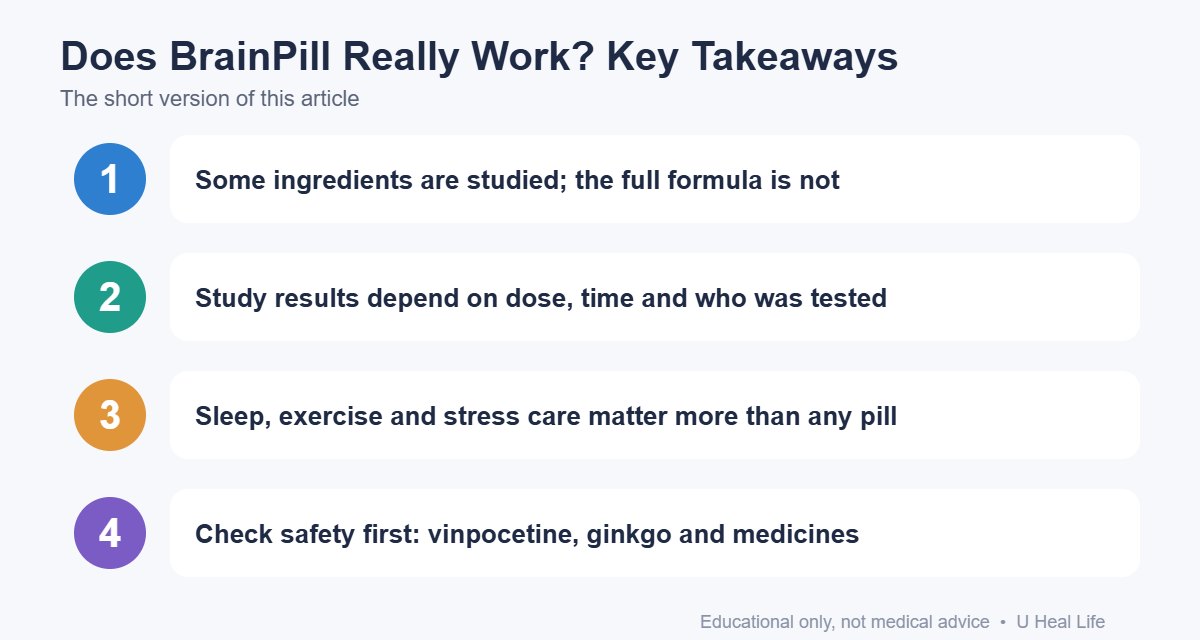
Key takeaways infographic: Some ingredients are studied; the full formula is not; Study results depend on dose, time and who was tested; Sleep, exercise and stress care matter more than any pill; Check safety first: vinpocetine, ginkgo and medicines
The key points at a glance.

What Does “Work” Actually Mean?

A supplement “works” if it does more than a sugar pill, in people like you, at the dose in the product, and without causing harm. In real life that means:

  • A noticeable improvement in focus or memory
  • A benefit that is larger than the placebo effect
  • Results that other researchers can repeat
  • Good safety for the people who use it

What the Manufacturer Says

BrainPill is made by Leading Edge Health. Its ingredient page describes a blend of 13 nootropics and uses strong words such as “clinically proven” for some ingredients. It says the formula can support focus, concentration, memory and mental stamina.

At the bottom of the same website there is the standard notice that these statements have not been evaluated by the FDA and that the product is not meant to diagnose, treat, cure, or prevent any disease. That notice is important. Marketing claims on a supplement page are not the same as approved medical claims.

What Independent Research Says

Here is a simple overview of what is known about the main ingredients. It is a summary, not a full scientific review.

IngredientWhat research has looked atStrength of evidence for healthy adults
CiticolineAttention and memory in small trialsLimited and mixed
Bacopa monnieriMemory and attention after several weeksSome promising results, but mixed
L-theanineRelaxation and attention, often with caffeineModest, unclear on its own
PhosphatidylserineMemory, mostly in older adultsMixed
TyrosineThinking under stress or lack of sleepShort-term, special conditions
Ginkgo bilobaMemory and dementia preventionUncertain
Huperzine AEffects on the brain chemical acetylcholineNot shown to help healthy adults
VinpocetineBlood flow in the brainFDA has issued a pregnancy safety warning
B vitamins and DHANormal brain functionMatter most if you are low in them

For example, the National Center for Complementary and Integrative Health reports that ginkgo has not been shown to prevent or slow dementia.

The Gap Between Ingredient Studies and the Finished Product

Even when an ingredient looks promising, the finished product can behave differently. Here is why:

  • Dose: A study may use a higher or lower amount than a capsule contains.
  • Combination: Mixing many ingredients can change how each one acts, and it becomes hard to know which one, if any, causes an effect.
  • People tested: Many studies are in older adults or people with a health condition, not busy, healthy adults.
  • Time: Some ingredients were tested for weeks or months, not days.
  • Outcome: A small change on a lab test does not always mean a real change in daily life.

Why Some People Feel Better

Many users say they feel sharper. This can have normal explanations:

  • The placebo effect. Expecting to feel better can improve how you feel and perform.
  • Other changes made at the same time, such as better sleep or less stress.
  • Natural ups and downs in energy and focus.
  • A real benefit if the person was low in a nutrient, such as vitamin B12.

None of this means the product is useless. It means personal stories are not proof.

How to Test Any Supplement Fairly

  1. Talk to a doctor or pharmacist first, especially if you take medicine.
  2. Fix the basics first: sleep, food, water, movement and stress.
  3. Change only one thing at a time so you know what caused a change.
  4. Keep a short daily note on focus, mood and sleep for 8 to 12 weeks.
  5. Stop and speak to a professional if you notice side effects.
  6. Use any refund window carefully and read the terms.

View BrainPill Product Information and Current Pricing

Paid affiliate link. We may earn a commission from qualifying purchases.

Safety Comes Before Results

The most important safety points for BrainPill are:

  • The FDA has warned that vinpocetine may harm a pregnancy.
  • Ginkgo may raise bleeding risk with some medicines.
  • The manufacturer says not to use the product if you are pregnant, planning pregnancy, or breastfeeding.

You can read more in our guide to BrainPill side effects.

What About the Refund Policy?

The manufacturer’s site describes a 60-day guarantee. Returns must reach the warehouse within a set number of days after delivery, shipping costs are not refunded, and refunds are limited to one order per customer. Terms can change, so read the current policy before you order. A refund policy lowers your money risk, but it does not prove that a supplement works.

Frequently Asked Questions

Is there clinical proof that BrainPill works?

The manufacturer points to research on individual ingredients. We did not find an independent, placebo-controlled trial of the finished product in healthy adults.

How long does BrainPill take to work?

There is no reliable timeframe. Some ingredient studies lasted around 12 weeks, but that does not mean you should expect the same result.

Is BrainPill like a prescription focus medicine?

No. It is a dietary supplement. It has not been tested as a replacement for prescription treatment for ADHD or any other condition.

Is it safe with other medicines?

Ask a doctor or pharmacist. Ingredients such as ginkgo and huperzine A can interact with some medicines.

Final Thoughts

BrainPill contains ingredients that scientists find interesting, but “interesting” is not the same as “proven.” If you decide to try it anyway, go in with realistic expectations, check the label, and keep your daily habits strong. For the full picture, read our complete BrainPill review.

Related Reading

Disclaimer: This article is for educational purposes only and is not medical advice. Dietary supplements are not intended to diagnose, treat, cure, or prevent any disease. Talk to a qualified healthcare professional before using supplements, especially if you take medicine, are pregnant or breastfeeding, or have a health condition.