
BrainPill vs Other Nootropic Supplements: A Comparison
Affiliate disclosure: This article contains affiliate links. If you buy through our links, we may earn a commission at no extra cost to you. Our content is educational and based on public product information and published research, not personal testing.
There are hundreds of nootropic supplements on the market. How does BrainPill compare? Instead of declaring a winner, this guide gives you a fair way to compare any two products.
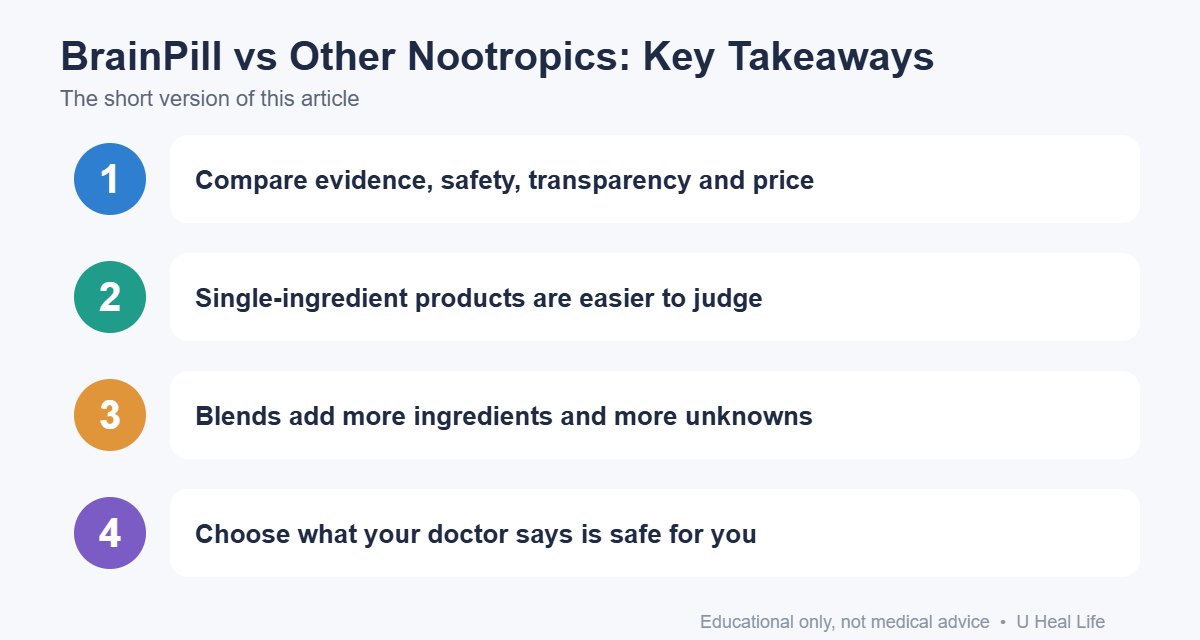
Quick answer: We are not aware of any head-to-head trials comparing BrainPill with other nootropics, so no one can honestly name a “best” product. Compare products on evidence, safety, label transparency, price and refund terms, and choose what a healthcare professional says is safe for you.
The Main Types of Cognitive Supplements
| Type | Common ingredients | Pros | Cons |
|---|---|---|---|
| Single-ingredient | Omega-3 (DHA/EPA), L-theanine, citicoline, creatine | Easy to judge and to stop if you react | You may need several products |
| Caffeine plus L-theanine | Caffeine, L-theanine | Well-known pairing with some research | Caffeine can cause jitters or poor sleep |
| Vitamin and mineral formulas | B-complex, vitamin D, magnesium | Useful if you have a deficiency | Little benefit if your diet is already good |
| Herbal blends | Ginkgo, bacopa, ashwagandha | Traditional use | Quality and strength can vary; some interact with medicine |
| Multi-ingredient nootropic blends | Many ingredients, such as BrainPill | One product with many ingredients | Hard to know which part does what; more safety checks needed |
Where BrainPill Fits
BrainPill is a multi-ingredient blend. The manufacturer lists 13 ingredients, including citicoline, bacopa, L-theanine, tyrosine, ginkgo, huperzine A, vinpocetine, DHA and B vitamins. It also offers a published 60-day money-back guarantee.
The main trade-offs are that more ingredients mean more things to check for safety, and the evidence for the finished blend is limited. Details are in our guides to BrainPill ingredients and BrainPill side effects.
7 Questions to Compare Any Two Products
- Evidence: Were the ingredients, and ideally the finished product, tested in good human studies?
- Doses: Does the label show the exact amount of each ingredient?
- Safety: Are there known warnings, such as pregnancy or medicine interactions?
- Quality: Is there third-party testing, and who makes the product?
- Price: What does it cost per month of use, including shipping?
- Refunds: Are the return terms clear and fair?
- Fit: Does it suit your health, medicines and goals?
Red Flags to Avoid
- Claims like “limitless” or “genius in 30 days”
- Saying a supplement is “FDA approved” for memory
- Fake doctor endorsements or too-good-to-be-true reviews
- Pressure tactics, such as “only 3 left”
- No ingredient amounts on the label
- Claims to treat or cure ADHD, anxiety or dementia
Which Type May Suit You?
- You want a simple, low-risk start: a single ingredient your doctor approves, or just better sleep and routines.
- You may have a deficiency: ask for a blood test before buying vitamins.
- You like a multi-ingredient product: compare labels closely and check every ingredient for safety.
Cheaper First Steps Than Any Supplement
Better sleep, regular exercise, fewer distractions and well-timed caffeine can help focus without cost. See our guide to the best ways to improve focus and concentration naturally.
View BrainPill Product Information and Current Pricing
Paid affiliate link. We may earn a commission from qualifying purchases.
Frequently Asked Questions
Is BrainPill better than other nootropics?
No one can say, because there are no direct comparison studies that we know of. Compare the label, evidence, safety and price for yourself.
Is a supplement with more ingredients better?
Not necessarily. More ingredients can mean more risk and less clarity on what works.
Are there prescription alternatives?
Doctors may prescribe medicine for conditions such as ADHD. Do not self-treat with supplements. See a professional for a proper diagnosis.
What is the safest way to try a nootropic?
Talk to a doctor, change one thing at a time, follow the label, and stop if you have side effects.
Final Thoughts
The best nootropic is the one that is safe for you, honest about what it can do, and supported by good habits. For more on our view of this product, read the full BrainPill review.
Related Reading
- BrainPill Review 2026: Ingredients, Benefits, Side Effects & Does It Really Work?
- What Are Nootropics? Benefits, Risks and Evidence
- BrainPill Ingredients Explained: Benefits and Safety
- Best Ways to Improve Focus and Concentration Naturally
Disclaimer: This article is for educational purposes only and is not medical advice. Dietary supplements are not intended to diagnose, treat, cure, or prevent any disease. Talk to a qualified healthcare professional before using supplements, especially if you take medicine, are pregnant or breastfeeding, or have a health condition.