Impact-Site-Verification: 65ebaf0c-2dbc-4200-9d50-11ea7af40e54

Forehead Scars and Self-Esteem: How Appearance Can Affect Mental Health

Facial scars, especially those on the forehead, are often the first thing people notice. While scars can be a mark of resilience and strength, they can also deeply affect how individuals feel about themselves. For many, forehead scars become a silent battle — impacting self-esteem, confidence, and overall mental health.

In this article, we’ll explore the connection between forehead scars and emotional well-being, and how healing goes beyond skin-deep.

Why Forehead Scars Feel So Exposed

The forehead is a central feature of the face, involved in facial expressions, emotions, and first impressions.
A visible scar in this area can sometimes:

  • Attract unwanted attention
  • Invite intrusive questions
  • Cause feelings of self-consciousness
  • Lead to negative self-perception

Since we can’t easily hide our foreheads without drastic changes, those living with forehead scars often feel vulnerable in social settings, fueling anxiety and lowering self-esteem.

The Emotional Toll of Visible Scars

Visible scars can trigger a range of emotional challenges, including:

  • Low Self-Esteem: Feeling “different” can create a sense of inferiority compared to societal beauty standards.
  • Social Anxiety: Fear of being judged or stared at can make social interactions stressful.
  • Body Dysmorphic Disorder (BDD): Individuals may obsessively focus on their scars, perceiving them as larger or more noticeable than they actually are.
  • Depression: Prolonged emotional distress over appearance can lead to feelings of sadness, hopelessness, and withdrawal from activities once enjoyed.

The Role of Society and Media

The media often promotes flawless beauty ideals, rarely showcasing people with facial scars in empowering roles.
This lack of representation reinforces the idea that scars must be hidden or “fixed” — rather than accepted.
The pressure to conform to unrealistic beauty standards can intensify the emotional struggles faced by individuals with forehead scars.

Positive Representation Matters

When brands, films, and influencers showcase real, unfiltered appearances — including visible scars — it sends a powerful message: You are beautiful exactly as you are.

Coping Strategies: Healing the Mind, Not Just the Skin

While cosmetic treatments like laser therapy or surgery can sometimes help reduce the appearance of scars, emotional healing is equally important. Here are strategies that can support mental health:

1. Therapy and Counseling

Professional help, such as cognitive-behavioral therapy (CBT), can address negative thought patterns and improve self-esteem.

2. Support Groups

Joining a support community for people living with scars can provide validation, shared experiences, and encouragement.

3. Practicing Self-Compassion

Treat yourself with the kindness you would offer a close friend.
Affirmations, journaling, and mindfulness practices can nurture self-acceptance.

4. Focusing on Inner Strength

Remember that your scar tells a story of survival, strength, and resilience.
Shift focus from external appearance to inner qualities like kindness, courage, and intelligence.

5. Advocacy and Storytelling

Sharing your journey with others can be a powerful step toward embracing your scar and helping others feel less alone.

Conclusion: Your Worth Is Not Defined by Your Skin

A forehead scar does not lessen your value, your beauty, or your strength.
The journey toward self-acceptance may not be easy, but it is possible. By fostering resilience, seeking support, and challenging harmful beauty norms, individuals with visible scars can build stronger, more compassionate relationships with themselves and the world around them.

You are more than your appearance — you are your story, your strength, and your heart.

Facial Scars and Mental Health: The Emotional Impact of Visible Injuries

Facial scars can be powerful symbols of survival, but they can also deeply affect a person’s mental health and emotional well-being. In a society where appearance often plays a major role in self-esteem, visible injuries can lead to profound psychological challenges.
In this article, we’ll explore the emotional impact of facial scars, the mental health issues that can arise, and ways to find healing and acceptance.

How Facial Scars Affect Self-Esteem and Confidence

The face is central to identity and communication. When a visible scar alters one’s appearance, it can trigger feelings of embarrassment, shame, or self-consciousness. Many people with facial scars experience:

  • Low self-esteem
  • Social anxiety
  • Fear of judgment
  • Depression and sadness
  • Avoidance of public or social situations

Because facial scars are highly visible, individuals often feel that they are constantly being watched or judged, leading to heightened anxiety and emotional stress.

The Mental Health Impact of Visible Injuries

Visible facial scars can lead to several mental health conditions, including:

  • Post-Traumatic Stress Disorder (PTSD): Especially when scars are linked to traumatic accidents or events.
  • Social Anxiety Disorder: Fear of interacting with others due to perceived negative judgment.
  • Body Dysmorphic Disorder (BDD): An obsessive focus on perceived flaws in appearance.
  • Depression: Feelings of hopelessness or sadness about changes in appearance and lifestyle.

Understanding the psychological effects of facial scars is crucial in providing compassionate support to those affected.

Society’s Influence on Body Image and Mental Health

Modern media and beauty standards often promote unrealistic expectations of flawless skin and perfect appearances. Unfortunately, people with visible scars are rarely represented positively in mainstream media.
This lack of representation can reinforce negative self-perceptions, leading individuals to feel isolated, unattractive, or “less than” others.

To improve mental health outcomes for individuals with facial scars, we need a cultural shift that embraces all forms of beauty and values diversity over perfection.

Coping Strategies for Living with Facial Scars

Healing emotionally after a facial injury involves more than medical treatment. It often requires mental health support and self-acceptance. Here are effective coping strategies:

1. Seek Professional Help

Therapists, counselors, and support groups specializing in trauma or body image can provide essential tools for managing emotions and rebuilding confidence.

2. Connect with Others

Talking to others who have experienced visible injuries can help normalize feelings and provide encouragement.

3. Practice Self-Compassion

Learning to treat yourself with kindness rather than criticism is key to emotional healing.

4. Advocate for Representation

Sharing your story, advocating for inclusive beauty standards, or supporting organizations that promote diversity can be empowering.

5. Focus on Strength, Not Scars

Remind yourself (and others) that scars are signs of strength, survival, and resilience, not imperfections.

Building a More Compassionate and Inclusive Society

To reduce the emotional toll of facial scars on mental health, we must challenge narrow beauty standards and foster a culture of acceptance.
Every scar tells a story — of endurance, bravery, and personal growth. By celebrating these stories and supporting mental health, we create a world where everyone feels seen, valued, and loved.

From Shame to Strength: Embracing My Forehead Scar and Mental Health Story

For a long time, I looked in the mirror and saw only shame. My forehead scar wasn’t just a reminder of the injury—it was a symbol of everything I thought I had lost: confidence, security, and peace of mind. But over time, that scar became something different. It became a sign of survival, resilience, and strength. Today, I’m sharing how I moved from shame to strength, and how embracing both my forehead scar and mental health story changed my life.


The Invisible Weight of a Visible Scar

Scars are often viewed as imperfections. After my accident, I felt like my scar was a neon sign that screamed “broken” to the world. The internal dialogue was brutal:

  • “Will people see me differently?”
  • “Am I damaged now?”
  • “Why can’t I move past this?”

What I didn’t realize then is that healing physically and emotionally are two separate battles—and both deserve attention and care.


The Link Between Physical Trauma and Mental Health

Research shows that survivors of visible injuries, particularly facial scars, often experience higher rates of anxiety, depression, and PTSD.
The emotional pain isn’t just vanity—it’s rooted in very real psychological reactions to trauma, loss, and identity shifts.

I battled feelings of:

  • Insecurity about my appearance
  • Social withdrawal
  • Persistent sadness and flashbacks

Recognizing that my mental health needed healing too was a pivotal step.


Learning to Embrace My Story

The journey from shame to strength wasn’t linear. It was full of small, powerful moments that reshaped how I viewed myself.

1. Reframing the Narrative

Instead of seeing the scar as a flaw, I started to view it as proof that I endured and survived. Every scar tells a story, and mine was one of fighting through physical and emotional pain.

2. Seeking Support

Talking to a therapist helped me process the trauma. Therapy gave me tools to challenge negative thoughts and build a more compassionate relationship with myself.

3. Practicing Self-Compassion

I stopped bullying myself for not “moving on” fast enough. Healing takes time, and setbacks are part of the process.

4. Sharing My Story

Opening up about my experience on social media and in personal conversations not only empowered me but also connected me with others going through similar journeys.


Finding Strength in Vulnerability

One of the greatest lessons my forehead scar taught me is that vulnerability is strength. By sharing my story, I found community, understanding, and deep self-acceptance.

Today, when I look at my scar, I don’t see something to hide—I see a badge of resilience.

  • It’s a reminder that I faced pain and survived.
  • It’s proof that my value is not tied to perfection.
  • It’s a part of a bigger story about healing, growth, and courage.

Final Thoughts

If you are struggling with a visible scar or the emotional scars left behind from trauma, know this: your scars do not define you—they empower you.
Embracing both your physical and mental health journey can unlock a strength you never knew you had.

Your story matters. Your healing matters. And your strength is already within you.

Healing Inside and Out: Navigating Mental Health After a Forehead Injury

When we talk about healing from an injury, we often focus on the physical wounds—stitches, scars, and rehabilitation. But what about the emotional wounds? After a forehead injury, healing isn’t just about what’s visible on the surface; it’s also about navigating the mental health challenges that come with trauma. In this post, I’m diving deep into the journey of healing inside and out—because true recovery embraces both body and mind.


The Unexpected Emotional Impact of Physical Injuries

At first glance, a forehead injury might seem purely physical. There’s pain, bleeding, and eventually a scar. But many people underestimate the emotional toll an injury can take. Experiencing trauma, no matter how big or small, can leave lasting mental scars that are often harder to heal.

For me, the emotional aftermath included:

  • Feelings of vulnerability and fear
  • Anxiety about how others would perceive me
  • A struggle with self-esteem and body image
  • Recurring flashbacks and heightened stress responses

Acknowledging the mental side of healing was the first, crucial step toward full recovery.


The Connection Between Trauma and Mental Health

Physical injuries, especially those involving the head and face, are deeply personal. They affect how we see ourselves and how we think others see us. Research shows that individuals recovering from visible injuries often experience higher rates of anxiety, depression, and PTSD.

Understanding that my feelings were a normal response to trauma helped me be kinder to myself. Mental health struggles aren’t a sign of weakness—they’re a natural reaction to a life-altering experience.


Steps to Heal Mentally and Physically

Navigating the healing process required patience, support, and proactive steps:

1. Seeking Professional Help

Talking to a therapist helped me unpack the emotional weight of my experience. Therapy provided tools to manage anxiety, rebuild self-confidence, and accept my new reality.

2. Building a Support Network

Opening up to trusted friends and family was crucial. Having people who listened without judgment made the journey feel less lonely.

3. Practicing Self-Compassion

Healing isn’t linear. Some days were harder than others, and that’s okay. Practicing mindfulness, positive affirmations, and allowing myself grace were game changers.

4. Redefining Beauty and Strength

I started to see my scar not as a flaw, but as a symbol of survival and resilience. My forehead injury became part of my story—a story of strength, perseverance, and healing.

5. Caring for My Body

Physical recovery matters, too. Following medical advice, practicing good skincare, and giving my body time to heal were essential to my overall well-being.


The Journey Toward Wholeness

Healing after a forehead injury—or any trauma—is about more than just closing a wound. It’s about rebuilding your relationship with yourself. It’s about learning to trust your body, honor your emotions, and embrace your scars—both visible and invisible.

Today, I look at my reflection and see more than a scar. I see a reminder that I survived, that I grew, and that I’m stronger than I ever imagined.


Final Thoughts

If you’re navigating the mental and physical healing process after a forehead injury, know this: you are not alone. Healing takes time, courage, and patience. Every scar has a story, and every story holds the power to inspire healing—not just for yourself, but for others too.

Be proud of your journey. You’re healing inside and out—and that’s a beautiful thing.

The Story Behind the Scar: How a Forehead Scar Became a Symbol of My Mental Health Journey

Scars tell stories—stories of survival, resilience, and transformation. For me, one particular scar, sitting prominently on my forehead, isn’t just a mark left by an accident. It’s a powerful symbol of my mental health journey. What once felt like an ugly reminder of pain has evolved into a badge of strength, growth, and healing. Here’s the story behind the scar—and how it came to define the person I am today.


The Moment That Changed Everything

It happened during one of the darkest periods of my life. Struggling with anxiety and depression, I often felt overwhelmed by a world that seemed too loud, too fast, and too indifferent. One day, in the midst of a breakdown, a simple accident led to a fall that left me with a deep cut across my forehead.

At first, I was devastated. The physical pain was sharp, but the emotional pain cut even deeper. Every time I looked in the mirror, I saw not just the scar, but the broken pieces of myself that I thought could never be put back together.


From Shame to Acceptance

In the early days, I did everything I could to hide the scar. Makeup, hats, hairstyles—anything to make it less visible. I was terrified that others would see it and know how broken I felt inside.

But as time passed, something unexpected happened. Friends and even strangers would ask about my scar, not out of judgment, but genuine curiosity. Their openness encouraged me to open up too—not just about the accident, but about my mental health struggles. Talking about it helped me heal in ways I hadn’t thought possible.

Slowly, I realized: my scar was not something to hide. It was a physical representation of a battle fought and survived.


A Symbol of Healing and Growth

Today, my forehead scar is a part of me—and I wear it with pride. It reminds me daily of the strength it takes to face inner demons and come out the other side. It symbolizes:

  • Resilience: I survived when I thought I couldn’t.
  • Growth: I learned that healing isn’t linear, and that’s okay.
  • Authenticity: I no longer feel the need to hide my struggles.
  • Hope: I am living proof that even deep wounds can heal.

My mental health journey is ongoing, but my scar reminds me how far I’ve come—and how far I’m willing to go to take care of myself.


Why Sharing Your Story Matters

Mental health stigma thrives in silence. When we open up and share our experiences—even the messy, painful parts—we create a culture of compassion and understanding. Whether it’s through scars you can see or ones you can’t, your story matters.

If you’re reading this and carrying your own scars, visible or invisible, know this: you are not alone. Healing is messy, nonlinear, and uniquely yours—and it’s worth it.


Final Thoughts

The story behind my forehead scar isn’t just about an accident. It’s a story of falling, getting back up, and learning to love the journey—even when it leaves marks. Today, I see my scar not as a flaw, but as a symbol of strength, healing, and endless resilience.

Your scars tell your story, too. Embrace them. They are proof that you’re still here—and still fighting.

Breaking Free from Depression and Anxiety: A Path to a New Life

Depression and anxiety can feel like invisible chains, weighing down every aspect of your life. But the good news is healing is possible. Breaking free from these struggles might not happen overnight, but with the right steps, you can reclaim your joy, rebuild your confidence, and start living the life you deserve.

In this article, we’ll explore practical strategies to overcome depression and anxiety, and open the door to a new, fulfilling future.

Understanding Depression and Anxiety

Before we talk about breaking free, it’s important to understand what you’re facing:

  • Depression often brings feelings of hopelessness, sadness, and a lack of energy or motivation.
  • Anxiety causes excessive worry, fear, and a sense of being overwhelmed, even by everyday situations.

Both conditions are real medical issues, not just “bad moods” you can simply shake off. Recognizing them is the first step toward healing.

Signs It’s Time for a Change

If you notice any of the following, it might be time to seek help and start your healing journey:

  • Persistent sadness, guilt, or worthlessness
  • Sleep problems — too much or too little
  • Loss of interest in activities once enjoyed
  • Constant worry or fear
  • Physical symptoms like headaches or stomach issues without a clear cause
  • Difficulty concentrating or making decisions

7 Practical Steps to Break Free from Depression and Anxiety

1. Reach Out for Help

You don’t have to face this alone. Talk to a mental health professional like a therapist or counselor. They can provide valuable support, coping strategies, and sometimes medication if needed.

Pro Tip: Even one conversation can make a difference. Don’t wait for a “perfect time” — take the first step today.

2. Create a Routine

When you’re depressed or anxious, days can blur together. Building a simple daily routine brings structure and a sense of control to your life.

  • Wake up and go to bed at the same time each day.
  • Set small, achievable goals.
  • Include time for rest, movement, and connection.

3. Prioritize Physical Health

Mind and body are deeply connected. Supporting your physical health will boost your mental health too:

  • Exercise: Even a 10-minute walk can improve mood.
  • Nutrition: Eat balanced meals to nourish your body and brain.
  • Sleep: Aim for 7-9 hours of quality sleep each night.

4. Practice Mindfulness and Meditation

Mindfulness helps you stay present instead of getting trapped in negative thoughts about the past or future. Daily meditation or simple breathing exercises can reduce stress and anxiety.

Start simple: Try deep breathing for 3 minutes a day.

5. Challenge Negative Thoughts

Depression and anxiety often feed on negative self-talk. Practice questioning these thoughts:

  • Is this thought 100% true?
  • What evidence do I have for or against it?
  • What would I tell a friend who had this thought?

Changing your inner dialogue takes practice, but it’s a powerful tool for transformation.

6. Build a Support System

Stay connected to people who lift you up. Isolation fuels depression and anxiety. Even if it’s hard, reach out to friends, family, or join support groups where you feel safe and understood.

7. Set Small Victories

Celebrate every small step you take — getting out of bed, going for a walk, making a phone call. Progress is progress, no matter how small.

Why Your Future Is Bright

Breaking free from depression and anxiety doesn’t mean you’ll never feel sad or worried again. It means you learn to manage these emotions, build resilience, and create a life filled with hope, purpose, and joy.

Imagine waking up excited for the day ahead, feeling strong in your skin, and believing in the beauty of your future. It’s possible — and it’s waiting for yo

The journey to overcoming depression and anxiety is not a straight line. There will be ups and downs, but every step you take is a step toward freedom.

If you’re struggling, remember: You are not alone. Healing is possible. Your new life begins today.

Top 10 2B Mindset Recipes for Easy and Healthy Eating

If you’re following the 2B Mindset nutrition program, you already know it’s all about making smart choices, staying hydrated, and focusing on what you can eat instead of what you can’t. One of the best parts of the 2B Mindset is how flexible and satisfying the meals can be—no strict calorie counting or complex meal prep needed.

To help you stay on track while enjoying your food, we’ve put together this list of Top 10 2B Mindset recipes that are not only easy to make but also super delicious!


1. 🥦 Cauliflower Fried Rice

Why it’s 2B Approved: Packed with non-starchy veggies and a protein of your choice, this low-carb version of fried rice is a weeknight staple.

Ingredients:

  • Riced cauliflower
  • Bell peppers, carrots, peas
  • Eggs or tofu/chicken/shrimp
  • Coconut aminos or low-sodium soy sauce

Tip: Cook in avocado oil for healthy fat!


2. 🥒 Cucumber & Avocado Tuna Salad

Why it’s 2B Approved: A veggie-loaded, protein-rich meal that keeps you full and satisfied.

Ingredients:

  • Tuna (in water)
  • Diced cucumber
  • Avocado chunks
  • Red onion
  • Lemon juice & salt

Pro Tip: Serve in lettuce wraps or over a big salad.


3. 🥗 Zoodle Pasta with Turkey Meat Sauce

Why it’s 2B Approved: Swap pasta for zucchini noodles for a full veggie base with lean protein.

Ingredients:

  • Zucchini noodles
  • Lean ground turkey
  • Crushed tomatoes
  • Italian seasoning, garlic, onion

Optional: Add spinach for extra fiber.


4. 🥚 Egg Muffin Cups

Why it’s 2B Approved: A great grab-and-go breakfast or snack packed with protein and veggies.

Ingredients:

  • Eggs or egg whites
  • Diced veggies (spinach, bell peppers, mushrooms)
  • Low-fat cheese (optional)

Bake in muffin tins and store in the fridge for the week.


5. 🥒 Greek Yogurt Veggie Dip with Raw Veggies

Why it’s 2B Approved: Great as a snack or side, this dip is high in protein and pairs perfectly with raw veggies.

Ingredients:

  • Plain Greek yogurt
  • Garlic powder, dill, lemon juice
  • Chopped cucumber or bell pepper

Serve with: Celery, carrots, snap peas.


6. 🍗 Lemon Herb Baked Chicken with Roasted Broccoli

Why it’s 2B Approved: Protein and veggies—the perfect combo for a satisfying dinner.

Ingredients:

  • Chicken breast
  • Lemon juice, garlic, thyme
  • Broccoli florets
  • Olive oil, salt, pepper

Roast everything on one sheet pan for minimal cleanup!


7. 🥒 Stuffed Bell Peppers with Quinoa and Black Beans

Why it’s 2B Approved: Great for lunch or dinner, this plant-based dish is filling and nutrient-dense.

Ingredients:

  • Bell peppers
  • Cooked quinoa
  • Black beans
  • Salsa, corn, onion, cilantro

Optional: Sprinkle a little cheese on top before baking.


8. 🥬 Big Veggie-Packed Salad with Grilled Salmon

Why it’s 2B Approved: A satisfying lunch that fills your plate with fiber, greens, and healthy fat.

Ingredients:

  • Mixed greens, tomatoes, cucumbers, onions
  • Grilled salmon
  • Olive oil & balsamic vinegar dressing

Add some avocado for creaminess.


9. 🍳 Shakshuka (Eggs in Tomato Sauce)

Why it’s 2B Approved: This Mediterranean dish is perfect for any meal and loaded with veggies.

Ingredients:

  • Eggs
  • Crushed tomatoes
  • Bell peppers, onion, garlic, paprika
  • Spinach or kale

Serve in a bowl with extra greens on the side.


10. 🥬 Spaghetti Squash with Pesto and Grilled Chicken

Why it’s 2B Approved: A creative way to enjoy pasta without the carbs!

Ingredients:

  • Roasted spaghetti squash
  • Grilled chicken
  • Homemade or store-bought pesto (watch for added sugars)
  • Cherry tomatoes

Top with parmesan if desired.


Final Thoughts

Eating healthy with the 2B Mindset doesn’t have to mean boring or repetitive meals. With the “Water First, Veggies Most” philosophy, these recipes help you stay full, energized, and motivated on your journey.

👉 Have a favorite 2B Mindset-friendly recipe? Share it in the comments below!

The Hidden Impact of Social Media on Mental Health What You Need to Know
The Hidden Impact of Social Media on Mental Health: What You Need to Know

In today’s hyperconnected world, social media is everywhere — from the moment we wake up to the last minute before we sleep. While it helps us stay informed and entertained, there’s a side we often ignore — its hidden impact on our mental health.

Let’s dive deep into the real effects of social media on your mind and how to stay aware, informed, and mentally strong.


What Is the Connection Between Social Media and Mental Health?

Studies have shown that excessive social media use can contribute to:

  • Anxiety
  • Depression
  • Low self-esteem
  • Sleep disturbances
  • Social isolation
  • Fear of missing out (FOMO)

While not everyone is affected the same way, patterns of mental exhaustion and comparison are increasingly common — especially among teens, entrepreneurs, and professionals.


Eye-Opening Statistics

  • 📱 63% of users report feeling anxious or stressed after scrolling social media.
  • 😞 Teens who spend more than 3 hours a day on social platforms are 35% more likely to develop depressive symptoms.
  • 🔁 The constant comparison culture triggered by Instagram and Facebook has led to a spike in body image issues and self-worth problems.

(Source: APA, Pew Research, WHO)


The Hidden Dangers of Social Media Use

1. The Comparison Trap

Endless highlight reels from others can lead you to feel “less than” — even when you’re doing just fine in reality.

2. Validation Addiction

The need for likes, shares, and comments can become a form of digital dependency, feeding self-worth through numbers.

3. Overstimulation & Burnout

Continuous scrolling keeps the brain in a loop of overstimulation, which can affect focus, decision-making, and mood stability.

4. Cyberbullying & Negativity

Social platforms sometimes become a ground for trolls, hate comments, and mental harassment, especially for young users.

5. Sleep Disruption

Late-night screen time and dopamine spikes from notifications interfere with deep sleep cycles, which is essential for mental wellness.


How to Stay Mentally Healthy While Using Social Media

Here are some expert-backed tips:

  1. Set time limits using digital well-being tools (30 mins–1 hour/day max)
  2. Unfollow accounts that trigger comparison or negativity
  3. Follow mental health pages that inspire and educate
  4. Mute notifications during focus or relaxation time
  5. Practice digital detox weekly (1 day off-screen works wonders)
  6. Curate your feed for positivity, growth, and learning
  7. Talk to someone if you feel anxious after being online
  8. Use journaling or meditation apps instead of endless scrolling
  9. Focus on real connections over likes and DMs
  10. Use social media intentionally, not out of boredom

Final Thoughts: Awareness is the First Step to Healing

Social media isn’t evil — but our relationship with it needs to be healthy. Like food or money, it can be helpful or harmful depending on how we use it. The more aware we become, the better decisions we make for our mental, emotional, and even professional health.

Ways to live your dream life: a person looking toward a bright future
Ways to Live Your Dream Life: 10 Practical Steps to Start Today

Are you feeling like “I can’t do it” or “why is my life so difficult”? If yes, you are not the only one. Almost everyone goes through tough times, stress and self-doubt, and not just once. These moments can shape who we become, depending on how we respond to them.

The good news is that you do not need a perfect life or a big stroke of luck to start moving toward the life you want. You need clarity, steady habits and a kind attitude toward yourself. In this guide, you will learn simple ways to live your dream life, step by step.

Quick answer: To live your dream life, get clear on what you really want, break it into small goals, stay determined, learn from failure, step out of your comfort zone, practice gratitude, look after your health and take small actions every day. Progress comes from steady habits, not overnight changes.

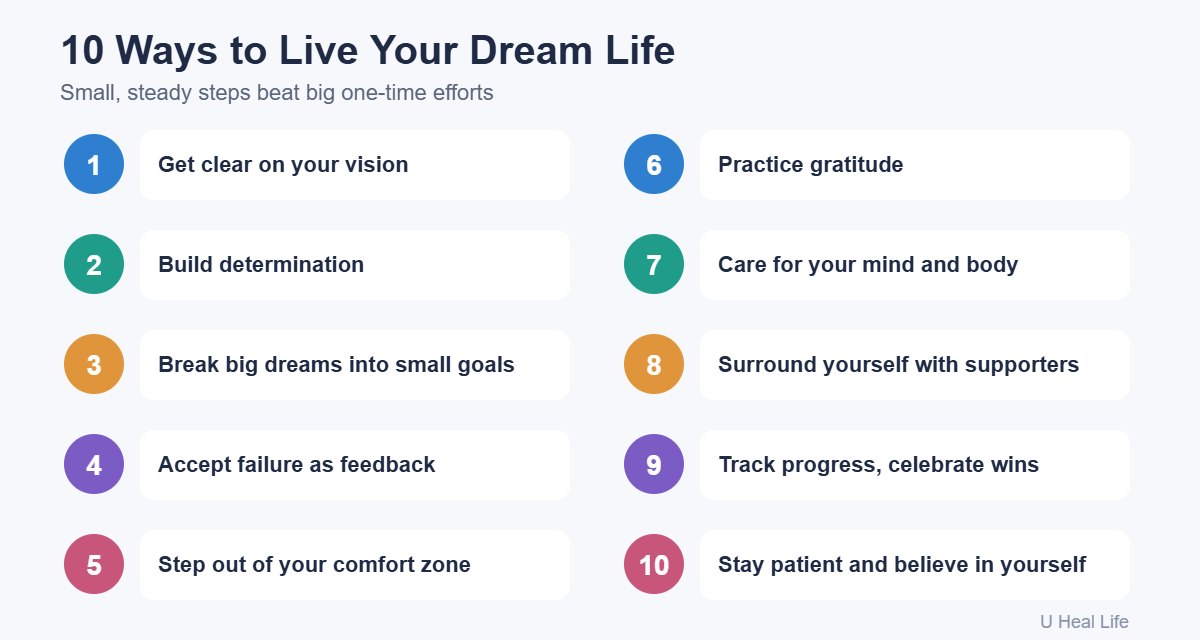
Infographic listing 10 ways to live your dream life, from getting clear on your vision to staying patient and believing in yourself
10 ways to live your dream life at a glance.

What Does “Living Your Dream Life” Really Mean?

A dream life is different for everyone. For one person it may be a satisfying career. For another it may be peace of mind, a loving family, better health, financial stability or the freedom to travel. There is no single right answer.

What matters is that your dream life feels meaningful to you, not just impressive to others. Before you follow any of the ways to live your dream life below, take a moment to ask yourself: “What do I really want, and why?”

10 Ways to Live Your Dream Life

1. Get Clear on What Your Dream Life Looks Like

You cannot move toward something you cannot see. Take 15 minutes with a notebook and write down:

  • How you want to feel every day
  • What kind of work, relationships and lifestyle you want
  • What is missing in your life right now

Be specific. “Be happy” is vague. “Have a calm morning, work I enjoy and time with my family” is clear.

2. Build Determination

Your determination decides whether you keep going when things get hard. It helps you handle struggles, disappointments and failures. A clear vision of your dream makes it easier to stay committed.

Remind yourself why you started. Put your goal where you can see it every day, such as on your phone wallpaper or a sticky note on your desk.

3. Break Big Dreams Into Small Goals

A huge dream can feel scary and slow. Break it into small steps you can finish this week and this month.

  • Write one big goal.
  • Split it into 3 smaller goals.
  • Choose one action for today.

Small steps done daily beat big plans that never start.

4. Accept That Failure Is Part of the Journey

To live the life you want, you need to be willing to face struggles and pass through them. If you give up at the first hurdle, it is hard to taste success. Almost every successful person has failed many times along the way.

When you fail, ask: “What did I learn? What will I try differently?” Then try again. Failure is feedback, not the end of the story.

5. Step Out of Your Comfort Zone

When you feel you are facing hurdles, it often means you are doing something outside your comfort zone. That is a sign of growth. The sooner you understand this, the easier it becomes.

Start small: speak up in a meeting, learn a new skill, or reach out to someone you admire. Be mentally and emotionally ready, and take one brave step at a time.

6. Practice Gratitude

Gratitude can take you a long way. We all face bad days, and it is easy to focus only on what is missing. Make it a habit to notice the little things you already have: good health, a warm meal, a kind friend.

Each night, write three things you are thankful for. Gratitude does not ignore problems. It helps you see the whole picture and stay positive while you work.

7. Take Care of Your Mind and Body

You cannot chase your dreams if you are exhausted. Protect your sleep, move your body, eat well and give your mind rest. Our guide on daily habits that support long-term brain health shows simple ways to start. A short 10-minute evening routine to reduce stress can also help you reset after a hard day.

If you often feel drained, read the signs you need a mental health day.

8. Surround Yourself With Supportive People

The people around you influence your mindset. Spend more time with people who encourage you, and share your goals with someone you trust. If someone constantly puts you down, create some distance.

You can also learn from mentors, books and online communities. You do not have to do this alone.

9. Track Your Progress and Celebrate Small Wins

Progress is easy to miss when you only look at the far-away goal. Keep a simple log of what you completed each week. When you hit a small milestone, celebrate it. This keeps you motivated and shows you how far you have come.

10. Stay Patient and Believe in Yourself

Change takes time. There will be slow days and doubts. Keep your mind and vision clear, trust the process, and be kind to yourself. Self-belief and steady hard work give you the best chance of reaching your goals.

Common Mistakes to Avoid

  • Waiting for the perfect moment. Start small, right now.
  • Comparing yourself with others. Your path is your own.
  • Setting too many goals at once. Focus on one or two.
  • Ignoring rest. Burnout slows you down.
  • Giving up after one failure. Learn and try again.

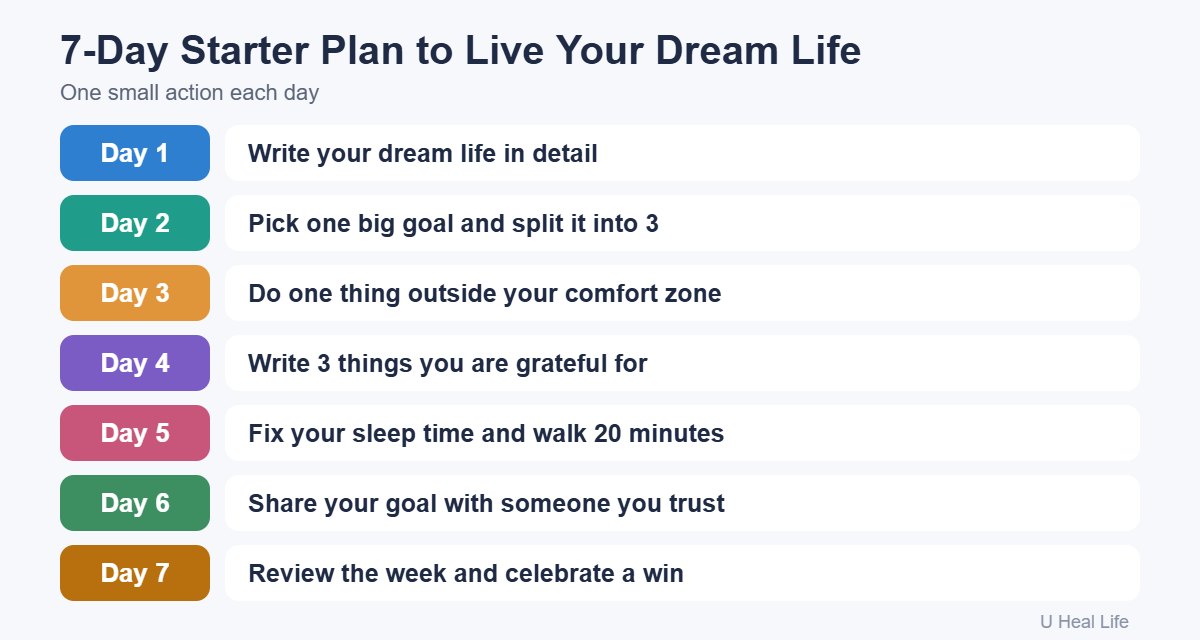
A Simple 7-Day Starter Plan

DayAction
Day 1Write what your dream life looks like in detail
Day 2Pick one big goal and split it into 3 small goals
Day 3Do one small thing outside your comfort zone
Day 4Write down 3 things you are grateful for
Day 5Fix your sleep time and take a 20-minute walk
Day 6Share your goal with someone you trust
Day 7Review your week and celebrate one small win
7-day starter plan with ways to live your dream life: write your vision, set goals, leave your comfort zone, practice gratitude, rest, share your goal and review your week
A simple 7-day plan to get started.

When Your Dream Feels Too Heavy

Chasing a dream can bring stress, worry and self-doubt. If you feel constantly anxious, hopeless or stuck, please talk to a trusted person or a mental health professional. Our guides on feeling anxious for no reason and how to stop overthinking at night may help you understand what you are feeling.

If you are thinking about harming yourself, call or text 988 (the Suicide & Crisis Lifeline in the US) or your local emergency number right away.

Frequently Asked Questions About Ways to Live Your Dream Life

How do I start living my dream life?

Start by writing what you really want, then pick one small action you can do today. Repeat it daily and build from there.

What if I do not know what my dream life is?

That is normal. Try new things, notice what makes you feel energized, and write down what you value. Your vision can change over time.

How long does it take to live your dream life?

There is no fixed time. It depends on your goals and effort. Focus on steady progress rather than a deadline.

Is it too late to start?

No. You can start at any age. Small steps today still move you forward.

How do I stay motivated when things get hard?

Remind yourself why you started, break the goal into smaller steps, celebrate small wins and ask for support when you need it.

Final Thoughts

Living your dream life is not about being perfect. It is about knowing what you want, taking small steps, learning from setbacks and being grateful along the way. Pick one idea from this list and try it today. Your future self will thank you.

Disclaimer: This article is for general information and motivation only and is not professional advice. If you are struggling with your mental health, please speak with a qualified professional.