

How Does Garmin Measure Stress? HRV, Stress Score and Accuracy Explained
If you wear a Garmin watch, you have probably seen a stress score and wondered where it comes from. How does Garmin measure stress, and can you trust the number? This guide explains how the feature works, what the levels mean, what can change your reading and how to use it in a healthy way.
Quick answer: Garmin measures stress mainly by tracking heart rate variability (HRV), the small changes in time between heartbeats, using the optical heart rate sensor on your wrist. When your body is under stress, HRV tends to drop. Garmin turns this into a stress score from 0 to 100 and groups it into rest, low, medium and high. It is a helpful trend tool, not a medical measurement.
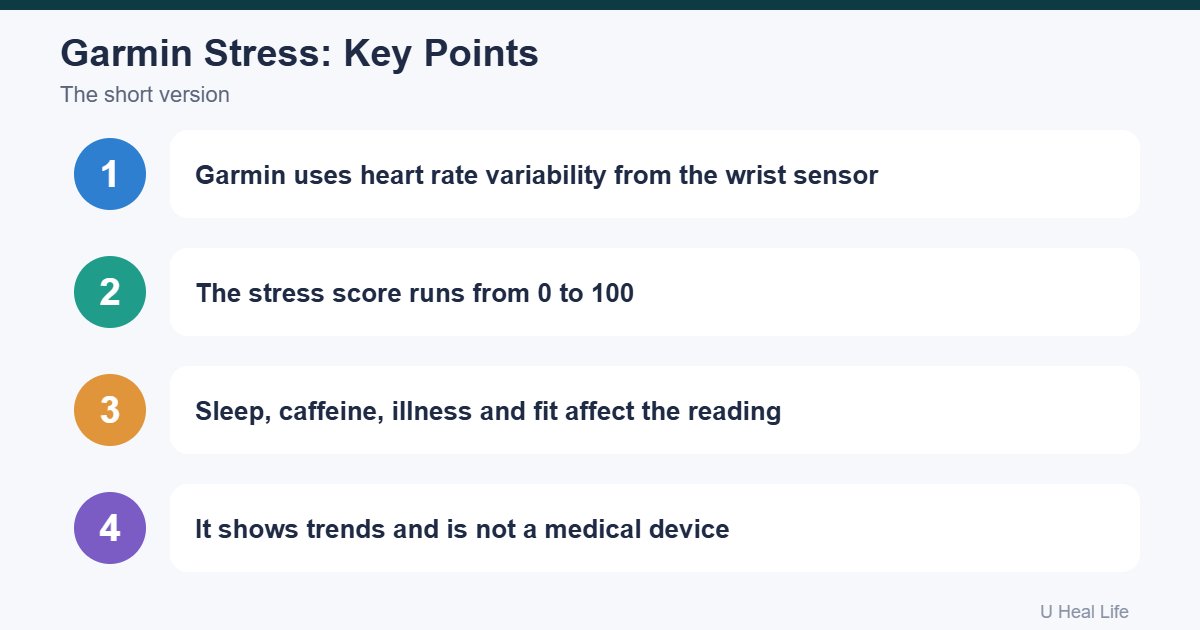
Table of Contents
How Does Garmin Measure Stress?
Garmin watches use a wrist-based optical sensor that continuously tracks your pulse. From this, the watch estimates your heart rate variability, which is the variation in time between each heartbeat.
When you relax, your heart rate tends to vary more. When you are stressed, your autonomic nervous system becomes more active and HRV tends to drop. The watch compares these patterns and gives you a stress score through the day.
What Do the Stress Levels Mean?
Garmin shows stress as a score from 0 to 100, grouped into ranges:
| Score | Level | What it generally suggests |
|---|---|---|
| 0 to 25 | Rest | Your body appears calm or recovering |
| 26 to 50 | Low stress | Normal daily activity |
| 51 to 75 | Medium stress | Your body is under more strain |
| 76 to 100 | High stress | Strong physical stress response |
Ranges are as described by Garmin and may differ slightly by model or software version.
What Can Change Your Stress Reading?
Stress on a Garmin is a body signal, not just a feeling. Many things can affect it:
- Emotional stress, worry or pressure at work
- Poor sleep or too little recovery
- Caffeine, alcohol or a large meal
- Illness or fever
- Hard exercise (the watch may not measure stress during workouts)
- How well the watch fits and how still your wrist is
This means a high score does not always mean you feel stressed, and a low score does not always mean you feel calm.
How Accurate Is Garmin Stress Tracking?
Wrist sensors can be affected by movement, skin contact and temperature, so readings are best used to spot patterns over days and weeks rather than to judge a single moment. Garmin stress tracking is not a medical device and cannot diagnose stress, anxiety or any health condition.
How to Use Your Stress Score in a Healthy Way
- Look at trends, not one number
- Notice what daily habits push your score up, such as late nights or heavy caffeine
- Try a short breathing exercise when your stress is high. Many Garmin models include breathing or relaxation features.
- Protect your sleep. See our 10-minute evening routine to reduce stress.
- Take short breaks and practice mindfulness. Our simple mindfulness exercises take only a few minutes.
When Should You Talk to a Professional?
If you feel stressed, anxious or low for weeks, or it affects your work, sleep or relationships, please speak with a doctor or licensed mental health professional, no matter what your watch says. If you are in crisis, call or text 988 in the US or your local emergency number.
Frequently Asked Questions About How Garmin Measures Stress
Does Garmin measure stress all day?
Garmin tracks stress throughout the day using your heart rate data, but it may not measure it during workouts.
What is a normal Garmin stress score?
Low scores such as 25 to 50 are typical during normal daily activity, and under 25 usually means rest. What is normal for you can differ.
Why is my Garmin stress high when I feel fine?
The score reflects your body’s response. Caffeine, illness, poor sleep or a loose-fitting watch can raise it even when you feel calm.
Is the Garmin stress score accurate?
It is useful for spotting patterns, but it is not medical-grade and can be affected by movement and fit.
How can I lower my Garmin stress score?
Sleep well, take breaks, try slow breathing, stay active and limit caffeine and alcohol.
Is Garmin stress the same as anxiety?
No. The score measures a body response, and anxiety is a mental health condition that needs a professional to assess.
Helpful resource: For device settings and features, see Garmin Support.
Related Reading
- How to Calm Your Mind in 5 Minutes
- How to Calm Down After a Stressful Day
- 10-Minute Evening Routine to Reduce Stress
- Why Do I Feel Anxious for No Reason?
- Daily Habits That Support Long-Term Brain Health
Disclaimer: This article is for general information only and is not medical advice. Garmin is a trademark of its owner, and we have no affiliation with the company.