

BrainPill Review 2026: Ingredients, Benefits, Side Effects & Does It Really Work?
Updated: October 2026
Affiliate disclosure: This article contains affiliate links. If you purchase through our links, we may earn a commission at no additional cost to you. Our analysis is based on publicly available product information and scientific research, not personal testing of BrainPill.
Medical disclaimer: This article is for educational purposes only and is not medical advice. Consult a qualified healthcare professional before using dietary supplements, especially if you take medication or have an existing medical condition.
Maintaining concentration throughout a busy workday isn’t always easy. Between constant notifications, demanding schedules, poor sleep, and everyday stress, many adults struggle to stay mentally focused.
BrainPill is a dietary supplement marketed to people looking for support with memory, focus, concentration, and mental performance.
But does BrainPill actually work? Are its ingredients supported by scientific research? And what should you know about its safety before considering it?
In this independent BrainPill review, we’ll examine the formula, potential benefits, research limitations, possible side effects, pricing considerations, and important precautions.
What Is BrainPill?
BrainPill is a cognitive-support dietary supplement marketed by Leading Edge Health.
The manufacturer promotes it as a nootropic formula designed to support:
- Focus and concentration
- Memory and recall
- Mental alertness
- Cognitive endurance
- Productivity during demanding tasks
Nootropics are substances marketed or studied for their possible effects on cognitive functions such as attention, learning, and memory.
Some nootropic ingredients have been evaluated in human studies, but the quality and strength of evidence vary considerably.
Important distinction: Evidence supporting an individual ingredient does not automatically prove that a finished supplement containing multiple ingredients delivers the same results.
BrainPill should not be considered a treatment for ADHD, anxiety disorders, depression, dementia, or other medical conditions.
BrainPill Ingredients: What’s Inside?
According to the manufacturer’s ingredient page, BrainPill combines vitamins, botanical extracts, and other compounds associated with cognitive function.
The advertised formula includes citicoline, Bacopa monnieri, L-theanine, phosphatidylserine, tyrosine, ginkgo biloba, huperzine A, vinpocetine, DHA, and several B vitamins.
The ingredients deserve individual consideration because their mechanisms, evidence, and safety profiles differ.
1. Citicoline (Cognizin)
Citicoline is involved in processes related to phospholipid production and cellular function.
Researchers have investigated citicoline for potential effects on attention, memory, and other cognitive outcomes.
Some studies have reported encouraging findings in particular populations, but results cannot automatically be generalized to every healthy adult.
The amount used, study population, duration, and measured outcomes all matter.
Our assessment: Citicoline is a relevant ingredient for cognitive-health research, but its inclusion alone does not establish BrainPill’s effectiveness.
2. Bacopa Monnieri (Synapsa)
Bacopa monnieri is a botanical ingredient traditionally used in Ayurvedic medicine.
It has attracted scientific interest because of possible effects on memory and information processing.
Some controlled trials have suggested benefits on selected memory measures after sustained supplementation.
However, studies differ in extract standardization, dosage, participant characteristics, and methodology.
Bacopa can also cause gastrointestinal discomfort in some individuals.
Our assessment: Bacopa has some promising research, but it is not an instant solution for memory difficulties or poor concentration.
3. L-Theanine
L-theanine is an amino acid naturally present in tea.
Researchers have investigated its possible effects on relaxation, attention, and responses to stress.
Some studies have examined L-theanine together with caffeine, making it important not to attribute every observed effect to L-theanine alone.
BrainPill is marketed as a caffeine-free supplement.
Our assessment: L-theanine is an interesting ingredient, but the evidence does not establish that BrainPill will reliably improve focus.
4. Phosphatidylserine
Phosphatidylserine is a phospholipid found in cell membranes, including those of brain cells.
It has been studied for potential effects on cognitive performance, particularly in certain older populations.
The evidence is mixed and depends on the formulation and population being studied.
Our assessment: Its biological role is established, but clinical benefits from supplementation should not be assumed.
5. Tyrosine
Tyrosine is an amino acid involved in producing several important signaling molecules.
Research has explored whether supplementation may influence cognitive performance under demanding conditions, such as acute stress or sleep deprivation.
Findings from specialized laboratory conditions do not necessarily translate into meaningful improvements during ordinary daily activities.
6. Ginkgo Biloba
Ginkgo biloba is widely marketed for memory and brain health.
However, evidence for improving cognitive performance in healthy adults remains uncertain.
The National Center for Complementary and Integrative Health reports that ginkgo has not been shown to prevent or slow dementia.
Ginkgo may also increase bleeding risk, particularly when combined with certain medications.
Our assessment: Ginkgo should not be treated as a proven memory enhancer.
7. Huperzine A
Huperzine A is a compound studied for its effects on acetylcholinesterase, an enzyme involved in the breakdown of acetylcholine.
Because it can affect neurotransmitter activity, it deserves particular attention when evaluating medication interactions and side effects.
Research into selected cognitive conditions does not establish that huperzine A improves everyday performance in healthy adults.
8. Vinpocetine
Vinpocetine is one of the most important ingredients to consider from a safety perspective.
The U.S. Food and Drug Administration has warned that vinpocetine may cause miscarriage or harm fetal development.
The FDA has also questioned its regulatory status as a dietary supplement ingredient.
People who are pregnant or could become pregnant should avoid products containing vinpocetine.
BrainPill’s manufacturer separately warns against use during pregnancy, when planning pregnancy, or while breastfeeding.
9. DHA and B Vitamins
DHA is an omega-3 fatty acid involved in normal brain function.
Vitamins B5, B6, B9, and B12 contribute to various metabolic and neurological processes.
Correcting a nutritional deficiency can be important for health and cognitive function.
However, taking additional vitamins when nutritional status is already adequate does not necessarily produce better memory or concentration.
Excessive intake of certain vitamins can also create health risks.
Does BrainPill Really Work?
This is the central question for anyone researching BrainPill.
The manufacturer makes several claims about focus, memory, and cognitive performance.
Some individual ingredients have been studied in humans, but ingredient-level findings are not equivalent to evidence from rigorous clinical trials of the complete commercial formula.
To establish that BrainPill itself produces meaningful improvements, ideally researchers would conduct well-designed, randomized, placebo-controlled trials using the marketed formulation and clearly defined cognitive outcomes.
Important questions include:
- Was the complete formula tested?
- How many participants were included?
- Were participants healthy adults or people with specific conditions?
- Was the study randomized and placebo-controlled?
- Were outcomes clinically meaningful?
- Were findings independently replicated?
- Were adverse events systematically monitored?
The manufacturer’s published ingredient explanations and research references are useful starting points, but they should not be treated as independent proof of every advertised benefit.
Our verdict on effectiveness: BrainPill contains several ingredients of scientific interest, but the publicly reviewed evidence is insufficient to conclude that the finished product reliably improves memory, focus, or productivity in healthy adults.
Potential BrainPill Benefits: What Is Reasonable to Expect?
Focus and concentration
Some ingredients have been investigated for effects on attention.
However, BrainPill should not be expected to produce a predictable improvement for every user.
Memory support
Certain ingredients have been studied for memory-related outcomes.
The research varies in quality, and results cannot automatically be applied to the complete BrainPill formula.
Mental fatigue
The manufacturer markets BrainPill for mental endurance.
However, fatigue may result from poor sleep, stress, nutritional deficiencies, medication effects, or medical conditions.
A supplement should not replace identifying and addressing the underlying cause.
Productivity
Productivity depends on multiple factors, including sleep, work environment, workload, habits, and mental well-being.
There is not sufficient evidence to promise that BrainPill will make someone more productive.
BrainPill Side Effects and Safety Concerns
No dietary supplement should be assumed to be completely free of side effects.
BrainPill contains multiple active ingredients, making individual tolerance and possible interactions important considerations.
Depending on the ingredients, potential concerns may include:
- Headaches or dizziness
- Digestive discomfort
- Allergic reactions
- Medication interactions
- Bleeding-related concerns associated with ginkgo
- Reproductive safety concerns associated with vinpocetine
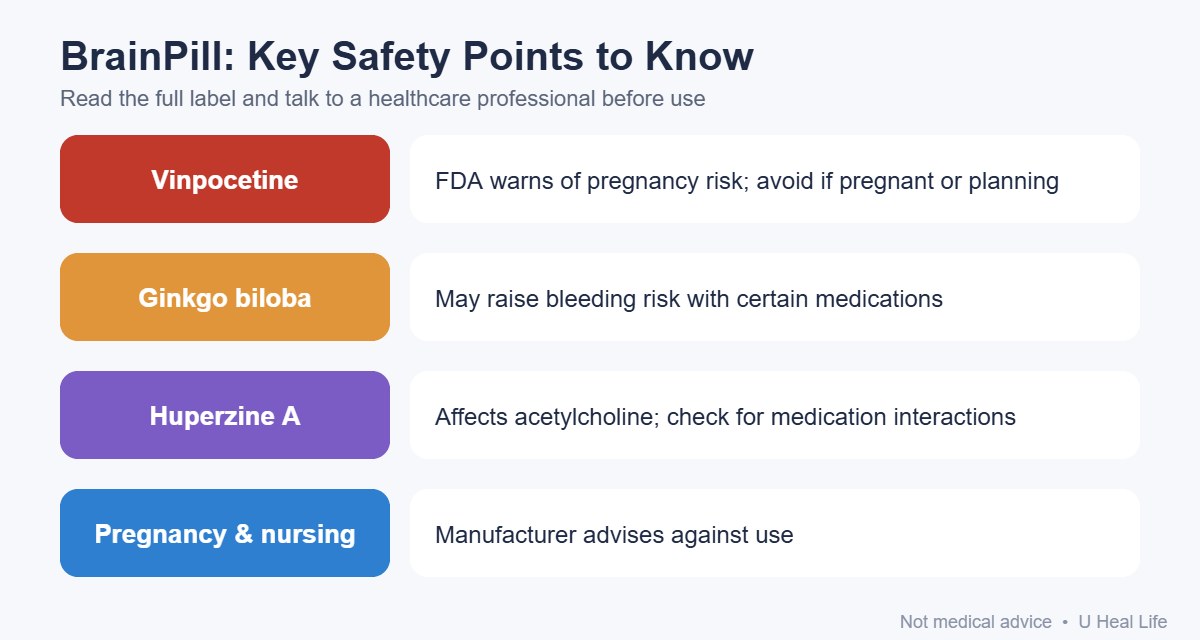
This is not a complete list of possible adverse effects, and it does not establish the frequency of side effects from BrainPill itself.
The FDA’s warning about vinpocetine is particularly significant.
Do not use BrainPill if you are pregnant, planning to become pregnant, or breastfeeding, consistent with the manufacturer’s warning.
If you take prescription medications, have a chronic health condition, or are considering multiple supplements, discuss the complete ingredient label with a healthcare professional before use.
Who Should Avoid BrainPill?
BrainPill may be inappropriate for several groups, including:
Pregnant individuals or those who could become pregnant: Vinpocetine has specific FDA safety warnings.
People who are breastfeeding: The manufacturer advises against use.
People taking certain medications: Some botanical ingredients may interact with prescription drugs.
People with unexplained or worsening cognitive symptoms: Persistent brain fog, memory changes, or difficulty concentrating deserve appropriate medical assessment.
People seeking treatment for a diagnosed condition: BrainPill is not a substitute for evidence-based medical care.
BrainPill Price and Where to Buy
BrainPill is promoted through its official website.
Pricing, package discounts, shipping terms, and availability may change, so readers should check the current product page rather than rely on an outdated price quoted in a review.
Before purchasing, review:
- Current price per bottle
- Number of servings
- Complete Supplement Facts label
- Shipping charges
- Refund eligibility
- Terms of purchase
- Any restrictions relevant to your location
View BrainPill Product Information and Current Pricing
Paid affiliate link. We may earn a commission from qualifying purchases.
BrainPill Refund Policy
The manufacturer advertises a 60-day satisfaction guarantee.
Its published terms describe return conditions and a deadline for receiving returned products, with shipping and handling generally excluded from refunds.
Readers should verify the current terms directly before ordering, including which opened and unopened containers qualify.
A refund policy can reduce some financial uncertainty, but it does not establish that a supplement is safe or effective.
BrainPill Pros and Cons
Potential advantages
- Includes several ingredients that have been investigated in cognitive-health research
- Manufacturer provides ingredient information
- Marketed as caffeine-free
- Offers a published refund policy
- Provides an option for readers interested in researching multi-ingredient nootropic supplements
Limitations
- The complete formula’s effectiveness has not been adequately established by the evidence reviewed here
- Ingredient research does not prove product-level benefits
- Contains vinpocetine, which carries significant reproductive safety concerns
- Some ingredients may interact with medications
- Results cannot be predicted for individual users
- A multi-ingredient formula makes it harder to identify which ingredient, if any, is responsible for an effect
BrainPill vs. Other Cognitive Supplements
When comparing BrainPill with another nootropic product, don’t focus only on the number of ingredients or marketing claims.
Consider these factors:
| Comparison factor | What to look for |
|---|---|
| Ingredient transparency | Complete ingredient names and quantities |
| Clinical evidence | Human studies on the actual finished formula |
| Safety | Known risks, contraindications, interactions |
| Quality | Manufacturing and independent testing information |
| Price | Cost per serving and total monthly expense |
| Refunds | Clear written conditions |
| Suitability | Your medical history and individual needs |
A product with fewer ingredients and clearer evidence may be easier to evaluate than a complex blend.
Natural Alternatives for Better Focus and Mental Clarity
Before purchasing a cognitive supplement, consider foundational habits that influence concentration and mental performance.
1. Prioritize consistent sleep
Sleep plays an important role in attention, learning, and memory.
Maintain a regular sleep schedule and address ongoing sleep problems rather than relying on supplements to compensate for insufficient rest.
2. Exercise regularly
Regular physical activity supports overall health and can benefit aspects of cognitive and emotional well-being.
Choose activities appropriate for your fitness level and medical circumstances.
3. Reduce unnecessary distractions
Try working in focused blocks, silencing nonessential notifications, and creating a distraction-reduced environment.
4. Eat a balanced diet
Adequate nutrition supports normal brain function.
If you suspect a deficiency, discuss appropriate testing with a healthcare professional instead of assuming that a supplement will help.
5. Manage everyday stress
Mindfulness exercises, regular breaks, social support, and reasonable workloads can help make daily demands more manageable.
6. Investigate persistent brain fog
Ongoing concentration problems may have medical, psychological, sleep-related, or medication-related causes.
A clinician can help determine whether further evaluation is appropriate.
Is BrainPill Worth It in 2026?
BrainPill may attract people interested in cognitive-support supplements because it combines several well-known nootropic ingredients.
However, the decision should not be based on marketing promises alone.
The most important limitation is the gap between research on individual ingredients and reliable evidence that the complete BrainPill formula improves real-world cognitive performance.
The presence of vinpocetine also raises a meaningful safety consideration, especially for people who are pregnant or could become pregnant.
Our conclusion: BrainPill is a product worth researching carefully, not a proven shortcut to sharper memory or better productivity. We cannot recommend it as a reliable cognitive enhancer based on the evidence reviewed here.
Anyone considering it should first evaluate the complete label, potential interactions, personal health circumstances, and available alternatives.
Review BrainPill’s Official Product Details
Paid affiliate link. Purchases through this link may generate a commission for UHealLife.
Frequently Asked Questions
Is BrainPill FDA-approved?
BrainPill is marketed as a dietary supplement, not an FDA-approved medication for improving memory or treating cognitive disorders. Dietary supplements are generally not approved by the FDA for safety and effectiveness before marketing.
Does BrainPill help with brain fog?
The manufacturer promotes BrainPill for brain fog, but there is insufficient independent evidence reviewed here to conclude that the finished product reliably improves this symptom.
Persistent brain fog should be evaluated for possible underlying causes.
How long does BrainPill take to work?
The manufacturer suggests sustained use may be necessary. However, there is no well-established timeframe in which consumers can reliably expect cognitive improvements from the finished product.
Is BrainPill safe for everyone?
No. The product contains ingredients with potential risks and interactions. The manufacturer advises against use during pregnancy, when planning pregnancy, or while breastfeeding.
Can BrainPill treat ADHD or anxiety?
No reliable evidence establishes BrainPill as a treatment for ADHD, anxiety disorders, or other medical conditions. It should not replace professional assessment or prescribed treatment.
Is BrainPill caffeine-free?
The manufacturer describes BrainPill as caffeine-free. Check the current product label to confirm the formulation before purchasing.
Does BrainPill offer a money-back guarantee?
The manufacturer advertises a 60-day guarantee, subject to its current return conditions. Verify those conditions before ordering.
Final Thoughts
Better focus and mental clarity are worthwhile goals, but the best approach starts with understanding why concentration is difficult in the first place.
BrainPill contains ingredients that have attracted scientific interest, yet that does not establish that the combined product will work as advertised.
Consumers should balance possible benefits against uncertainty, safety concerns, cost, and more established approaches to cognitive well-being.
At UHealLife, our goal is to help readers make informed wellness decisions through balanced information rather than exaggerated promises.
Related Reading
- Simple Mindfulness Exercises for Busy People
- How to Calm Your Mind in 5 Minutes: 12 Science-Backed Techniques
- How to Stop Overthinking at Night
References and Further Reading
- BrainPill — Official Ingredients
- BrainPill — Frequently Asked Questions
- FDA — Vinpocetine in Dietary Supplements
- NCCIH — Ginkgo: Usefulness and Safety
- NCCIH — Dietary Supplements and Cognitive Function: What the Science Says
Editorial note: This article is an independent desk-based research review. UHealLife has not conducted personal product testing or an independent clinical trial of BrainPill.