
Online Therapy vs In-Person Therapy: What Is the Difference?
Today you can see a therapist from your living room or from an office. Both are real options, and both are used widely. This guide compares online therapy vs in-person therapy in simple terms: how they differ, what research says, what to consider and when each may fit better.
By the U Heal Life editorial team. Last updated: October 2026. This is general information, not medical, legal or financial advice. We are not licensed clinicians.
Quick answer: Research and reports from the American Psychological Association suggest online therapy can work about as well as in-person therapy for many people and many common concerns. Online therapy is usually more convenient and sometimes cheaper. In-person therapy may suit people in crisis or with severe symptoms, or who want more privacy than they have at home. Choose a licensed therapist and check that they can practice in your state.
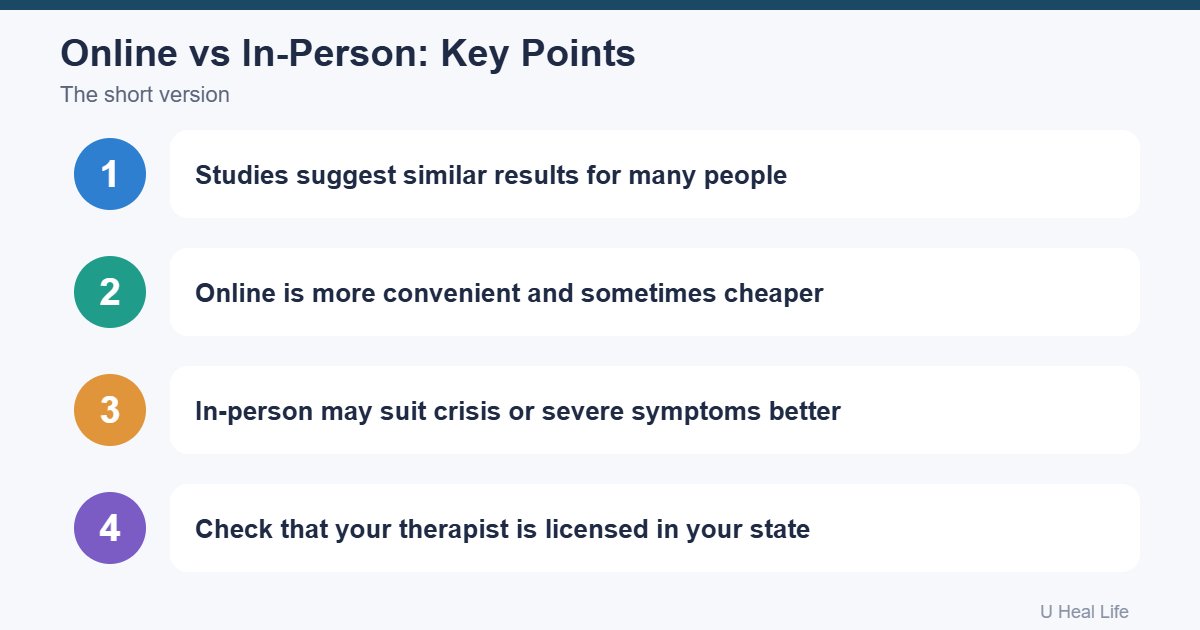
Table of Contents
What the Research Says
The APA reported that about 96 percent of psychologists in a 2022 survey said they treated patients virtually. Reviews of studies, including a 2018 review of 20 studies reported by Scientific American, found online therapy to be about as effective as in-person therapy for conditions such as depression and several anxiety disorders. Many therapists still see in-person therapy as a slightly stronger experience for some people, but they agree that online therapy is far better than no therapy. Results depend on the therapist, the approach and you.
Online vs In-Person: Side by Side
| Online therapy | In-person therapy | |
|---|---|---|
| Convenience | No travel, flexible times | Travel and fixed office hours |
| Cost | Often lower, but varies | Often higher in private practice |
| Privacy | Needs a quiet, private space at home | Private office |
| Connection | Can feel close, though body language is harder to read | Easier to read body language |
| Access | Reaches rural areas and busy schedules | Limited to local providers |
| Technology | Needs internet and a device | None needed |
| Crisis support | Less suited to crisis situations | Often better for crisis |
When Online Therapy May Fit Better
- You live far from providers or have a busy schedule
- You prefer to start from the comfort of home
- Travel or mobility is difficult
- Cost is a barrier
When In-Person May Fit Better
- You are in a crisis or have severe symptoms
- You do not have a private space at home
- You find screens tiring or distracting
- Your provider recommends it for an assessment
If you are thinking about harming yourself, call or text 988 in the US or your local emergency number right away. Do not wait for an appointment.
What to Check for Either Format
- License: therapists must be licensed to practice in your state. Verify through your state licensing board
- Privacy: ask how they protect your information
- Fees and cancellation rules
- Approach: ask which methods they use and how sessions work
- Fit: it is fine to try a few sessions and switch if it does not feel right
A Word on Online Therapy Programs
Some online services describe structured programs and not only weekly video sessions. For example, Online-Therapy.com describes CBT-based programs for individuals and couples. This is an affiliate link: we may earn a commission at no cost to you. We have not tested the service and we cannot promise results, so please check the details and talk to a professional about what fits you. Learn more about Online-Therapy.com
Frequently Asked Questions: Online Therapy Vs In-Person Therapy
Is online therapy as effective as in-person therapy?
For many people and common concerns, research suggests yes. It depends on the person, the therapist and the approach.
Is online therapy cheaper?
Often, but not always. Compare fees, session length and what is included.
Is online therapy private?
It can be, but you need a private space and a provider that protects your data.
Can online therapy be used in a crisis?
It is not designed for emergencies. In the US, call or text 988, or call local emergency services.
Can I switch from online to in-person?
Yes. Many therapists offer both, or you can find a new provider. See how to find a therapist.
Helpful resource: The American Psychological Association shares information about psychotherapy and telepsychology.
Related Reading
- How to Find a Therapist
- How Much Does Therapy Cost Without Insurance?
- Does Health Insurance Cover Therapy?
- Free and Low-Cost Therapy Options in the USA
- Why Do I Feel Anxious for No Reason?
Disclaimer: This article is for general information only and is not medical, mental health, tax or insurance advice. Prices, rules and availability change, so please check current details with each provider or plan. If you are in crisis or thinking about harming yourself, call or text 988 (the Suicide and Crisis Lifeline in the US) or your local emergency number right away.