How Much Does Therapy Cost Without Insurance? Price Ranges and Ways to Save (2026)
Cost is one of the biggest reasons people delay therapy. If you do not have insurance, or your plan does not cover what you need, it helps to know the usual price ranges and the ways to pay less. This guide explains how much therapy costs without insurance in the United States, what changes the price and practical ways to save.
By the U Heal Life editorial team. Last updated: October 2026. This is general information, not medical, legal or financial advice. We are not licensed clinicians.
Quick answer: Without insurance, a therapy session in the US typically costs about $100 to $200, according to several cost guides, and some reports put the national average between roughly $140 and $175 per session. Prices are higher in big cities and lower with sliding scale providers, community clinics, student clinicians and some online options. Ask any provider about fees, sliding scale and cancellation rules before your first session.
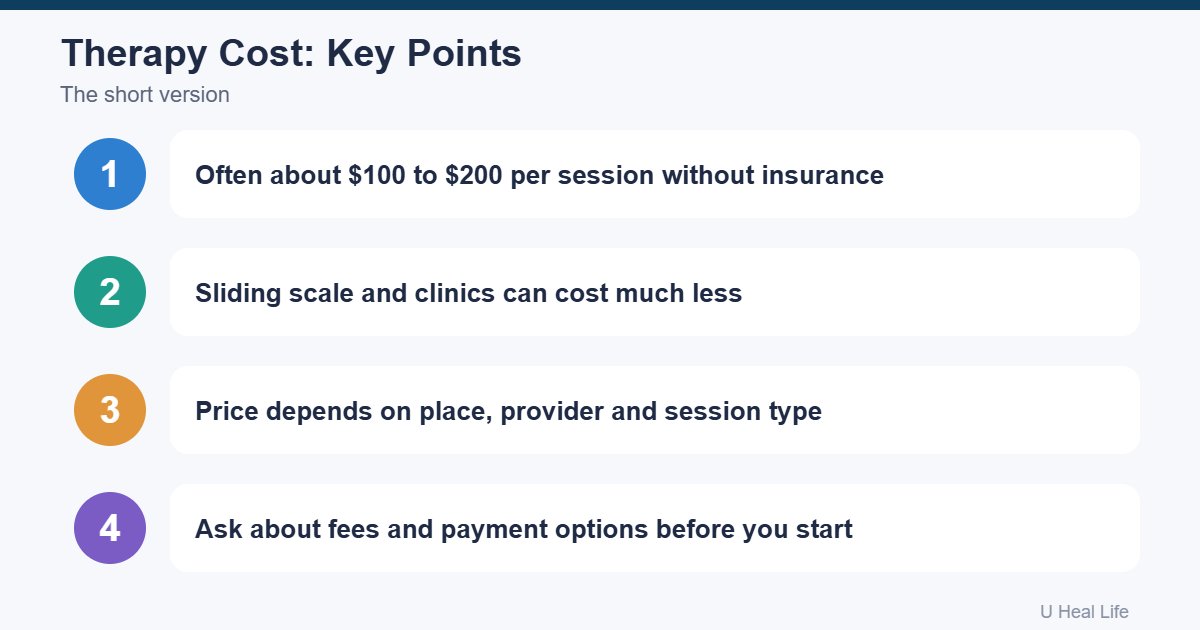
Table of Contents
Typical Price Ranges
Figures below come from public cost guides and change often. Treat them as rough ranges, not quotes.
| Option | Typical cost per session |
|---|---|
| Private practice therapist (self-pay) | About $100 to $200 |
| National average (varies by report) | Roughly $140 to $175 |
| Psychologist | Often at the higher end of private rates |
| Sliding scale therapist | Often about $30 to $100, based on income |
| Community or sliding-fee clinics | Often $0 to $60, based on income |
| Online therapy platforms | Often reported around $60 to $120 per session or per week |
Rates in big coastal cities are often much higher than in rural areas.
What Changes the Price?
- Location: big cities usually cost more
- Provider type and training: psychologists and psychiatrists often charge more than counselors
- Session length and format: 45 to 60 minutes is common; couples and group sessions differ
- Specialty: some therapists charge more for specialized work
- In-person or online
Ways to Pay Less
- Ask for a sliding scale. Many therapists reduce their fee based on income. Just ask when you call.
- Try Open Path Collective. This nonprofit lists therapists who offer lower fees. At the time of writing it lists a one-time membership fee of about $65 and session fees of about $40 to $70 for individual therapy, and lower fees with student interns. Check the site for current prices and eligibility.
- Use a community mental health center or health center. Many offer sliding-fee care. See our guide to free and low-cost therapy options in the USA.
- Look at university training clinics. Supervised students may offer lower fees.
- Check your employer’s Employee Assistance Program (EAP). It may include a few free sessions.
- Ask about out-of-network reimbursement. Some plans reimburse part of the cost if you have a receipt (sometimes called a superbill). Check with your insurer.
- Use HSA or FSA money, if you have it. See can you use an HSA or FSA for therapy.
- Compare online and in-person. See online therapy vs in-person therapy.
Questions to Ask Before Your First Session
- What is your fee per session, and how long is a session?
- Do you offer a sliding scale?
- What is your cancellation policy?
- Can I pay by card, and will you provide receipts?
- How many sessions do you usually suggest?
Frequently Asked Questions: How Much Does Therapy Cost Without Insurance
How much is therapy per session without insurance?
Often about $100 to $200 in private practice, but it can be lower with sliding scale or clinics, and higher in big cities.
Is online therapy cheaper?
Sometimes. Some online options are priced lower, but prices and formats differ widely, so compare what you get.
What is a sliding scale?
It means the fee is based on your income. People with lower incomes pay less.
Can I get therapy for free?
Some community clinics, support groups and programs are free or very low cost. See free and low-cost therapy options.
Does insurance cover therapy?
Many plans do, but coverage varies. Read our mental health insurance coverage guide.
Helpful resource: For help finding low-cost care, see the SAMHSA treatment locator and Open Path Collective.
Related Reading
- Does Health Insurance Cover Therapy?
- Free and Low-Cost Therapy Options in the USA
- Can You Use an HSA or FSA for Therapy?
- Online Therapy vs In-Person Therapy
- How to Find a Therapist
Disclaimer: This article is for general information only and is not medical, mental health, tax or insurance advice. Prices, rules and availability change, so please check current details with each provider or plan. If you are in crisis or thinking about harming yourself, call or text 988 (the Suicide and Crisis Lifeline in the US) or your local emergency number right away.