
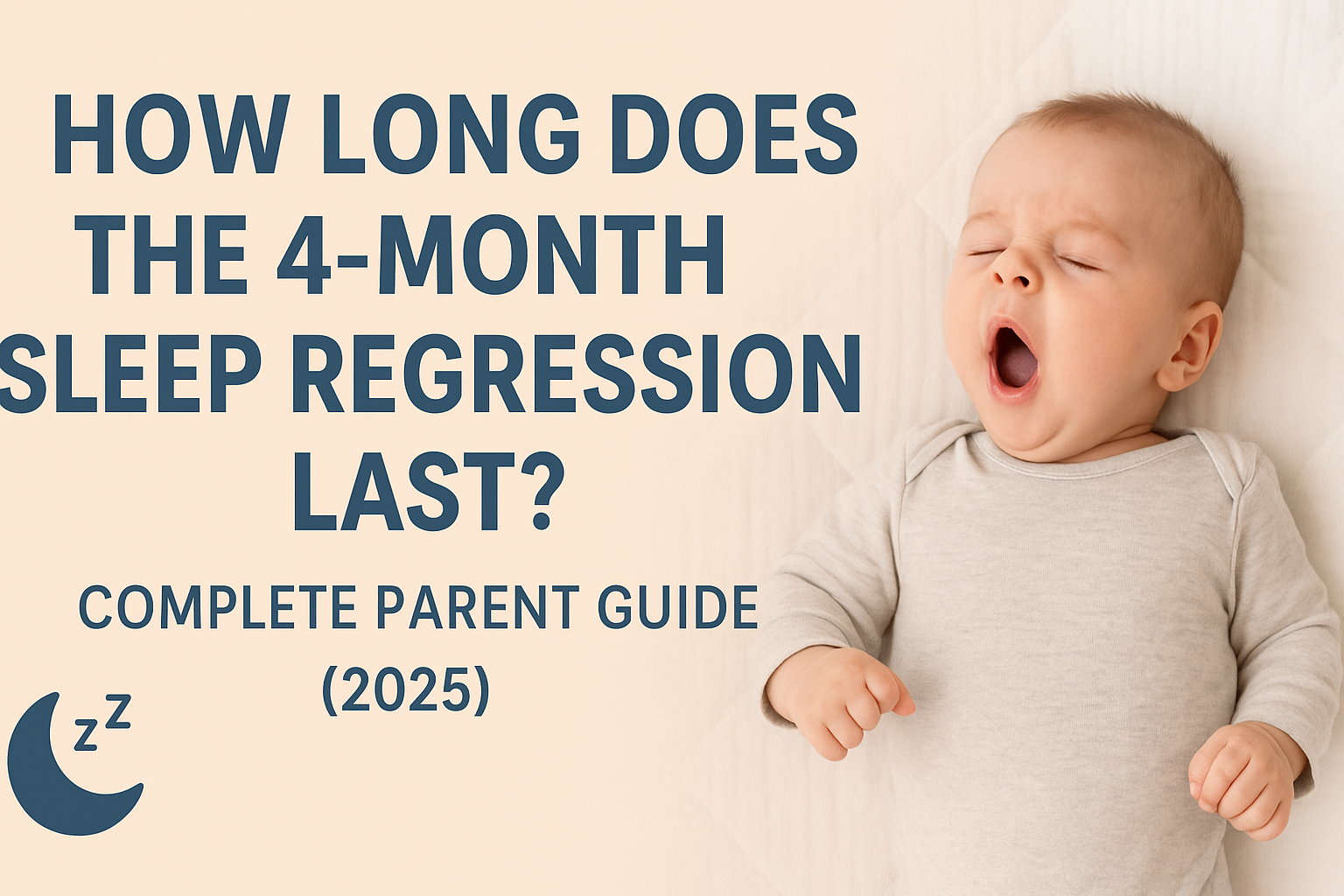
How Long Does the 4-Month Sleep Regression Last? A Complete Parent Guide (2025)
Introduction
If your baby suddenly stops sleeping well at around 4 months, you’re not alone. Parents around the world experience the same phase:
The 4-Month Sleep Regression.
It can feel exhausting, confusing, and emotionally draining — especially if your baby was previously sleeping well.
The good news?
It’s temporary.
In this 2025 updated guide, you’ll learn exactly:
- How long the 4-month sleep regression lasts
- Why it happens
- Signs your baby is going through it
- Proven tips to help your baby sleep better
- When you should seek help
⭐ How Long Does the 4-Month Sleep Regression Last?
Generally, the 4-month sleep regression lasts 2 to 6 weeks.
For most babies:
- Mild cases: 1–2 weeks
- Typical cases: 3–4 weeks
- Longer cases: 5–6 weeks
Every baby is different, but the average duration is around 4 weeks.
⭐ Why Does the 4-Month Sleep Regression Happen?
This regression occurs because your baby’s brain is going through a major developmental change.
Around 4 months, babies:
- Shift from newborn sleep cycles to adult-like sleep cycles
- Become more aware of sounds, lights, and people
- Learn new skills (rolling, grabbing, babbling)
- Experience growth spurts
- Need longer and deeper sleep routines
This is not a “problem” — it’s a normal developmental milestone showing healthy brain growth.
⭐ Signs Your Baby Is in the 4-Month Sleep Regression
Look for these common symptoms:
✓ Frequent night wakings
Waking every 1–3 hours, even if sleeping well earlier.
✓ Shorter naps
20–40 minute naps become common.
✓ Increased crying or fussiness
Especially during bedtime or nap time.
✓ Baby fights sleep
More alert, more active, more distracted.
✓ Changes in feeding
Some babies want to feed more frequently.
✓ Rolling or physical changes
New skills disrupt sleep patterns.
If your baby shows most of these signs, the sleep regression is likely happening.
⭐ How to Survive the 4-Month Sleep Regression (Parent-Tested Tips)
These methods help soothe your baby and support better sleep.
1. Establish a Consistent Bedtime Routine
A predictable routine helps the baby understand it’s time to sleep.
Include:
- Warm bath
- Light massage
- Dim lights
- Soft music or white noise
- Short calming cuddles
Consistency = smoother sleep.
2. Use White Noise
White noise mimics the womb and blocks sudden noises.
Babies fall asleep faster with:
- Rain sounds
- Fan noise
- Ocean waves
Avoid loud or harsh noises.
3. Create the Ideal Sleep Environment
A good sleep space includes:
- Cool room (20–22°C / 68–72°F)
- Dark curtains
- Comfortable sleepwear
- Safe, firm mattress
The calmer the environment, the longer the sleep.
4. Follow Wake Windows
At 4 months, ideal wake window is 90–120 minutes.
This prevents overtiredness and reduces crying.
5. Offer Extra Feeding if Needed
Growth spurts during this age increase hunger.
A little extra milk can improve sleep.
6. Avoid Over-Stimulation Before Bed
No screens, loud voices, or bright lights 1 hour before sleep.
Babies need calmness, not excitement.
7. Practice Gentle Sleep Training (Optional)
You can try:
- Pick-up, put-down method
- Chair method
- Pat-and-shush
Avoid strict methods — 4 months is still early.
⭐ Does Every Baby Experience the 4-Month Sleep Regression?
Not always.
Some babies:
- Show mild signs
- Show no signs
- Pass through quickly
But 70–80% of babies experience some level of sleep disruption around 4 months.
⭐ When Should You Worry?
Seek help if:
- Sleep issues last longer than 8 weeks
- Baby is not feeding well
- Baby loses weight
- Baby cries excessively
- You feel overwhelmed or depressed
Consult a pediatrician if anything feels “off.”
⭐ When Does Sleep Improve After the 4-Month Regression?
Once this phase passes, sleep becomes more stable around:
- 5 months
- 6 months
- Once a routine is established
Many babies start sleeping longer again after this regression.
⭐ Conclusion: It’s Hard, but It Won’t Last Forever
The 4-month sleep regression is challenging, but it’s temporary.
Remember:
✔ It usually lasts 2–6 weeks
✔ It’s a normal part of development
✔ Your baby’s brain is growing
✔ Good routines make it easier
✔ Better sleep is coming soon
Be patient, stay calm, and support your baby through this important milestone.
You’re doing a great job!