Free and Low-Cost Therapy Options in the USA: Where to Look
If cost is stopping you from getting help, you have more options than you may think. Free and low-cost therapy options exist in many places, though some come with waiting lists or limits. This guide explains where to look in the United States, how to find each option and tips for getting started.
By the U Heal Life editorial team. Last updated: October 2026. This is general information, not medical, legal, tax or financial advice. We are not licensed clinicians or tax professionals.
Quick answer: Options for free and low-cost therapy in the US include community mental health centers and federally funded health centers that use sliding fees, university training clinics with supervised students, Open Path Collective, employer Employee Assistance Programs, support groups and helplines. You can search the SAMHSA treatment locator at findtreatment.gov or call the SAMHSA helpline at 1-800-662-4357 for referrals. In a crisis, call or text 988.
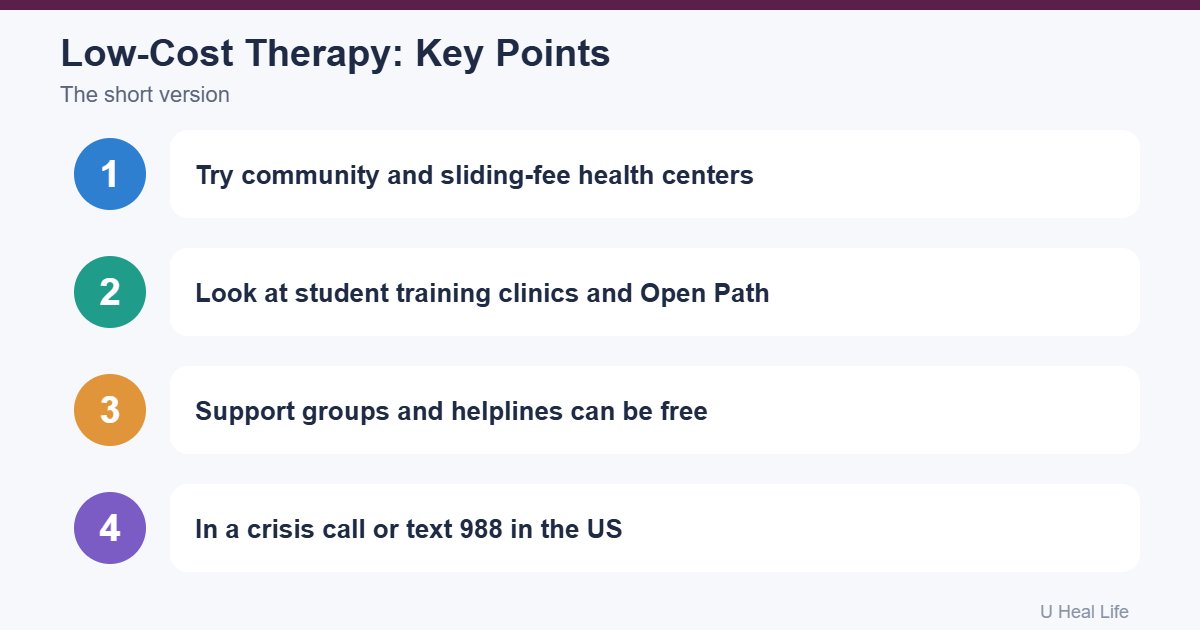
Table of Contents
Where to Look
| Option | What it is | How to find it |
|---|---|---|
| Community mental health centers | Nonprofit or public clinics that often charge by income | Search the SAMHSA treatment locator or call 211 |
| Federally funded health centers | Health centers that offer sliding-fee care, often with mental health services | Search for a health center near you and ask about sliding fees |
| University training clinics | Supervised graduate students offer lower-cost sessions | Search for psychology or counseling programs near you |
| Open Path Collective | Nonprofit network with lower session fees and a one-time membership fee | See Open Path for current prices |
| Employee Assistance Program (EAP) | Employer benefit that may offer a few free sessions | Ask HR or check your benefits |
| Support groups | Peer groups, many free | Look at local chapters, such as NAMI |
| Helplines | Free referrals and support | SAMHSA: 1-800-662-4357. NAMI: 1-800-950-NAMI |
Tips for Using These Options
- Ask about fees up front. Many providers can reduce a fee if you ask
- Contact several places. Waitlists are common, so apply to more than one
- Ask about a sliding scale. Private therapists may offer it too
- Check your insurance or Medicaid. You may have more coverage than you think. See our insurance coverage guide
- Use HSA or FSA funds if you have them. See can you use an HSA or FSA for therapy
- Consider online options that may cost less. See online therapy vs in-person therapy
What to Expect
Low-cost providers may have waiting lists, limited session counts or students in training who work under supervision. This can still be useful care. If your needs change or you are in crisis, tell them right away.
Pay-Per-Session Costs to Compare
Private-practice therapy often costs $100 to $200 per session without insurance, while sliding scale and clinics can cost much less. See how much therapy costs without insurance.
When to Get Help Right Away
If you are in crisis, thinking about harming yourself or worried about someone’s safety, call or text 988 (the Suicide and Crisis Lifeline) in the US, or call your local emergency number. In India, you can call Tele-MANAS at 14416.
Frequently Asked Questions: Free And Low-Cost Therapy Options
How do I find free therapy near me?
Start with the SAMHSA treatment locator and ask about sliding-fee clinics. You can also call 211 or the SAMHSA helpline for referrals.
What is a sliding scale?
A fee based on your income. People with lower incomes pay less.
Is therapy with a student clinician good?
It can be, because students are supervised by licensed professionals. Ask how supervision works.
Can I use Open Path without insurance?
Open Path is designed for people who are uninsured or find regular rates hard to afford. Check their current rules and prices.
What if I am in crisis?
Call or text 988 in the US, or use your local emergency number.
Helpful resource: SAMHSA lists free and low-cost treatment options.
Related Reading
- How Much Does Therapy Cost Without Insurance?
- How to Find a Therapist
- Can You Use an HSA or FSA for Therapy?
- Does Health Insurance Cover Therapy?
- How to Calm Your Mind in 5 Minutes
Disclaimer: This article is for general information only and is not medical, mental health, tax or insurance advice. Rules, prices and availability change, so please check current details with your plan administrator, a tax professional or the provider. If you are in crisis or thinking about harming yourself, call or text 988 (the Suicide and Crisis Lifeline in the US) or your local emergency number right away.