
Reclaim Wellness Carmel
How Reclaim Wellness Carmel Empowers You to Take Back Your HealthWellnessHow Reclaim Wellness Carmel Empowers You to Take Back Your Health

In today’s fast-paced world, most people focus on treating symptoms instead of addressing the real cause of their health challenges. But at Reclaim Wellness Carmel, the philosophy is different. This leading holistic wellness center in Carmel, Indiana helps individuals take back control of their health through a root-cause, integrative approach that focuses on long-term healing, not temporary relief.

🌿 The Reclaim Wellness Philosophy: Heal from the Inside Out

At Reclaim Wellness Carmel, wellness isn’t just about the absence of illness — it’s about achieving balance in body, mind, and spirit. The center’s approach is based on functional medicine and holistic care, combining modern science with natural healing methods.

Rather than prescribing quick fixes, the expert team looks at the whole person — lifestyle, nutrition, mental health, and environment — to uncover what’s truly affecting your wellbeing. This personalized care model helps restore balance and empowers you to become an active participant in your healing journey.

💪 Key Services That Help You Reclaim Your Health

Reclaim Wellness Carmel offers a wide range of services designed to improve vitality, energy, and mental clarity. Each program is tailored to meet the specific needs of every individual.

1. Functional Medicine & Root-Cause Diagnosis

Through advanced lab testing and health assessments, the team identifies the underlying factors behind chronic fatigue, hormonal imbalance, gut issues, and inflammation. The goal is to correct these imbalances naturally and sustainably.

2. IV Therapy & Nutrient Optimization

For those dealing with nutrient deficiencies or low energy, IV therapy provides a direct boost of vitamins, minerals, and hydration. This therapy supports immunity, enhances metabolism, and promotes recovery from stress or illness.

3. Weight Management & Metabolic Health

Instead of crash diets or fad solutions, Reclaim Wellness focuses on long-term metabolic balance. Customized nutrition guidance, body composition tracking, and lifestyle support help you lose weight while improving overall wellness.

4. Hormone Optimization & Anti-Aging Treatments

Hormonal imbalance is one of the most common yet overlooked issues affecting both men and women. The clinic provides bioidentical hormone replacement therapy and anti-aging programs to restore vitality, improve sleep, and enhance mood.

5. Mind-Body Therapies & Stress Management

Emotional health plays a crucial role in overall wellness. Mind-body therapies, meditation guidance, and stress-relief programs help patients reduce anxiety, improve mental clarity, and build emotional resilience.

🌸 Why Choose Reclaim Wellness Carmel

  • Personalized care: Every treatment plan is tailored to your body and lifestyle.
  • Integrative approach: Combines traditional medicine, nutrition, and holistic therapies.
  • Root-cause focus: Addresses underlying issues, not just symptoms.
  • Expert practitioners: A team of skilled professionals with years of experience in integrative health.
  • Community-centered care: A welcoming, supportive environment where your health journey truly matters.

🌞 The Power to Reclaim Your Health Starts with You

Taking back control of your health is not about short-term results — it’s about sustainable change. Reclaim Wellness Carmel gives you the tools, guidance, and ongoing support to live a healthier, more balanced life.

If you’ve been struggling with fatigue, stress, or unexplained health issues, it’s time to stop managing symptoms and start reclaiming your vitality.

👉 Visit Reclaim Wellness Carmel today to begin your journey toward true healing and holistic wellness.
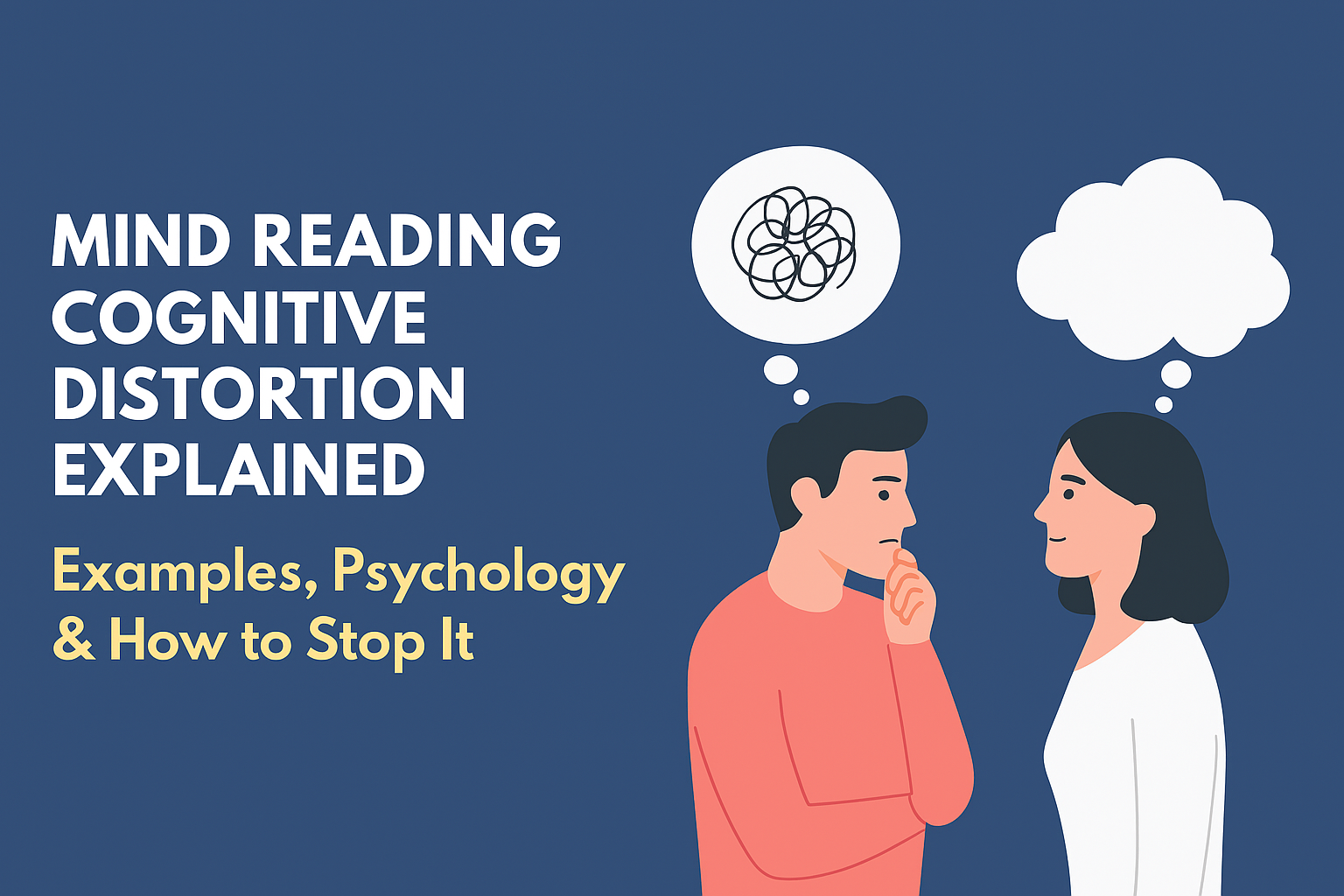
Mind Reading Cognitive Distortion Explained — Examples, Psychology & How to Stop It

What Is the Mind Reading Cognitive Distortion?

Have you ever caught yourself thinking, “They must be judging me,” or “She probably thinks I’m stupid” — without any real proof?
That’s called mind reading, a cognitive distortion where you assume you know what others are thinking, usually in a negative way.

In psychology, mind reading is part of a group of distorted thinking patterns that cause unnecessary stress, anxiety, and conflict. When you assume others’ thoughts without evidence, you’re essentially projecting your own fears or insecurities onto them.


The Psychology Behind Mind Reading

Mind reading often develops as a defense mechanism. Our brains evolved to predict others’ intentions for survival, but in modern life, this can backfire.
Cognitive behavioral psychologists explain that this distortion stems from automatic negative thoughts (ANTs) — mental shortcuts that jump to conclusions without data.

For example:

  • You see a friend texting while you’re talking and think, “They’re bored of me.”
  • A coworker doesn’t reply to your message, and you assume, “They must be upset with me.”

In reality, your friend might just be responding to an urgent message, and your coworker might be busy. But your brain interprets uncertainty as rejection.


Common Examples of Mind Reading Cognitive Distortion

  1. Social Anxiety Situations
    “Everyone at the party thinks I’m awkward.”
    → You avoid conversations and reinforce isolation.
  2. Workplace Scenarios
    “My boss didn’t smile today — she must think my work is bad.”
    → You lose confidence and overthink your performance.
  3. Relationships
    “He didn’t text me back; he must have lost interest.”
    → You start acting distant or defensive, creating tension that didn’t exist before.

How Mind Reading Affects You

Constantly assuming what others think leads to:

  • Increased anxiety and self-doubt
  • Miscommunication and strained relationships
  • Negative self-talk that reinforces low self-esteem
  • Emotional exhaustion from overanalyzing every interaction

Over time, this thinking pattern can make you overly self-conscious and disconnected from reality.


How to Stop Mind Reading Cognitive Distortion

1. Ask Instead of Assuming

When in doubt, communicate directly.
Example: Instead of thinking, “They’re mad at me,” ask, “Hey, is everything okay between us?”

2. Challenge Your Thoughts

Write down your assumptions and question them:

  • What’s my evidence for this thought?
  • Is there another explanation?
  • Would I think the same way if I was in a calm state?

3. Practice Mindfulness

Stay grounded in the present moment.
Mindfulness helps you observe thoughts without automatically believing them.

4. Use Cognitive Behavioral Therapy (CBT) Techniques

CBT helps identify and reframe distorted thinking.
You can learn to replace “They think I’m boring” with “I don’t actually know what they think — and that’s okay.”

5. Build Self-Confidence

When your self-esteem improves, you rely less on others’ imagined opinions.
Engage in positive self-affirmations and celebrate small wins daily.


Final Thoughts

The mind reading cognitive distortion tricks you into believing assumptions are facts.
By challenging these thoughts, communicating openly, and practicing mindfulness, you can break free from this mental trap and enjoy more honest, peaceful relationships.


Mind Reading Cognitive Distortion
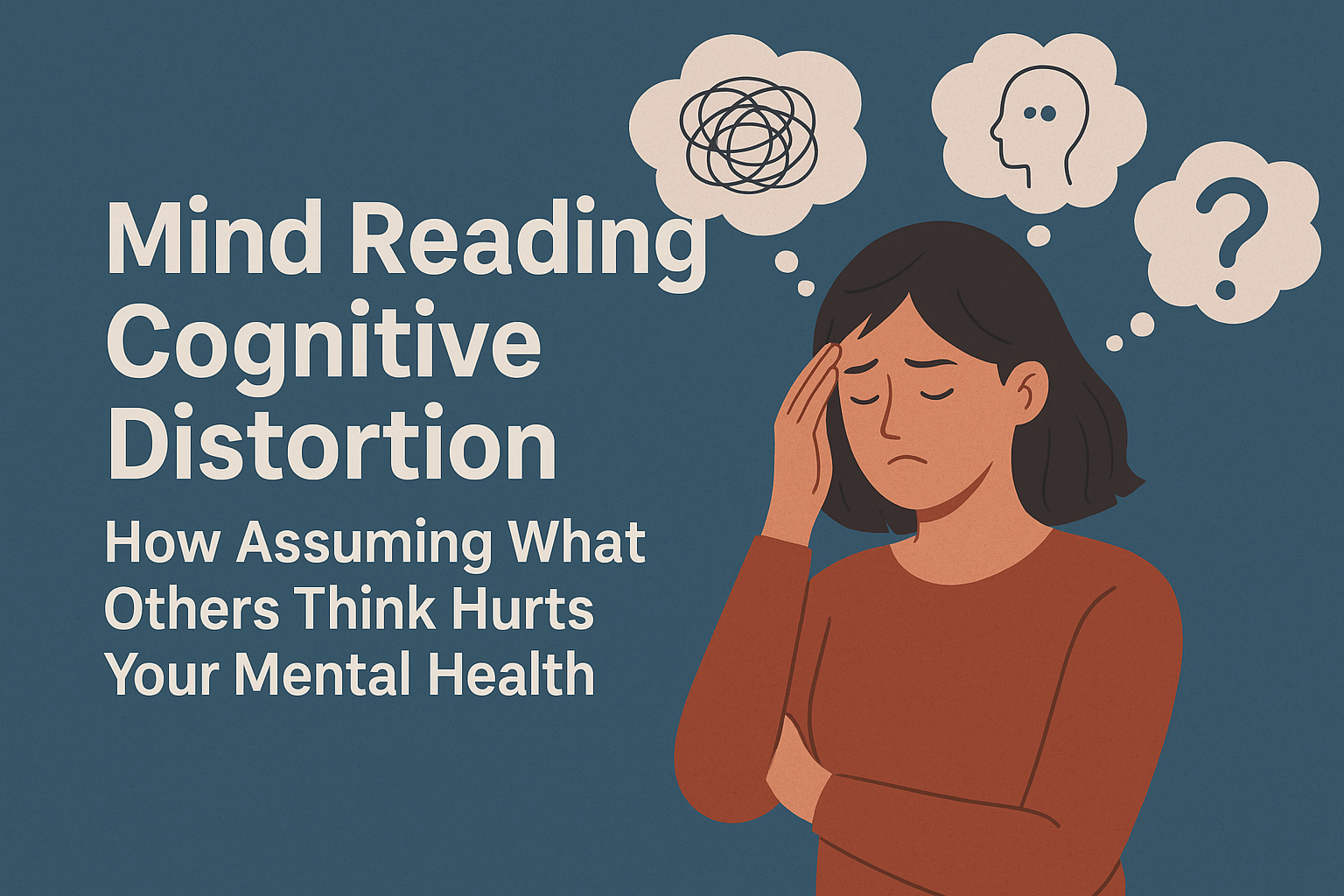
Mind Reading Cognitive Distortion: How Assuming What Others Think Hurts Your Mental Health

Have you ever caught yourself thinking, “They must be judging me” or “She probably thinks I’m not good enough”?
If so, you’ve experienced what psychologists call Mind Reading — a common cognitive distortion that can seriously affect your confidence and mental health.

This article explains what the mind reading distortion is, how it harms your mental well-being, and how to stop assuming what others think about you.


What Is Mind Reading Cognitive Distortion?

The Mind Reading Cognitive Distortion occurs when you assume you know what others are thinking — usually something negative about you — without any real evidence.

Examples include:

  • “My boss didn’t smile today; she must be unhappy with my work.”
  • “My friend didn’t reply; he must be ignoring me.”
  • “People probably think I’m awkward in social situations.”

This distortion is part of Cognitive Behavioral Therapy (CBT) principles, which identify unhelpful thought patterns that distort reality and contribute to anxiety and depression.


Why We Fall Into the Mind Reading Trap

Humans are naturally social and wired to interpret others’ emotions. However, when our self-esteem is low or we’re under stress, our brains start filling in the blanks with negative assumptions.

This often happens because of:

  • Fear of rejection or criticism
  • Past negative experiences
  • Perfectionism or social anxiety
  • Low self-worth

Essentially, mind reading acts as a self-defense mechanism — but instead of protecting you, it often makes you feel worse.


How Mind Reading Hurts Your Mental Health

Constantly trying to guess what others think creates emotional exhaustion. Here’s how it damages your mental well-being:

  1. Increases Anxiety
    You become hyper-focused on others’ reactions, reading hidden meanings in every word or gesture.
  2. Destroys Self-Confidence
    Believing others think poorly of you lowers your self-esteem and prevents you from expressing your authentic self.
  3. Causes Miscommunication
    You might act defensively or withdraw, leading to misunderstandings and strained relationships.
  4. Triggers Overthinking
    Instead of living in the present, your mind replays interactions, searching for “proof” that someone disapproves of you.

Signs You’re Engaging in Mind Reading

Ask yourself:

  • Do I often assume what others feel without asking them?
  • Do I think people are judging me even when they haven’t said anything?
  • Do I interpret neutral behavior as rejection?
    If you said yes to most of these, you might be stuck in the mind reading loop.

How to Stop Mind Reading

Breaking free from this cognitive distortion takes awareness and practice. Here’s how:

1. Challenge Your Thoughts

Ask yourself:

  • Do I have solid evidence for this belief?
  • Could there be another explanation for their behavior?

2. Communicate Directly

Instead of guessing, ask. Open communication helps replace assumption with clarity.

3. Practice Mindfulness

Mindfulness helps you observe thoughts without judgment, allowing you to notice distorted thinking before it takes over.

4. Build Self-Esteem

The more confident you are, the less you’ll care about others’ opinions. Focus on your achievements and values.

5. Use CBT Techniques

Journaling your thoughts and reframing negative assumptions are key tools from Cognitive Behavioral Therapy that can help you see reality more clearly.


Example of Reframing a Mind Reading Thought

Before: “She didn’t reply to my text — she must be angry.”
After: “There could be many reasons she hasn’t replied. Maybe she’s busy or didn’t see it yet.”

By reframing, you stop assigning negative meanings to neutral events.


The Psychology Behind Mind Reading

Psychologists link mind reading to cognitive bias — specifically, the negativity bias, where people focus more on negative interpretations than positive or neutral ones.

Over time, this pattern can contribute to:

  • Social anxiety disorder (SAD)
  • Depressive thinking
  • Low emotional resilience

Recognizing and correcting this bias is essential for mental well-being.


Final Thoughts

Mind reading may seem harmless, but over time, it fuels anxiety, isolation, and self-doubt. Remember — you can’t truly know what someone else is thinking.

The key to better mental health is challenging your assumptions, communicating clearly, and focusing on facts, not fears.

When you stop trying to read minds, you start freeing your own.

Married to Mind Reader Chinese Drama Explained — Full Plot Summary & Ending
Married to Mind Reader Chinese Drama Explained — Plot Summary & Ending

If you’re a fan of romantic Chinese dramas with a touch of mystery and telepathy, Married to Mind Reader is a must-watch. This drama has recently captured the attention of C-drama lovers for its unique storyline and emotional depth. In this post, we’ll explain the full plot, introduce the main characters, and break down the ending for you — spoiler alert ahead!


Plot Summary

Married to Mind Reader follows the story of Su Nian, a cheerful and kind-hearted writer, and Gu Jun, a cold yet intelligent CEO who has an unusual ability — he can read minds.

Su Nian accidentally marries Gu Jun through a twist of fate when a misunderstanding during a business event turns into a viral scandal. To save their reputations, both agree to a contract marriage. But soon, Gu Jun’s hidden power starts complicating their relationship. He can hear Su Nian’s true thoughts — from her insecurities to her genuine love and fear.

As they start living together, Gu Jun begins to realize that hearing someone’s mind isn’t as easy as it seems. He discovers Su Nian’s painful past and her struggle to trust again. Over time, his cold heart starts to melt, and genuine love blossoms between them.


Main Characters

  • Gu Jun (Male Lead) – A brilliant businessman with the ability to read minds. Though distant at first, he eventually learns the true meaning of love.
  • Su Nian (Female Lead) – A warm-hearted writer who teaches Gu Jun that emotions are not meant to be controlled but felt.
  • Lin Yue (Second Lead) – Su Nian’s best friend who provides comic relief and emotional support.
  • Qin Hao (Antagonist) – A rival businessman who discovers Gu Jun’s secret and uses it against him.

Themes and Message

The drama explores several key themes:

  • Trust and vulnerability in relationships
  • The burden of knowing too much about others’ thoughts
  • Healing through love and emotional honesty

It beautifully balances fantasy and realism, showing how love can overcome even supernatural challenges.


Ending Explained

In the final episodes, Gu Jun’s mind-reading ability starts to fade — a symbolic moment showing his emotional healing. He learns to trust Su Nian without relying on his power.

The couple faces one last conflict when Qin Hao exposes Gu Jun’s ability to the media. Su Nian, instead of running away, stands by Gu Jun and confesses her love publicly.

In the end, Gu Jun proposes again — this time out of pure love, not obligation. The drama closes with a heartfelt wedding scene where both promise to build a life based on honesty and understanding.

The ending delivers a powerful message:

“Love doesn’t need mind reading; it needs trust.”


Why Fans Love This Drama

  • A refreshing romantic fantasy concept
  • Strong chemistry between the leads
  • Emotional storytelling with a satisfying ending
  • Beautiful cinematography and soundtrack

Viewers describe Married to Mind Reader as a blend of romance, comedy, and emotional healing that stays in your heart long after the final episode.


Where to Watch

You can stream Married to Mind Reader on:

  • iQIYI
  • YouTube (official channels)
  • Viki (depending on your region)

Always check for English subtitles for the best experience!


Final Thoughts

Married to Mind Reader is more than just a romantic fantasy — it’s a heartfelt story about trust, love, and understanding. Whether you’re new to Chinese dramas or a longtime fan, this series is worth adding to your watchlist.

Do Psychiatrists Go to Medical School? Education & Career Path in the USA (2025)

If you’re considering a career in mental health, you might wonder — do psychiatrists go to medical school?
The short answer is yes. Psychiatrists are medical doctors (MDs or DOs) who specialize in diagnosing, treating, and preventing mental illnesses through medication and therapy.

In this article, we’ll explore the full education path, degrees required, and career journey to becoming a psychiatrist in the United States.


🩺 What Is a Psychiatrist?

A psychiatrist is a licensed medical doctor who specializes in mental health. Unlike psychologists or counselors, psychiatrists can:

  • Prescribe medications
  • Conduct physical examinations
  • Diagnose complex mental disorders (such as depression, bipolar disorder, or schizophrenia)
  • Combine psychotherapy with medical treatment

Because they deal with both the biological and psychological aspects of mental health, psychiatrists must complete medical training just like any other physician.


🎓 Do Psychiatrists Go to Medical School?

Yes — psychiatrists attend medical school after completing a bachelor’s degree.
Medical school is essential because psychiatry is a branch of medicine. During medical school, future psychiatrists study:

  • Anatomy and physiology
  • Neuroscience
  • Pharmacology
  • Behavioral science
  • Psychiatry rotations in hospitals or clinics

After graduating, they receive an MD (Doctor of Medicine) or DO (Doctor of Osteopathic Medicine) degree.


🪜 Step-by-Step Path to Becoming a Psychiatrist in the USA

1. Earn a Bachelor’s Degree (4 years)

The first step is to complete a pre-med bachelor’s degree. Most students major in:

  • Biology
  • Psychology
  • Neuroscience
  • Chemistry

Taking pre-med courses like physics, biochemistry, and organic chemistry is necessary for medical school admission.


2. Take the MCAT Exam

Before applying to medical school, students must pass the Medical College Admission Test (MCAT) — a standardized test assessing scientific knowledge and critical thinking.


3. Attend Medical School (4 years)

Medical school lasts four years:

  • First 2 years: Classroom-based studies in medicine, anatomy, and pharmacology
  • Last 2 years: Clinical rotations in hospitals (including psychiatry, internal medicine, pediatrics, etc.)

Upon graduation, students receive an MD or DO degree.


4. Complete Psychiatry Residency (4 years)

After medical school, psychiatrists enter a psychiatry residency program where they get hands-on experience diagnosing and treating patients with mental disorders.

During residency, doctors work in:

  • Hospitals and mental health centers
  • Addiction treatment units
  • Outpatient clinics

5. Obtain a Medical License & Board Certification

To legally practice psychiatry in the U.S., doctors must:

  • Pass the United States Medical Licensing Examination (USMLE) or COMLEX-USA
  • Apply for a state medical license
  • Optionally, become board-certified through the American Board of Psychiatry and Neurology (ABPN)

6. Consider a Subspecialty (Optional)

Psychiatrists can also specialize in fields such as:

  • Child and adolescent psychiatry
  • Forensic psychiatry
  • Addiction psychiatry
  • Geriatric psychiatry

Each subspecialty may require 1–2 additional years of fellowship training.


💰 How Long Does It Take to Become a Psychiatrist?

Becoming a psychiatrist in the USA takes about 12 years in total:

  • 4 years – Bachelor’s degree
  • 4 years – Medical school
  • 4 years – Psychiatry residency

Optional subspecialty training can extend this timeline by another 1–2 years.


👩‍⚕️ Psychiatrists vs. Psychologists: Key Difference

FeaturePsychiatristPsychologist
DegreeMD or DOPhD or PsyD
Medical School✅ Yes❌ No
Prescribes Medication✅ Yes❌ No
FocusBiological & medical aspects of mental illnessBehavioral & cognitive therapies

So, if you want to prescribe medication or practice medicine, psychiatry is the path — which means medical school is mandatory.


📈 Career Outlook & Salary

According to the U.S. Bureau of Labor Statistics (BLS):

  • Average salary: $230,000–$280,000 per year
  • Job growth: Steady demand due to increased mental health awareness
  • Top employers: Hospitals, private practices, universities, and telepsychiatry platforms

🧩 FAQs About Psychiatry Education

Q1. Can you become a psychiatrist without going to med school?

No. Psychiatry is a medical specialty, so medical school is mandatory to become a licensed psychiatrist.

Q2. How long is psychiatry residency in the USA?

A psychiatry residency typically lasts 4 years after medical school.

Q3. What major should I choose before med school?

Most future psychiatrists major in biology, psychology, or neuroscience.

Q4. Are psychiatrists doctors or therapists?

Psychiatrists are doctors who can also provide therapy, but their main role involves diagnosing and prescribing medications.


🏁 Conclusion

So, do psychiatrists go to medical school?
Absolutely — it’s the foundation of their career. Every psychiatrist in the USA must complete medical school, residency, and licensing before practicing.

If you’re passionate about mental health and interested in both medicine and psychology, psychiatry offers one of the most rewarding and impactful careers in healthcare.

Quantum physics and spirituality connection illustration showing energy waves, human consciousness, and cosmic universe background
Quantum Physics and Spirituality: Exploring the Connection Between Science, Consciousness, and the Soul

For centuries, spirituality and science have often been seen as separate worlds. But with the rise of quantum physics, many researchers and thinkers are beginning to ask a profound question: Is there a connection between science, consciousness, and the soul?

The field of quantum mechanics—the science of the smallest particles in the universe—doesn’t just change how we understand matter and energy; it also opens doors to conversations about spirituality and human awareness.

What Is Quantum Physics?

Quantum physics is the branch of science that studies the behavior of subatomic particles—electrons, photons, and atoms—that make up everything in the universe. Unlike classical physics, quantum mechanics shows us that reality at the smallest scale is unpredictable, mysterious, and interconnected.

Key principles include:

  • Wave-Particle Duality – Matter can behave both as a particle and a wave.
  • Quantum Entanglement – Particles remain connected across vast distances.
  • Observer Effect – The act of observation changes the outcome.

These ideas sound almost mystical—and that’s where the bridge to spirituality begins.

The Link Between Quantum Physics and Spirituality

1. Consciousness as a Creative Force

Quantum theory suggests that the observer effect—the idea that consciousness influences outcomes—may indicate that our thoughts and awareness shape reality. This resonates with many spiritual traditions that teach the power of intention and belief.

2. Interconnectedness of All Things

Quantum entanglement shows that particles can be connected instantly, regardless of distance. Spirituality has long taught that everything in the universe is interconnected—a concept seen in Buddhism, Hinduism, and Native American wisdom.

3. Beyond Material Reality

Quantum mechanics challenges the idea of a purely physical universe. Similarly, spirituality emphasizes the existence of the soul, spirit, or higher consciousness beyond the body.

What Scientists and Spiritual Thinkers Say

  • Albert Einstein described entanglement as “spooky action at a distance.”
  • Niels Bohr, a founder of quantum theory, believed physics and spirituality overlapped in describing reality.
  • Spiritual teachers like Deepak Chopra and Dalai Lama often reference quantum concepts to explain spiritual awakening and inner awareness.

Practical Implications for Daily Life

The connection between quantum physics and spirituality is not just theory—it can influence how we live.

  • Mindfulness & Meditation – Observing thoughts without judgment mirrors the observer effect.
  • Positive Intention – The energy you focus on may shape outcomes.
  • Healing Practices – Many holistic therapies draw on the idea of energy fields and quantum interconnectedness.
  • Spiritual Awakening – Understanding reality as both material and non-material deepens awareness of the soul.

Final Thoughts

The link between quantum physics, consciousness, and spirituality is still a mystery, but it invites us to see life in a new way. Science and spirituality may not be enemies but partners—helping us understand the universe and our place within it.

By exploring quantum spirituality, we may unlock deeper truths about the soul, human connection, and the very nature of reality.

FAQs on Quantum Physics and Spirituality

1. What is the relationship between quantum physics and spirituality?

Quantum physics shows that reality at the smallest level is uncertain, interconnected, and influenced by observation. Spirituality similarly teaches about the power of consciousness, intention, and the soul. Together, they suggest a deeper link between science and spiritual awareness.

2. Does quantum physics prove the existence of the soul?

While quantum physics does not directly prove the soul’s existence, its principles—such as consciousness affecting outcomes and the interconnectedness of all matter—support spiritual concepts that go beyond material reality.

3. How does quantum physics relate to consciousness?

Quantum theory highlights the observer effect, which suggests that consciousness plays a role in shaping reality. Many spiritual thinkers interpret this as evidence that human awareness influences the physical world.

4. Can quantum physics explain spiritual experiences?

Quantum concepts like entanglement and non-locality provide scientific frameworks that align with mystical experiences of oneness, intuition, and spiritual awakening. While not fully proven, these parallels are intriguing.

5. How can I apply quantum spirituality in daily life?

You can apply it through practices like meditation, mindfulness, setting positive intentions, and focusing on interconnectedness. These approaches help align emotional, spiritual, and mental well-being.

Why emotionally healthy spirituality matters in today’s fast-paced American lifestyle – balance emotional health and spirituality for peace and well-being
Why Emotionally Healthy Spirituality Matters in Today’s Fast-Paced American Lifestyle

In today’s fast-paced American lifestyle, many people find themselves overwhelmed by stress, work pressure, digital distractions, and the constant demand to achieve more. While physical fitness and financial success often take center stage, emotional health and spirituality are equally important for long-term happiness and balance. This is where the concept of emotionally healthy spirituality plays a life-changing role.

What Is Emotionally Healthy Spirituality?

Emotionally healthy spirituality is the practice of integrating emotional well-being with spiritual growth. It’s about being deeply connected with your faith or inner beliefs while also addressing your emotional struggles such as anxiety, stress, or unresolved trauma.

In short, it helps you:

  • Build a deeper connection with yourself and others.
  • Develop resilience in stressful situations.
  • Live with purpose, peace, and balance.

Why It Matters in the American Lifestyle

The U.S. is known for its hustle culture. Long working hours, financial pressures, and social comparison on platforms like Instagram and TikTok often leave people feeling drained. Without emotional balance, spirituality can become superficial, and without spirituality, emotional health may feel incomplete.

Here’s why emotionally healthy spirituality is essential for Americans today:

1. Reduces Stress and Anxiety

By combining mindfulness, prayer, or meditation with emotional awareness, people can effectively reduce stress and find inner calm.

2. Improves Relationships

Emotional awareness allows you to communicate better, while spiritual practices foster forgiveness and empathy—both vital in relationships.

3. Prevents Burnout

Work-driven Americans often push themselves beyond limits. Spiritually healthy living helps set boundaries and prioritize rest without guilt.

4. Strengthens Faith and Inner Peace

When emotional wounds are healed, spiritual practices become more meaningful. People feel connected to something greater than themselves, offering peace in tough times.

Practical Steps to Develop Emotionally Healthy Spirituality

If you want to embrace an emotionally and spiritually healthy lifestyle in America, here are a few practical steps:

  1. Practice Daily Reflection – Journaling or meditation helps identify your emotions.
  2. Set Digital Boundaries – Reduce social media time to protect your mental and emotional energy.
  3. Integrate Faith and Therapy – Seeking counseling or therapy alongside prayer or meditation creates balance.
  4. Prioritize Rest and Sabbath – Take breaks, enjoy nature, or observe spiritual rest days.
  5. Cultivate Gratitude – A daily gratitude practice strengthens both emotional health and spiritual perspective.

Final Thoughts

In a society that values speed and productivity, slowing down to nurture your emotional health and spirituality is not a luxury—it’s a necessity. By practicing emotionally healthy spirituality, Americans can build stronger relationships, live with greater peace, and find deeper meaning in life.

Illustration of scarcity mindset showing a worried woman thinking about money, wallet, and shopping, used for blog post on meaning, examples, and effects on life and relationships.
What is Scarcity Mindset? Meaning, Examples, and How It Affects Your Life & Relationships

In today’s fast-paced world, we often hear terms like growth mindset, abundance mindset, and scarcity mindset. Among these, the scarcity mindset plays a huge role in shaping how we think, act, and build relationships. But what exactly is it? Why do so many people struggle with it, and how can it affect areas like dating, love, and even your career?

This guide will break down the meaning of scarcity mindset, give you real-life examples, explain why you might have it, and explore how it impacts relationships and dating.


What is Scarcity Mindset?

A scarcity mindset is the belief that there will “never be enough.” It’s the fear of losing resources, opportunities, or people. When you operate with this mindset, you focus on what you don’t have instead of what you do have.

For example:

  • Constantly worrying about money even when you’re financially stable.
  • Believing there aren’t enough good partners out there.
  • Thinking you don’t have enough time, talent, or opportunities compared to others.

In short, scarcity mindset makes you operate from a place of fear and lack, while its opposite – the abundance mindset – helps you act with trust and confidence.


Examples of Scarcity Mindset in Daily Life

Here are some common situations where a scarcity mindset shows up:

  1. Money & Career
    • “If I spend now, I won’t have anything left.”
    • “There aren’t enough good jobs for people like me.”
  2. Friendships & Relationships
    • “If I lose this person, I’ll never find someone else.”
    • “I need to hold on tightly, or they’ll leave me.”
  3. Personal Growth
    • “I’m not smart enough to achieve that.”
    • “Others are already ahead of me, so what’s the point?”

Why Do I Have a Scarcity Mindset?

Scarcity mindset usually comes from past experiences, upbringing, or environment. Some possible reasons include:

  • Childhood environment: Growing up where money, attention, or love felt limited.
  • Comparison culture: Social media constantly showing people who appear to have “more.”
  • Fear of rejection or failure: Believing opportunities are so rare that losing one means the end.
  • Negative self-beliefs: Thinking you’re not worthy of abundance.

Scarcity Mindset in Relationships

Relationships are one of the areas most affected by scarcity thinking. Some signs include:

  • Clinginess: Feeling the need to hold on tightly to your partner out of fear they’ll leave.
  • Jealousy: Believing someone else can easily “take” your partner because love is limited.
  • Low standards: Settling for less because you think “this is the best I can get.”
  • Fear of speaking up: Avoiding difficult conversations because you’re scared it might end the relationship.

This mindset often leads to unhealthy dynamics because you’re operating from fear of loss instead of confidence in love.


Scarcity Mindset in Dating

Dating can feel overwhelming when you’re stuck in scarcity thinking. Common patterns include:

  • Rushing into relationships out of fear you won’t find anyone else.
  • Overanalyzing messages and interactions, worrying about being ghosted.
  • Accepting red flags because you believe good partners are rare.
  • Competing instead of connecting, thinking others are “winning” if they find love before you.

When you see dating as a race with limited options, it leads to stress, anxiety, and poor decisions.


How to Overcome Scarcity Mindset

Shifting from scarcity to abundance takes time, but it’s possible. Some strategies include:

  1. Gratitude practice – Focus daily on what you already have.
  2. Reframe thoughts – Replace “there aren’t enough” with “opportunities are everywhere.”
  3. Build self-worth – Remind yourself that you are deserving of love, success, and happiness.
  4. Limit comparison – Reduce social media scrolling and external validation.
  5. Invest in growth – Read, learn, and surround yourself with people who think abundantly.

Final Thoughts

The scarcity mindset is more than just worrying—it’s a belief system that limits your opportunities in life, relationships, and dating. Recognizing it is the first step toward change. By shifting to an abundance mindset, you open yourself to healthier relationships, better career growth, and a more fulfilling life.

Remember: There’s always enough love, success, and opportunity when you choose to see the world through abundance.


15 Fun and Engaging Growth Mindset Activities for Kids to Build Confidence

In today’s fast-changing world, teaching kids a growth mindset is just as important as teaching them math, reading, or science. A growth mindset is the belief that abilities and intelligence can be developed with practice, learning, and determination. It helps children embrace challenges, learn from mistakes, and become more confident in their abilities.

Unfortunately, many kids grow up thinking that they are either “good” or “bad” at something and that their abilities are fixed. This is known as a fixed mindset, and it can limit a child’s potential. By encouraging a growth mindset from an early age, parents and teachers can help children develop resilience, problem-solving skills, and a love for learning.

Below are 15 fun and engaging growth mindset activities for kids that not only build confidence but also make the process exciting and memorable.


1. The “I Can Learn” Journal

Give your child a notebook dedicated to writing down something new they learn each day. It could be a fact, a skill, or a personal realization. This daily habit reinforces the idea that learning is a lifelong journey and that improvement comes with effort.


2. The Challenge Jar

Fill a jar with slips of paper, each containing a small challenge—such as “Draw a self-portrait,” “Try writing with your non-dominant hand,” or “Learn a new word.” Kids pick one daily or weekly. This encourages them to step out of their comfort zone.


3. Compliment Circle

Whether at home with siblings or in a classroom, have kids sit in a circle and take turns giving each other genuine compliments. This activity boosts self-esteem, fosters empathy, and helps children focus on others’ strengths as well as their own.


4. Growth Mindset Role Models

Read biographies or watch videos about people like Thomas Edison, J.K. Rowling, or Serena Williams—individuals who faced multiple failures before achieving success. Discuss how persistence and learning from mistakes helped them succeed.


5. The “Yet” Game

Whenever your child says, “I can’t do this,” encourage them to add the word “yet” at the end. This small language shift turns a negative statement into a hopeful one and helps children see that improvement is possible with practice.


6. Puzzle Time

Jigsaw puzzles, Sudoku, and brain teasers are excellent tools for building problem-solving skills. Encourage your child to work through the challenge instead of giving up when it feels hard.


7. Learn a New Skill Together

Choose a skill that neither you nor your child has mastered—like painting with watercolors, learning sign language, or baking bread. By learning alongside them, you model that it’s okay to be a beginner.


8. Mistake Celebration Day

Dedicate one day a week to openly sharing mistakes made during the week. Discuss what was learned from them and even reward “the best mistake” with a small prize. This helps kids see mistakes as valuable learning experiences.


9. Positive Affirmations Wall

Create a board where your child can post affirmations like, “I can improve with practice” or “I am capable of learning new things.” Reading these daily can boost confidence and encourage a positive outlook.


10. Role-Play Problem Solving

Give kids scenarios to act out—such as losing a game or having a disagreement with a friend—and let them come up with solutions. This builds social skills, adaptability, and resilience.


11. Growth Mindset Art Projects

Ask your child to draw or paint a goal they want to achieve, along with the steps they need to take to get there. Visualizing goals makes them more real and attainable.


12. Team-Building Games

Activities like scavenger hunts, relay races, or group challenges help kids understand the value of teamwork and persistence. When working together, they learn that success often requires cooperation.


13. Mindfulness & Breathing Exercises

Teaching children simple breathing techniques or mindfulness activities can help them manage stress and frustration during challenging tasks. Calm minds are better equipped to handle obstacles.


14. Storytelling with a Twist

Encourage kids to create stories where the main character faces multiple failures but eventually succeeds. This creative exercise reinforces the idea that setbacks are part of the journey.


15. Gratitude Practice

At the end of each day, ask your child to share three things they are grateful for. Gratitude shifts their focus from what went wrong to what went right, promoting optimism and emotional resilience.


Why Growth Mindset Activities Work

These activities work because they focus on effort, persistence, and learning from mistakes—the core principles of a growth mindset. When kids regularly practice these habits, they begin to naturally approach challenges with curiosity rather than fear.

By turning growth mindset lessons into fun and engaging activities, you help children internalize these valuable life skills without feeling like they’re in a formal lesson.


Tips for Parents and Teachers

  • Model a Growth Mindset: Let kids see you learning from your own mistakes.
  • Praise Effort, Not Just Results: Instead of saying “You’re so smart,” say “I’m proud of how hard you worked.”
  • Make Challenges Fun: Turn learning into a game so that trying new things feels exciting.

Final Thoughts

Raising confident, resilient kids starts with the mindset they carry into each new challenge. With these 15 fun and engaging growth mindset activities, you can help children see that they are capable of learning, improving, and achieving their dreams.

Trump’s Executive Order on Mental Health and Homelessness: What It Means for America

On July 24, 2025, former President Donald Trump signed an executive order titled “Ending Crime and Disorder on America’s Streets”, a policy that has quickly ignited national debate. At its core, the order directs federal agencies to promote involuntary civil commitment for individuals with mental illness or substance use disorders who are homeless and deemed unable to care for themselves. It also encourages overturning judicial precedents that limit such commitments.

While the White House frames this as a public safety and humanitarian measure, critics argue it marks a dangerous return to outdated and punitive approaches to mental health and homelessness.

What the Executive Order Says

The executive order focuses on:

  • Involuntary Institutionalization – Encouraging states to expand laws that allow people with mental illness or addiction to be placed in long-term psychiatric facilities, even without their consent.
  • Shifting Federal Funding – Moving away from Housing First and harm reduction programs, redirecting resources toward enforcement, treatment facilities, and psychiatric institutions.
  • Overturning Legal Protections – Reversing court decisions that have set limits on civil commitment, expanding the circumstances in which people can be institutionalized.

Supporters believe these measures will help “restore public order” in cities facing rising homelessness and visible mental health crises.

Criticism from Civil Rights and Mental Health Advocates

The reaction from advocacy groups has been swift and sharp:

  • American Civil Liberties Union (ACLU) condemned the order, calling it an attack on disabled and unhoused people that will “criminalize poverty” instead of solving it. They argue it undermines proven solutions such as permanent supportive housing and voluntary care.
  • American Psychological Association (APA) warned that the policy conflicts with core principles of mental health care—such as patient autonomy, informed consent, and the right to the least-restrictive treatment setting.
  • The Guardian and other media outlets highlighted the vague definitions in the order, which could lead to civil rights violations and mass institutionalization without due process.
  • Prison Policy Initiative noted that this approach could push vulnerable individuals from the streets into locked facilities without addressing root causes like housing shortages and inadequate community care.

Local Responses: Some Push Back

Not all states and cities are embracing the order:

  • Boulder, Colorado has rejected the institutionalization-first approach, reaffirming its commitment to the Housing First model that prioritizes providing stable housing before addressing mental health or substance use issues.
  • Pima County, Arizona emphasized that civil commitment decisions must still comply with state laws, require medical diagnosis, and be backed by adequate funding—something the federal order does not directly provide.

This mixed response reflects a deeper divide between federal directives and local priorities in addressing homelessness.

Why This Matters

The executive order raises crucial questions:

  • Will forced institutionalization improve public safety, or will it simply remove homeless individuals from sight without addressing their needs?
  • Could this policy erode civil liberties and trust in mental health systems?
  • Is this a step backward toward the era of mass psychiatric institutionalization that advocates fought to reform decades ago?

Critics fear that without adequate housing, voluntary treatment options, and community support, the order may worsen stigma around mental illness and homelessness.

The Bigger Picture

The tension between public health and public safety approaches is not new—but Trump’s executive order signals a decisive shift toward enforcement over compassion. For many advocates, the path forward lies not in criminalizing homelessness, but in:

  • Expanding affordable housing
  • Strengthening community-based mental health services
  • Investing in harm reduction programs
  • Protecting individual rights while ensuring access to care

Final Thoughts

The debate over Trump’s executive order on mental health and homelessness is about more than just policy—it’s about the kind of society America wants to be. Do we prioritize dignity, rights, and voluntary care, or do we return to a system that hides complex problems behind institutional walls?

Only time, advocacy, and public action will determine which path we choose.