
BrainPill Ingredients Explained: Benefits and Safety
Affiliate disclosure: This article contains affiliate links. If you buy through our links, we may earn a commission at no extra cost to you. Our content is educational and based on public product information and published research, not personal testing.
What is actually inside BrainPill? This guide explains each ingredient in simple words: what it is, what research suggests, and what to watch out for.
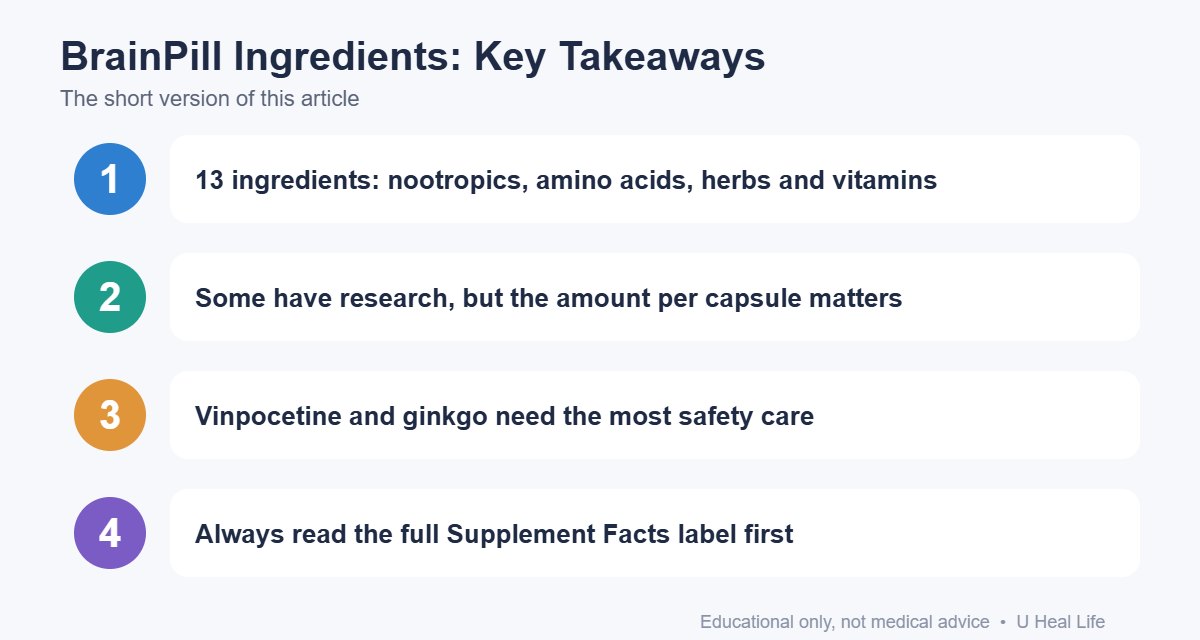
Quick answer: BrainPill’s official ingredient page lists 13 ingredients, including citicoline (Cognizin), Bacopa monnieri (Synapsa), L-theanine, phosphatidylserine, tyrosine, ginkgo biloba, huperzine A, vinpocetine, DHA and several B vitamins. Some have research behind them, but research on one ingredient does not prove the whole formula works.
How the Formula Is Organized
The manufacturer groups the ingredients into two ideas. The first is a “focus and cognitive energy” group built around citicoline, tyrosine, phosphatidylserine, L-theanine and B vitamins. The second is a “memory” group built around Bacopa monnieri, huperzine A, folic acid, vinpocetine, ginkgo biloba and DHA.
These groups are marketing categories, not scientific ones. It is better to look at each ingredient on its own.
The 13 Ingredients at a Glance
| Ingredient | What it is | What research suggests | Safety note |
|---|---|---|---|
| Citicoline (Cognizin) | A nutrient involved in brain cell membranes | Small studies on attention and memory | Generally well tolerated; mild stomach upset or headache can occur |
| Tyrosine | An amino acid | Possible help with thinking under stress or lack of sleep | Ask a pharmacist if you take thyroid medicine or certain antidepressants |
| Phosphatidylserine | A fat found in cell membranes | Mixed results, mostly in older adults | Can cause stomach upset in some people |
| Vitamin B12 | An essential vitamin | Matters most if you are low in it | Low risk at normal amounts |
| L-theanine | An amino acid found in tea | May support relaxation and attention | Usually well tolerated |
| Vitamin B6 | An essential vitamin | Needed for normal brain function | Very high long-term doses can harm nerves |
| Vitamin B5 | An essential vitamin | Helps the body make energy | Low risk at normal amounts |
| Bacopa monnieri (Synapsa) | A traditional herb | Some trials suggest memory benefits after weeks of use | Can cause nausea or stomach cramps |
| Huperzine A | A compound from a moss called Huperzia serrata | Studied for memory problems, not proven for healthy adults | Can affect acetylcholine; check medicine interactions |
| Folic acid (B9) | A form of folate | Needed for normal brain and blood health | High amounts can hide a B12 deficiency |
| Vinpocetine | A lab-made compound based on a plant chemical | Studied for blood flow in the brain | FDA warns it may harm a pregnancy |
| Ginkgo biloba | A herbal extract | Evidence for memory in healthy adults is uncertain | May raise bleeding risk with some medicines |
| DHA complex | An omega-3 fat | Important for brain structure | May affect blood clotting at high doses |
Ingredients With the Most Research Interest
Citicoline and Bacopa monnieri get the most attention in focus and memory research. Studies are mostly small, and results depend on dose, time and who was tested. Bacopa trials usually last 12 weeks or more, so a short trial of a product does not tell you much.
L-theanine is often studied together with caffeine, which makes it hard to say what it does alone. Phosphatidylserine has mostly been studied in older adults.
Vitamins and Omega-3
B vitamins and DHA are real nutrients your brain needs. The NIH Office of Dietary Supplements has fact sheets on vitamin B12, vitamin B6 and omega-3 fatty acids. If your diet already gives you enough, extra amounts may not make you sharper.
Ingredients That Need Extra Caution
Three ingredients deserve a careful look:
- Vinpocetine: The FDA has warned that it may cause miscarriage or harm fetal development.
- Ginkgo biloba: The NCCIH says it has not been shown to prevent or slow dementia, and it may increase bleeding risk with some medicines.
- Huperzine A: It affects a brain chemical, so ask a pharmacist about interactions if you take prescription medicine.
The manufacturer also states that the product should not be used during pregnancy, while planning pregnancy, or while breastfeeding.
What the Ingredient List Cannot Tell You
Knowing the names is not enough. Before you decide, check the Supplement Facts label for:
- The exact amount of each ingredient per serving
- Serving size and number of servings per bottle
- Allergen information
- Whether any ingredient is hidden inside a “blend” without amounts
View BrainPill Product Information and Current Pricing
Paid affiliate link. We may earn a commission from qualifying purchases.
Frequently Asked Questions
How many ingredients are in BrainPill?
The manufacturer says it is a blend of 13 nootropic ingredients.
Are the ingredients natural?
Some are herbs or plant extracts, some are vitamins and amino acids, and vinpocetine is a lab-made compound inspired by a plant chemical.
Which ingredient is the most important?
None has been proven to be the key one. The evidence is stronger for some than for others, but none proves the formula works.
Can I get these nutrients from food?
Partly. Fish gives DHA, tea gives L-theanine, and a balanced diet gives B vitamins. A doctor can tell you if you need a supplement.
Final Thoughts
Understanding the ingredients is the best way to judge any supplement. BrainPill has a mix of well-known and debated ingredients, and a few that need real caution. To see how we weigh it all together, read our full BrainPill review.
Related Reading
- BrainPill Review 2026: Ingredients, Benefits, Side Effects & Does It Really Work?
- Does BrainPill Really Work? What the Evidence Says
- BrainPill Side Effects: What You Should Know
- What Are Nootropics? Benefits, Risks and Evidence
Disclaimer: This article is for educational purposes only and is not medical advice. Dietary supplements are not intended to diagnose, treat, cure, or prevent any disease. Talk to a qualified healthcare professional before using supplements, especially if you take medicine, are pregnant or breastfeeding, or have a health condition.