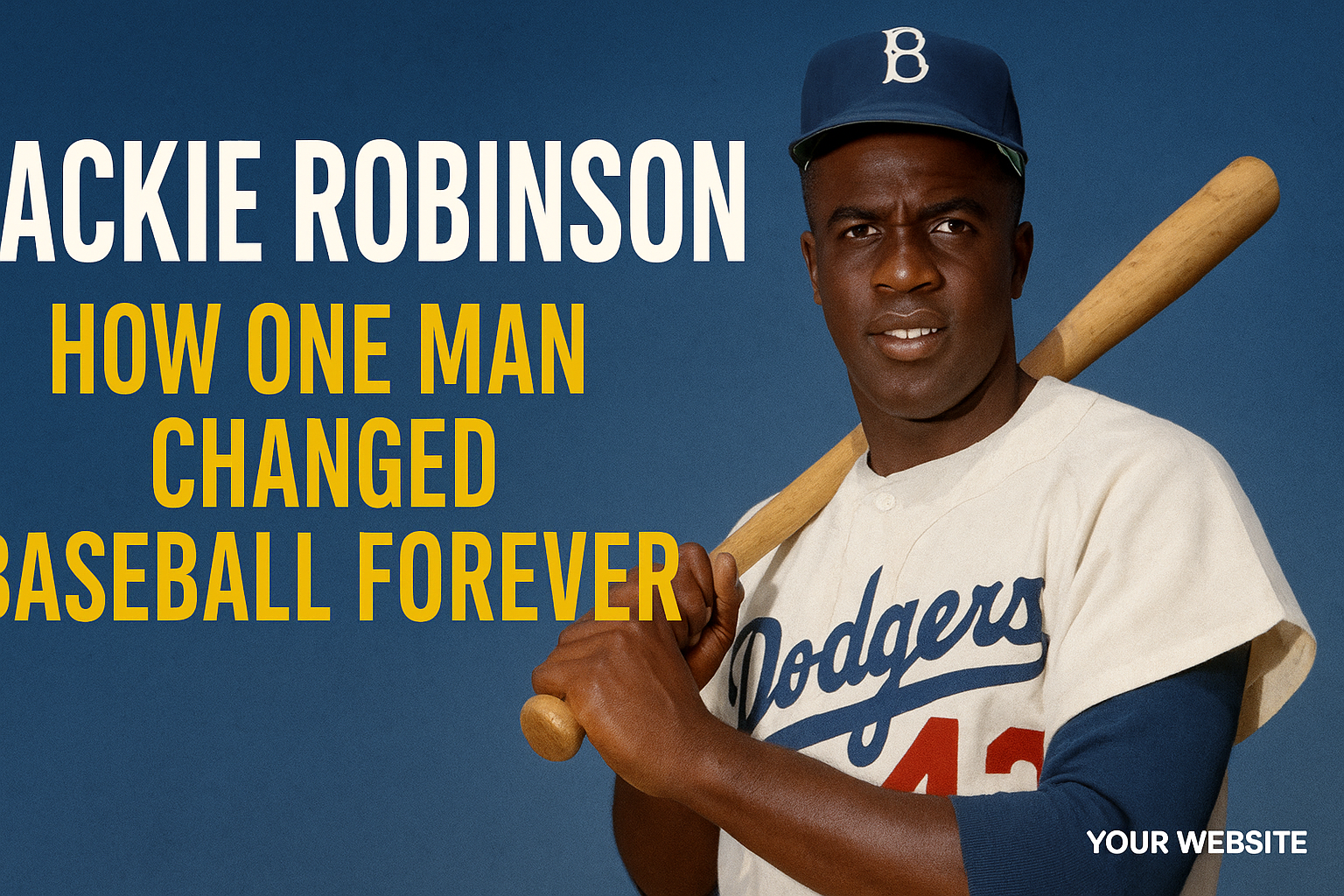
Jackie Robinson: How One Man Changed Baseball Forever

Jackie Robinson’s story is more than a chapter in baseball history — it’s a story about courage, equality, and the power of determination.
When Jackie Robinson stepped onto the field for the Brooklyn Dodgers on April 15, 1947, he did more than just play baseball. He shattered the color barrier in Major League Baseball (MLB) and changed the course of American sports and civil rights forever.

Today, more than 75 years later, Jackie Robinson remains a symbol of hope, strength, and integrity — a man who proved that one person’s courage can inspire an entire nation.


Who Was Jackie Robinson?

Born January 31, 1919, in Cairo, Georgia, Jack Roosevelt Robinson grew up in a time of deep racial segregation. After his father left the family, Jackie’s mother, Mallie Robinson, moved the family to Pasadena, California, in search of better opportunities.

From an early age, Robinson’s athletic ability was obvious. At UCLA, he became the first student to earn varsity letters in four sports — baseball, football, basketball, and track. But while he excelled on the field, he also experienced racial discrimination off it, shaping his lifelong fight for equality.


Early Career and the Negro Leagues

Before joining Major League Baseball, African American players were barred from playing in the major leagues. They instead showcased their talent in the Negro Leagues, which featured some of the best players in baseball history.

In 1945, Jackie Robinson joined the Kansas City Monarchs of the Negro Leagues. His incredible speed, hitting skills, and leadership caught the attention of Branch Rickey, the general manager of the Brooklyn Dodgers. Rickey wasn’t just looking for a talented player — he was searching for someone who had the strength to endure racial abuse without retaliation. Jackie Robinson was that man.


Breaking Baseball’s Color Barrier

On April 15, 1947, Jackie Robinson made his MLB debut with the Brooklyn Dodgers, becoming the first Black player in modern Major League Baseball. The moment marked the beginning of a new era in American sports.

However, Robinson’s first season was far from easy. He faced:

  • Racist slurs from fans and opponents
  • Threats to his life and family
  • Rejection from some teammates

Despite the hate, Jackie Robinson maintained his composure. Branch Rickey had famously told him, “I’m looking for a ballplayer with guts enough not to fight back.” Robinson embodied that discipline perfectly.

His performance spoke volumes — he finished the 1947 season with a .297 batting average, 12 home runs, and 29 stolen bases, earning him the Rookie of the Year Award.


Dominating the Game

As years went by, Jackie Robinson continued to prove himself as one of the league’s best.
Some of his career highlights include:

  • Six-time All-Star (1949–1954)
  • National League MVP (1949)
  • .311 lifetime batting average
  • World Series Champion (1955)
  • Stole home 19 times — a rare and electrifying baseball feat

He wasn’t just a good player; he was a game-changer. His aggressive playing style, athleticism, and leadership helped the Dodgers become one of baseball’s dominant teams of the 1950s.


How Jackie Robinson Changed Baseball

Jackie Robinson’s arrival in MLB didn’t just change a team — it transformed the culture of professional sports.
Before Robinson, baseball was seen as a “white man’s game.” After him, it became a sport for everyone.

1. He Opened Doors for Future Generations

Jackie Robinson’s success proved that Black athletes could thrive in Major League Baseball. Within a few years, more players from the Negro Leagues joined MLB, including Willie Mays, Hank Aaron, and Ernie Banks — all of whom became legends themselves.

2. He Brought Integration to the Forefront

Baseball was America’s pastime, and when Jackie Robinson integrated the league, it sent a message across the country that racial segregation was morally and socially wrong. His courage helped accelerate the Civil Rights Movement that would define the 1950s and 1960s.

3. He Inspired Social Change Beyond Sports

Jackie Robinson wasn’t just a baseball hero — he became a national civil rights icon. His grace under pressure inspired millions of Americans to challenge racism and demand equality in schools, workplaces, and communities.


Jackie Robinson’s Life Beyond Baseball

After retiring in 1956, Robinson remained active in business and civil rights.
He became the first Black vice president of a major American corporation, Chock full o’Nuts, and later helped establish the Freedom National Bank in Harlem to support Black-owned businesses.

He also worked with Dr. Martin Luther King Jr. and the NAACP, using his fame to raise awareness for racial equality, voting rights, and fair employment.

Even after facing personal and professional challenges, Jackie Robinson never stopped advocating for justice until his passing on October 24, 1972.


Honoring Jackie Robinson’s Legacy

Jackie Robinson’s legacy continues to inspire people around the world. His life has been celebrated in books, documentaries, and the acclaimed 2013 film “42”, starring Chadwick Boseman.

Major League Baseball honors him every year on April 15, known as Jackie Robinson Day. On this day:

  • Every player, coach, and umpire wears #42
  • Teams host special ceremonies
  • Fans reflect on how one man’s bravery reshaped sports and society

In 1997, MLB officially retired Jackie Robinson’s number 42 across all teams, ensuring that no other player would ever wear it again — a tribute shared by no other athlete in professional baseball.


Jackie Robinson’s Lessons for Today

Even decades after his debut, Jackie Robinson’s lessons remain relevant:

  1. Courage Over Comfort: True strength lies in standing firm when the world tests your limits.
  2. Equality Through Action: Change doesn’t happen through words alone — it takes action and perseverance.
  3. Legacy Through Integrity: Robinson showed that success means more when it lifts others up along the way.

Athletes, leaders, and young fans today still look to Jackie Robinson as proof that one person’s courage can inspire an entire generation.


Famous Quotes by Jackie Robinson

“A life is not important except in the impact it has on other lives.”
— Jackie Robinson

“I’m not concerned with your liking or disliking me… All I ask is that you respect me as a human being.”

These words capture the spirit of a man who used his platform not for fame, but for change.


Conclusion

Jackie Robinson wasn’t just a baseball player — he was a trailblazer who redefined what it meant to be an American hero. By breaking baseball’s color barrier, he opened doors for future generations and proved that dignity, discipline, and determination can overcome even the deepest prejudice.

Today, his story remains a beacon of inspiration — reminding us that the power to change the world often begins with one brave decision.

Married to Mind Reader Chinese Drama Explained — Full Plot Summary & Ending
Married to Mind Reader Chinese Drama Explained — Plot Summary & Ending

If you’re a fan of romantic Chinese dramas with a touch of mystery and telepathy, Married to Mind Reader is a must-watch. This drama has recently captured the attention of C-drama lovers for its unique storyline and emotional depth. In this post, we’ll explain the full plot, introduce the main characters, and break down the ending for you — spoiler alert ahead!


Plot Summary

Married to Mind Reader follows the story of Su Nian, a cheerful and kind-hearted writer, and Gu Jun, a cold yet intelligent CEO who has an unusual ability — he can read minds.

Su Nian accidentally marries Gu Jun through a twist of fate when a misunderstanding during a business event turns into a viral scandal. To save their reputations, both agree to a contract marriage. But soon, Gu Jun’s hidden power starts complicating their relationship. He can hear Su Nian’s true thoughts — from her insecurities to her genuine love and fear.

As they start living together, Gu Jun begins to realize that hearing someone’s mind isn’t as easy as it seems. He discovers Su Nian’s painful past and her struggle to trust again. Over time, his cold heart starts to melt, and genuine love blossoms between them.


Main Characters

  • Gu Jun (Male Lead) – A brilliant businessman with the ability to read minds. Though distant at first, he eventually learns the true meaning of love.
  • Su Nian (Female Lead) – A warm-hearted writer who teaches Gu Jun that emotions are not meant to be controlled but felt.
  • Lin Yue (Second Lead) – Su Nian’s best friend who provides comic relief and emotional support.
  • Qin Hao (Antagonist) – A rival businessman who discovers Gu Jun’s secret and uses it against him.

Themes and Message

The drama explores several key themes:

  • Trust and vulnerability in relationships
  • The burden of knowing too much about others’ thoughts
  • Healing through love and emotional honesty

It beautifully balances fantasy and realism, showing how love can overcome even supernatural challenges.


Ending Explained

In the final episodes, Gu Jun’s mind-reading ability starts to fade — a symbolic moment showing his emotional healing. He learns to trust Su Nian without relying on his power.

The couple faces one last conflict when Qin Hao exposes Gu Jun’s ability to the media. Su Nian, instead of running away, stands by Gu Jun and confesses her love publicly.

In the end, Gu Jun proposes again — this time out of pure love, not obligation. The drama closes with a heartfelt wedding scene where both promise to build a life based on honesty and understanding.

The ending delivers a powerful message:

“Love doesn’t need mind reading; it needs trust.”


Why Fans Love This Drama

  • A refreshing romantic fantasy concept
  • Strong chemistry between the leads
  • Emotional storytelling with a satisfying ending
  • Beautiful cinematography and soundtrack

Viewers describe Married to Mind Reader as a blend of romance, comedy, and emotional healing that stays in your heart long after the final episode.


Where to Watch

You can stream Married to Mind Reader on:

  • iQIYI
  • YouTube (official channels)
  • Viki (depending on your region)

Always check for English subtitles for the best experience!


Final Thoughts

Married to Mind Reader is more than just a romantic fantasy — it’s a heartfelt story about trust, love, and understanding. Whether you’re new to Chinese dramas or a longtime fan, this series is worth adding to your watchlist.

Dylan Efron siblings news
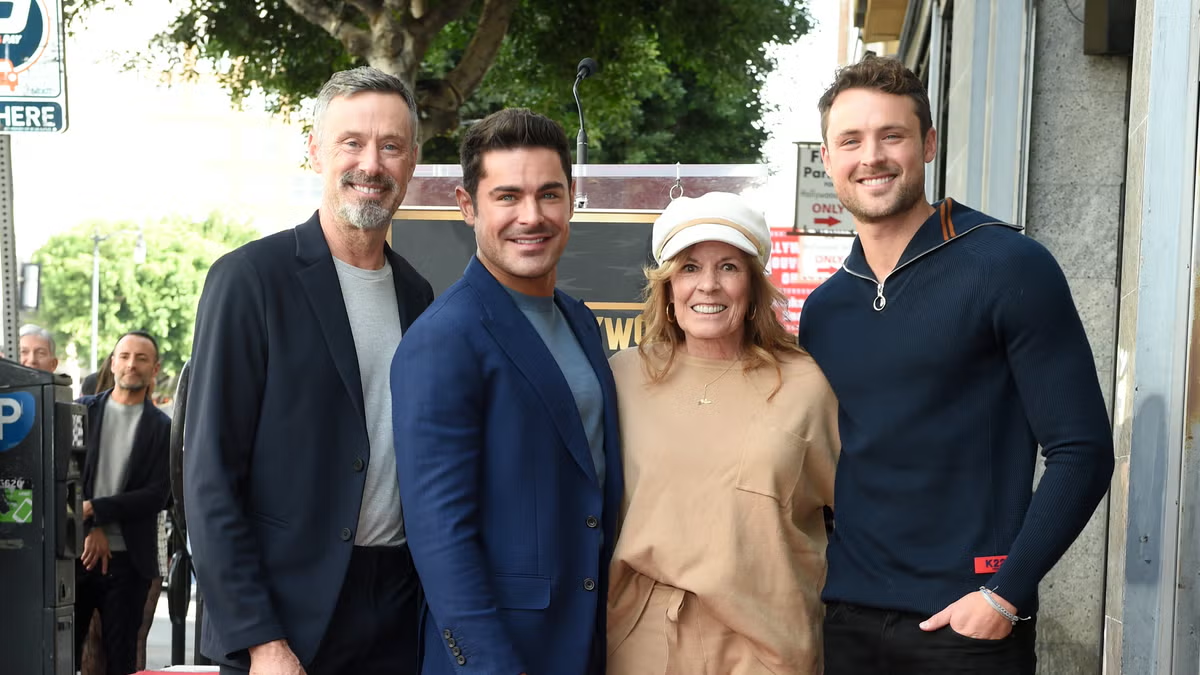
Dylan Efron’s Siblings: Zac, Olivia & Henry — What to Know

If you’ve been searching “Dylan Efron siblings” lately, you’re not alone. With Dylan Efron’s growing popularity — especially after his appearance on Dancing With the Stars 2025 — fans are curious to know more about his family and, of course, his famous brother Zac Efron.

Let’s take a closer look at Dylan Efron’s siblings — Zac, Olivia, and Henry — and what makes this Hollywood family so interesting.

Who Is Dylan Efron?

Before diving into his siblings, here’s a quick intro.
Dylan Efron was born on February 6, 1992, in San Luis Obispo, California. He’s not just Zac Efron’s younger brother — Dylan has built his own identity as a producer, athlete, and travel enthusiast.

He has worked behind the scenes in several Hollywood productions and often shares adventure-filled videos on his social media platforms. In 2025, he’s catching public attention for his heartfelt performance on Dancing With the Stars, which he dedicated to his younger sister, Olivia.


1. Zac Efron – The Famous Older Brother

Everyone knows Zac Efron, the High School Musical star who became a global sensation. Born on October 18, 1987, Zac is five years older than Dylan.

The Efron brothers share a very close bond. They often travel together, go hiking, and even share behind-the-scenes moments on social media. Dylan has worked as a producer and assistant on some of Zac’s shows, including Down to Earth with Zac Efron on Netflix.

Fans love their brotherly connection — Zac has even said in interviews that Dylan keeps him grounded and reminds him of who he was before fame.


2. Olivia Efron – The Adorable Younger Half-Sister

Meet Olivia Efron, the youngest member of the Efron family. She was born in December 2019 after Dylan and Zac’s father, David Efron, remarried.

Olivia is still very young, but she’s already become the heart of the family. Dylan often talks about her with love and even dedicated a recent DWTS dance performance to her, saying she motivates him to be a better person.

Fans got emotional when Dylan revealed that Olivia initially said “no way” to his dance idea — showing a glimpse of their cute sibling bond!


3. Henry Efron – The Quiet Half-Brother

Another lesser-known member of the Efron family is Henry Efron, Dylan’s younger half-brother. Like Olivia, Henry was born after their father’s second marriage.

While not much is known about Henry publicly, it’s clear that the Efron brothers are very protective of their younger siblings. Zac and Dylan both prefer to keep their personal family life private, especially when it comes to the kids.


Efron Family Background

Dylan and Zac were born to David Efron (an electrical engineer) and Starla Baskett (a former secretary at a power plant). The family lived a humble life in California before Zac’s acting career took off.

Their parents divorced in 2016, and their father later remarried, welcoming Olivia and Henry. Despite the changes, the Efron family seems close-knit, often celebrating special moments together.


Why Fans Love the Efron Siblings

What makes this family so admired is how grounded they remain despite fame.

  • Zac and Dylan continue to support each other’s dreams.
  • Dylan is building his own career, not just living in his brother’s shadow.
  • Their bond with Olivia and Henry shows a softer, family-oriented side that fans rarely get to see in Hollywood families.

Whether it’s hiking trips, birthday posts, or heartfelt interviews, the Efron siblings remind everyone that family always comes first.


Fun Facts About Dylan & His Siblings

  • Dylan’s full name is Nicholas Dylan Harrison Efron.
  • Dylan was named after singer Bob Dylan.
  • Zac and Dylan once planned a travel show together.
  • Dylan’s DWTS tribute to Olivia became a viral highlight in 2025.
  • The family often vacations together in California and Hawaii.

Final Thoughts

The Efron family continues to inspire fans with their warmth, talent, and humility. From Zac’s Hollywood fame to Dylan’s creative career and the joy of their younger siblings Olivia and Henry, their story is a refreshing reminder that family love never fades — no matter how bright the spotlight shines.

As Dylan’s journey continues, fans can’t wait to see more heartwarming moments with his siblings — both on-screen and off.

With the highly anticipated Killing Floor 3 just days away from launch, excitement is at an all-time high—and so are the questions. Developer Tripwire Interactive recently conducted a closed stress test to evaluate the game's online infrastructure, leaving fans eager to learn what it revealed about the game's multiplayer performance, gameplay mechanics, and server stability. Whether you're a long-time fan or a newcomer gearing up for launch, here’s everything you need to know about the Killing Floor 3 stress test—from playtest dates and features to NDA controversy and early player feedback. 🗓️ When Was the Killing Floor 3 Stress Test? Tripwire hosted a limited-access stress test from July 18–19, 2025, just one week before the scheduled Early Access launch on July 24, 2025. Select Steam users received invitations, with access granted under a strict Non-Disclosure Agreement (NDA). ⚠️ Note: The NDA surprised many fans by requiring silence for up to 5 years, sparking controversy in the community. 🧪 What Was Tested in the Stress Test? The purpose of the test was to simulate live multiplayer environments and gather data on: Server load handling Matchmaking speed and accuracy Network lag and desync issues Gameplay balance (Perks, Zeds, weapons) Performance across different hardware setups While Tripwire hasn’t released detailed public data yet, unofficial leaks (and some insider commentary) suggest the focus was on 4-player and 6-player co-op matchmaking and high-intensity Horde waves. 🔍 NDA Backlash: Why the 5-Year Silence? The biggest story to emerge from the test wasn’t the gameplay—it was the 5-year NDA. While stress tests often include NDAs to protect unreleased content, this unusually long restriction drew immediate criticism from players and gaming media. Critics argued: It prevents early community trust-building It limits content creation and streaming It raises concerns about what the devs want to hide 🎙️ "An NDA this long, for a game releasing in days, just doesn’t make sense unless you're trying to suppress something." – Reddit user on r/KillingFloor 🎮 What Players Experienced (Unofficial Reports) Despite the NDA, leaks and secondhand reports point to mixed but hopeful early impressions: ✅ Pros: Visually stunning upgrades to gore systems and lighting (powered by Unreal Engine 5) Improved weapon feel and melee responsiveness Smart UI tweaks for perk loadouts and team communication Zed AI feels more reactive and unpredictable ❌ Cons: Occasional frame rate drops on mid-range GPUs Some rubberbanding and latency in co-op play Server queues and matchmaking times varied Concerns about lack of content at launch (limited maps & classes) 🚀 How It Impacts the Launch Version Tripwire stated that the stress test helped them: Optimize matchmaking servers Fix UI bugs and texture issues Adjust perk balancing and difficulty scaling Improve controller support and input lag This feedback loop means that players can likely expect a smoother experience on launch day—though patch notes will ultimately confirm what made it into the Early Access build. 📅 Killing Floor 3 Launch Timeline July 18–19, 2025 – Closed Stress Test July 24, 2025 – Early Access Launch on PC (Steam & Epic Games Store) Late 2025 – Planned Xbox Series X|S and PlayStation 5 release 💡 Tip: Wishlist the game on Steam to get real-time updates and preload info. 🧠 Final Thoughts: Should You Be Hyped? Absolutely—Killing Floor 3 is shaping up to be a brutal, fast-paced return to what fans love most. The stress test may have had rough edges and controversial policies, but it’s a crucial step toward delivering a polished multiplayer shooter. If you're prepping for launch, here's what to do next: Join KF community forums or Discord servers Follow Tripwire Interactive for patch notes Prep your rig or console—this game’s going to be heavy on visual fidelity Expect Day 1 updates and minor hiccups—this is Early Access, after all
Killing Floor 3 Stress Test: What Gamers Need to Know Before Launch

With the highly anticipated Killing Floor 3 just days away from launch, excitement is at an all-time high—and so are the questions. Developer Tripwire Interactive recently conducted a closed stress test to evaluate the game’s online infrastructure, leaving fans eager to learn what it revealed about the game’s multiplayer performance, gameplay mechanics, and server stability.

Whether you’re a long-time fan or a newcomer gearing up for launch, here’s everything you need to know about the Killing Floor 3 stress test—from playtest dates and features to NDA controversy and early player feedback.


🗓️ When Was the Killing Floor 3 Stress Test?

Tripwire hosted a limited-access stress test from July 18–19, 2025, just one week before the scheduled Early Access launch on July 24, 2025. Select Steam users received invitations, with access granted under a strict Non-Disclosure Agreement (NDA).

⚠️ Note: The NDA surprised many fans by requiring silence for up to 5 years, sparking controversy in the community.


🧪 What Was Tested in the Stress Test?

The purpose of the test was to simulate live multiplayer environments and gather data on:

  • Server load handling
  • Matchmaking speed and accuracy
  • Network lag and desync issues
  • Gameplay balance (Perks, Zeds, weapons)
  • Performance across different hardware setups

While Tripwire hasn’t released detailed public data yet, unofficial leaks (and some insider commentary) suggest the focus was on 4-player and 6-player co-op matchmaking and high-intensity Horde waves.


🔍 NDA Backlash: Why the 5-Year Silence?

The biggest story to emerge from the test wasn’t the gameplay—it was the 5-year NDA. While stress tests often include NDAs to protect unreleased content, this unusually long restriction drew immediate criticism from players and gaming media.

Critics argued:

  • It prevents early community trust-building
  • It limits content creation and streaming
  • It raises concerns about what the devs want to hide

🎙️ “An NDA this long, for a game releasing in days, just doesn’t make sense unless you’re trying to suppress something.” – Reddit user on r/KillingFloor


🎮 What Players Experienced (Unofficial Reports)

Despite the NDA, leaks and secondhand reports point to mixed but hopeful early impressions:

✅ Pros:

  • Visually stunning upgrades to gore systems and lighting (powered by Unreal Engine 5)
  • Improved weapon feel and melee responsiveness
  • Smart UI tweaks for perk loadouts and team communication
  • Zed AI feels more reactive and unpredictable

❌ Cons:

  • Occasional frame rate drops on mid-range GPUs
  • Some rubberbanding and latency in co-op play
  • Server queues and matchmaking times varied
  • Concerns about lack of content at launch (limited maps & classes)

🚀 How It Impacts the Launch Version

Tripwire stated that the stress test helped them:

  • Optimize matchmaking servers
  • Fix UI bugs and texture issues
  • Adjust perk balancing and difficulty scaling
  • Improve controller support and input lag

This feedback loop means that players can likely expect a smoother experience on launch day—though patch notes will ultimately confirm what made it into the Early Access build.


📅 Killing Floor 3 Launch Timeline

  • July 18–19, 2025 – Closed Stress Test
  • July 24, 2025 – Early Access Launch on PC (Steam & Epic Games Store)
  • Late 2025 – Planned Xbox Series X|S and PlayStation 5 release

💡 Tip: Wishlist the game on Steam to get real-time updates and preload info.


🧠 Final Thoughts: Should You Be Hyped?

Absolutely—Killing Floor 3 is shaping up to be a brutal, fast-paced return to what fans love most. The stress test may have had rough edges and controversial policies, but it’s a crucial step toward delivering a polished multiplayer shooter.

If you’re prepping for launch, here’s what to do next:

  • Join KF community forums or Discord servers
  • Follow Tripwire Interactive for patch notes
  • Prep your rig or console—this game’s going to be heavy on visual fidelity
  • Expect Day 1 updates and minor hiccups—this is Early Access, after all
A Deep Dive into French Nuclear Submarines: Technology, Capabilities, and Global Impact

France is one of the world’s leading nations in the development and deployment of nuclear-powered submarines. These advanced vessels are a key component of the country’s military strategy, offering both strategic deterrence and superior defense capabilities. French nuclear submarines are known for their cutting-edge technology, exceptional endurance, and their crucial role in maintaining global security. In this article, we’ll take a deep dive into French nuclear submarines, exploring their technology, capabilities, and their impact on global naval defense.

The French Nuclear Submarine Program: A Brief Overview

The French nuclear submarine program began in the 1960s, with the development of the Le Redoutable-class submarines, which became operational in 1971. France is one of the few nations to possess both nuclear-powered ballistic missile submarines (SSBNs) and nuclear-powered attack submarines (SSNs). These two types of submarines form the backbone of France’s Strategic Oceanic Force (Force Océanique Stratégique) and its naval defense fleet.

Currently, France’s Triomphant-class SSBNs serve as the cornerstone of its nuclear deterrence strategy, while the Barracuda-class SSNs are the latest addition to its attack submarine fleet. Both types of submarines play critical roles in ensuring France’s defense capabilities and its position on the global stage.

Advanced Technology in French Nuclear Submarines

French nuclear submarines are equipped with state-of-the-art technology that enhances their stealth, endurance, and combat effectiveness. Here are some key technological features:

  1. Nuclear Propulsion Nuclear propulsion is a defining characteristic of these submarines. Unlike conventional diesel-electric submarines, nuclear-powered submarines can operate for extended periods without surfacing. The nuclear reactor onboard generates the energy required to propel the submarine and power its onboard systems. This allows French nuclear submarines to stay submerged for months, providing them with unmatched endurance and stealth capabilities.
  2. Stealth and Acoustic Signature French submarines are designed to be as quiet as possible, minimizing their acoustic signature to avoid detection. The Triomphant and Barracuda-class submarines use advanced sound-dampening technologies and specially designed hull shapes to reduce noise levels. This makes them extremely difficult to detect by enemy sonar systems, giving them a tactical advantage in stealth operations and underwater warfare.
  3. Weapon Systems The Triomphant-class SSBNs are armed with M51 ballistic missiles, capable of carrying multiple independently targetable re-entry vehicles (MIRVs) with nuclear warheads. These missiles provide France with a credible second-strike capability, which is essential for its nuclear deterrence strategy. The Barracuda-class SSNs are equipped with torpedoes, cruise missiles, and anti-ship missiles, making them versatile platforms for a variety of combat scenarios, including anti-submarine warfare, anti-surface warfare, and land attack missions. These submarines are also capable of deploying special forces for covert operations.
  4. Sonar and Detection Systems French nuclear submarines are outfitted with advanced sonar systems that allow them to detect enemy vessels at long distances. The submarines also feature sophisticated navigation and communication systems that enable them to operate in diverse underwater environments and coordinate with other naval assets in real-time.

Capabilities of French Nuclear Submarines

The capabilities of French nuclear submarines are extensive, making them critical assets for national defense and global security. Here are some of the primary capabilities:

  1. Nuclear Deterrence The Triomphant-class SSBNs form the maritime leg of France’s nuclear deterrence strategy. Their ability to remain hidden underwater for extended periods ensures the survivability of France’s nuclear arsenal, even in the event of a first-strike attack. This strategic deterrent prevents potential adversaries from considering a nuclear attack on France or its allies.
  2. Extended Range and Endurance Nuclear propulsion allows French submarines to travel great distances without needing to refuel, giving them global reach. This endurance enables them to conduct extended patrols in international waters, monitor potential threats, and carry out intelligence-gathering missions far from home.
  3. Covert Operations The stealth and versatility of Barracuda-class SSNs make them ideal for covert operations, including intelligence collection, surveillance, and special forces deployment. These submarines can operate undetected in hostile environments, gathering valuable information on enemy movements and capabilities.
  4. Anti-Submarine and Anti-Surface Warfare With their advanced sonar and weapon systems, French nuclear submarines are highly effective in anti-submarine warfare (ASW) and anti-surface warfare (ASuW). They can track and engage enemy submarines and surface ships, ensuring the protection of French naval assets and shipping lanes.
  5. Power Projection French nuclear submarines enhance France’s ability to project power globally. Their presence in strategic locations, such as the Mediterranean Sea, the Atlantic Ocean, and beyond, enables France to exert influence in key geopolitical regions. This is particularly important in maintaining security in areas such as the Indo-Pacific, where global maritime competition is intensifying.

Global Impact of French Nuclear Submarines

The presence of French nuclear submarines has far-reaching implications for global security and naval defense. As a nuclear-armed nation, France plays a critical role in maintaining the balance of power, especially within NATO and the broader international community.

  1. Strengthening NATO’s Maritime Defense France’s nuclear submarines contribute to NATO’s collective defense strategy, enhancing the alliance’s ability to deter potential threats and respond to emerging security challenges. The presence of French SSBNs adds another layer to NATO’s strategic deterrence, while the Barracuda-class SSNs support NATO’s anti-submarine warfare efforts.
  2. Maintaining Security in Key Geopolitical Regions French nuclear submarines are often deployed to regions of strategic importance, including the Atlantic Ocean, Mediterranean Sea, and Indian Ocean. Their presence in these areas helps deter potential adversaries and ensures the security of vital maritime trade routes, which are crucial for the global economy.
  3. Nuclear Non-Proliferation and Arms Control As a member of the Nuclear Non-Proliferation Treaty (NPT), France’s responsible stewardship of its nuclear arsenal, including its nuclear submarines, plays an important role in global arms control. While maintaining a credible nuclear deterrent, France advocates for the reduction of nuclear weapons worldwide and supports efforts to prevent the spread of nuclear technology to unstable regions.

Conclusion

French nuclear submarines represent a pinnacle of technological innovation and military capability. With their advanced nuclear propulsion, stealth features, and formidable weapon systems, they are vital assets in France’s national defense strategy and play a key role in global security. Whether it’s deterring nuclear threats, projecting power, or conducting covert operations, French nuclear submarines are at the forefront of modern naval warfare, ensuring that France remains a dominant player on the world stage.

Philly Marathon 2024
Everything You Need to Know About the Philly Marathon 2024: A Comprehensive Guide

The Philly Marathon 2024 is one of the most anticipated running events in the U.S., attracting thousands of runners and spectators from all over the world. Whether you’re planning to run the marathon or cheer from the sidelines, this guide will provide you with all the essential information about race dates, registration, race day logistics, and what to expect as both a participant and spectator.

1. Race Dates and Events

The Philadelphia Marathon Weekend includes several events, making it a celebration for runners of all levels. Here’s a breakdown of the key dates for 2024:

  • Marathon Date: Sunday, November 24, 2024
  • Half Marathon: Saturday, November 23, 2024
  • 8K Race: Saturday, November 23, 2024
  • Kids Fun Run: Saturday, November 23, 2024

Whether you’re aiming for the full 26.2 miles, the half marathon, or the shorter 8K, there’s a race for everyone.

2. Registration Details

To participate, registration is required for each event. Here’s what you need to know:

  • Registration Period: Opens in spring 2024 and closes a few weeks before the race or once slots are filled. The Philly Marathon often sells out, so it’s best to register early.
  • How to Register: Visit the official Philadelphia Marathon website to sign up for the event of your choice.
  • Entry Fees: Fees vary by event and increase as the race date approaches, so it’s smart to register during the early bird period to save money.
    • Full Marathon: Early bird prices start around $130.
    • Half Marathon: Prices start at $110.
    • 8K: Prices start at $45.
    • Kids Fun Run: Around $15.

Make sure to check the website for updated fees and deadlines.

3. Race Day Logistics

Race day in Philadelphia is a well-organized but busy event, so planning ahead is key. Here’s a quick look at the logistics to ensure a smooth race experience:

Start Times

  • Marathon Start Time: 7:00 AM
  • Half Marathon Start Time: 7:30 AM
  • 8K Start Time: 10:00 AM

Be sure to arrive at least 60 minutes early to allow time for parking, security checks, and warm-up.

Race Location and Route

The race starts and finishes on the iconic Benjamin Franklin Parkway near the Philadelphia Museum of Art (home of the famous Rocky Steps). The marathon route takes runners through some of the most scenic areas of Philadelphia, including the historic Old City, the beautiful Schuylkill River, and the leafy Fairmount Park.

  • Landmarks Along the Route: Independence Hall, Liberty Bell, and Boathouse Row
  • Elevation: Mostly flat with some rolling hills, particularly in the second half of the marathon.

Packet Pickup

Runners must collect their race packets, which include bib numbers, timing chips, and race swag, at the Health & Fitness Expo at the Pennsylvania Convention Center:

  • Expo Dates: November 22-23, 2024
  • Expo Hours: 12:00 PM – 9:00 PM (Friday), 10:00 AM – 7:00 PM (Saturday)

There is no race-day packet pickup, so plan accordingly.

4. Spectator Information

Watching the Philly Marathon can be just as exciting as running it! Here’s what spectators need to know to enjoy the event:

Best Viewing Spots

  • Start and Finish Line (Benjamin Franklin Parkway): Get there early to grab a spot and cheer on runners as they begin and finish their race.
  • Old City: Watch runners pass by historical landmarks like Independence Hall and the Liberty Bell.
  • Schuylkill River Trail (near Boathouse Row): A beautiful and quieter place to see runners as they push through the later miles of the race.

Tracking Runners

The Philly Marathon offers an app that allows spectators to track runners’ progress in real time. You can see split times and estimated finish times to know when and where to catch your runner at key points.

5. Transportation and Parking

Philadelphia can be busy on race weekend, so it’s essential to plan your transportation and parking in advance.

Public Transportation

  • SEPTA (Philadelphia’s Transit System): The subway, buses, and regional rail provide easy access to the race start and finish areas.
  • Race Day Special Routes: SEPTA usually offers special race-day schedules and additional services to accommodate participants and spectators.

Parking

If you prefer to drive, parking is available near the start/finish line, but it fills up quickly. Consider parking further out and using public transportation to get to the race site.

  • Recommended Parking: Look for parking garages near Center City, accessible via SEPTA or a short walk to the start line.

6. Weather and What to Wear

Philadelphia weather in late November can be unpredictable, often ranging from cool to cold, with occasional rain. Be prepared for various conditions:

  • Average Temperature: 40°F to 55°F (4°C to 13°C)
  • What to Wear: Layering is key. Wear moisture-wicking base layers, with warmer outer layers that can be discarded mid-race if necessary. Consider gloves, a hat, and a rain jacket if rain is in the forecast.

7. Post-Race Recovery and Celebrations

After crossing the finish line, runners can enjoy a post-race celebration, including:

  • Finisher’s Medal and Swag: All marathon and half marathon finishers receive a unique 2024 medal, race shirt, and other race-day goodies.
  • Post-Race Recovery Area: Grab some water, snacks, and a well-deserved rest in the runner recovery zone near the finish line.

Many runners and spectators head to local restaurants and cafes to celebrate after the race. Philadelphia is known for its vibrant food scene, so take the opportunity to refuel with a famous Philly cheesesteak or a hearty post-race meal.

8. Tips for First-Time Runners

If it’s your first time running the Philly Marathon, here are a few last-minute tips to ensure a successful race:

  • Stay Hydrated: Be sure to hydrate in the days leading up to the race and take advantage of the water stations along the course.
  • Pace Yourself: Start slower than your goal pace to conserve energy for the latter miles. The excitement of race day can lead to starting too fast, so stay disciplined.
  • Enjoy the Experience: The Philly Marathon is not just a race; it’s an experience. Take in the sights, high-five spectators, and enjoy running through one of America’s most historic cities.
online life style india
Unveiling Lifestyle Trends and Influences from India in the Online Space

India has long been a land of rich traditions and vibrant cultures. But in the digital age, this diversity is now taking center stage online. The fusion of ancient customs with modern sensibilities is creating unique lifestyle trends that are captivating audiences worldwide. As more people engage with Indian culture through social media platforms and e-commerce, they are discovering an exciting array of influences shaping how we live, dress, eat, and even think.

From traditional attire to contemporary wellness practices and culinary delights, the evolution of lifestyle in India is dynamic and ever-changing. This blog will explore how these trends emerge within the vast online landscape while highlighting their impact on both local communities and global audiences alike. Join us as we delve into what makes “lifestyle India online” such a fascinating journey!

The Rise of India’s Online Presence and Influence

India’s online presence has skyrocketed in recent years. With millions of users engaging on various platforms, the digital landscape is vibrant and dynamic.

This surge can be attributed to increased internet accessibility and smartphone usage. The youth, in particular, have embraced this shift wholeheartedly. They are shaping trends that reflect both tradition and modernity.

Influencers from diverse backgrounds are paving the way for new ideas and lifestyles. This growing community showcases everything from fashion to health tips, making a significant impact on consumer choices.

E-commerce is also thriving as consumers seek convenience alongside quality. Traditional markets now coexist with online shopping experiences, creating a unique blend of cultures.

As India continues to embrace its digital identity, it paves the way for exciting lifestyle innovations that resonate globally. The fusion of local flavors with global trends creates an ever-evolving narrative that’s hard to ignore.

The Impact of Social Media on Indian Lifestyle Trends

Social media has revolutionized how Indians connect, share, and express their lifestyles. Platforms like Instagram and TikTok have become vibrant showcases for trends that reflect the diverse tapestry of Indian culture.

Influencers play a pivotal role in this shift. They curate content that resonates with audiences, marrying traditional values with modern aesthetics. From fashion to food, these digital tastemakers inspire millions daily.

Moreover, social media fosters community engagement around lifestyle choices. Users exchange tips on wellness, sustainable living, and local travel experiences. This creates a shared sense of belonging among followers.

The instant feedback loop allows trends to emerge rapidly. Viral challenges or style fads can dominate online conversations overnight. In this dynamic landscape, what’s popular today may be forgotten tomorrow.

As more people join the conversation online, India’s lifestyle narrative continues to evolve—diverse yet interconnected through the power of social networks.

Traditional vs Modern Influences on Indian Lifestyle

Traditional influences in Indian lifestyle stem from centuries-old customs and rituals. These elements shape family structures, festivals, food habits, and clothing choices. For many, these traditions provide a sense of identity and belonging.

On the flip side, modern influences are rapidly reshaping how people live their lives. Globalization has introduced new values and lifestyles that often clash with traditional norms. Youth today embrace technology and social media while exploring diverse cultural expressions.

This fusion creates a dynamic landscape where tradition meets innovation. Traditional attire may be worn with contemporary accessories, blending old with new effortlessly.

Moreover, culinary preferences are evolving too; classic dishes are being reinvented to suit global palates without losing their essence. The interplay between these two worlds offers a vibrant tapestry of experiences that reflect India’s rich heritage while embracing change.

Shifting Focus: From Materialism to Experiences in Indian Culture

In recent years, a notable shift has emerged in Indian culture. Many are moving away from the pursuit of material possessions. Instead, there is an increasing emphasis on experiences and memories.

Traveling to offbeat destinations has become more appealing than acquiring luxury items. People are seeking adventures that enrich their lives rather than filling their closets with new clothes or gadgets.

Social media plays a crucial role in this transformation. Platforms like Instagram showcase breathtaking travel stories and unique cultural experiences, inspiring others to explore the world beyond consumerism.

This change also reflects a deeper appreciation for connections and personal growth over physical wealth. Workshops, retreats, and experiential learning sessions have gained popularity as individuals prioritize self-discovery over shopping sprees.

As Indian society evolves, embracing these values paints a colorful picture of modern life—one where joy comes from moments shared rather than things owned.

The Role of Bollywood in Shaping Indian Lifestyle Trends

Bollywood is more than just a film industry. It’s a cultural powerhouse that significantly influences Indian lifestyle trends. The glitz and glamour of movies often seep into everyday life, shaping fashion choices, beauty standards, and even attitudes.

Characters portrayed in films set the tone for what’s trendy. From iconic saris to modern athleisure wear, audiences look to their favorite stars for inspiration. This phenomenon transcends age groups; everyone wants a piece of Bollywood’s style.

Moreover, music from these films resonates deeply within society. Catchy tunes become anthems for celebrations and gatherings. Dance styles showcased on-screen create ripples in dance schools across the country.

Social issues highlighted by filmmakers also spark conversations about modern living. Themes like love, family dynamics, and personal aspirations mirror contemporary challenges faced by many Indians today. Thus, Bollywood plays a vital role in reflecting and defining what it means to embrace life in India online.

Conclusion: Embracing the Diversity of Indian Lifestyle in the Online World

The online landscape is a vibrant tapestry of India’s rich culture and diverse lifestyles. As digital platforms continue to evolve, they provide an avenue for people to explore various aspects of Indian life. From fashion trends inspired by traditional attire to evolving culinary experiences, the influence of India’s heritage remains strong.

Social media plays a significant role in this dynamic shift. It offers a space where individuals can share their stories, celebrate traditions, and connect with like-minded people across the globe. This connection fosters unity while allowing for individual expression.

Moreover, the balance between traditional and modern influences creates a unique blend that reflects contemporary values without losing sight of cultural roots. The transition from materialism towards valuing experiences highlights an exciting evolution in what it means to live well in India today.

Bollywood continues to lead many lifestyle conversations as its stars become trendsetters for millions. Their choices often inspire fans not just in fashion but also in wellness and social issues, proving how influential cinema can be on daily life.

Embracing these nuances allows everyone to appreciate the multifaceted nature of lifestyle India online—a celebration of diversity that invites participation from all corners of society. Engaging with these trends opens up discussions about identity, belonging, and shared experiences within our increasingly connected world.

why halloween is celebrated
Why Halloween is Celebrated

Halloween is a holiday celebrated on October 31st each year. It is a time for people to dress up in costumes, go trick-or-treating, carve pumpkins, and attend haunted houses. But why do we celebrate Halloween?

The origins of Halloween can be traced back to the ancient Celtic festival of Samhain. Samhain marked the end of the harvest season and the beginning of winter. It was also a time when the Celts believed that the veil between the worlds of the living and the dead was thin. This made it easier for spirits to cross over into the world of the living.

To protect themselves from evil spirits, the Celts would light bonfires, wear masks and costumes, and leave food and drink out for the dead. They also believed that it was important to honor the dead on Samhain.

In the 7th century AD, Pope Gregory III moved the Christian feast of All Saints’ Day from May 13th to November 1st. All Saints’ Day is a day to honor all the saints of the Christian church. The night before All Saints’ Day became known as All Hallows’ Eve, which eventually became Halloween.

Over time, the pagan elements of Halloween were gradually replaced with Christian elements. For example, bonfires were replaced with jack-o’-lanterns, which were carved from pumpkins and lit with candles. Jack-o’-lanterns were originally intended to scare away evil spirits.

Another popular Halloween tradition is trick-or-treating. Trick-or-treating is thought to have originated from a Celtic tradition called souling. On Samhain, poor people would go door-to-door begging for food and money in exchange for prayers for the dead.

Today, Halloween is a secular holiday that is celebrated by people of all faiths. It is a time to have fun, dress up in costumes, and enjoy the spooky atmosphere.

Here are some of the most popular Halloween traditions and their meanings:

  • Costumes: Costumes are worn to disguise oneself from evil spirits.
  • Trick-or-treating: Trick-or-treating is a way to honor the dead and receive their blessings.
  • Jack-o’-lanterns: Jack-o’-lanterns are carved from pumpkins and lit with candles to scare away evil spirits.
  • Bonfires: Bonfires are lit to ward off evil spirits and to guide the souls of the dead to their final resting place.
  • Apple bobbing: Apple bobbing is a game that is thought to have originated from a Celtic fertility ritual.
  • Haunted houses: Haunted houses are designed to scare people and to test their courage.

Halloween is a fun and festive holiday that is enjoyed by people of all ages. It is a time to celebrate the harvest season, to honor the dead, and to have fun with friends and family.tunesharemore_vert